skip to main |
skip to sidebar
In 3 Nephi we learn of the
terrible destruction of earthquakes and other natural phenomenon that took
place in the Land of Promise at the time of the crucifixion.

Many Theorists have made light of
this event since it does not fit into their models and history. John L.
Sorenson passes off the event by saying, “the wide geographical extent of the
catastrophe and the drama of the violence notwithstanding, it was mainly the face of the land that was affected—the
fundamental features of the landscape were not transformed” (An Ancient American Setting for the Book of
Mormon, p 318). Yet, the scriptural record (3 Nephi 8 & 9) describe “many
smooth places became rough…many great and notable cities were sunk [into the
depths of the sea]…the face of the whole earth became deformed…rocks were rent
in twain [and] were broken up upon the face of the whole earth…mountains
covered cities…the whole face of the land was changed…the sea “came up” to
cover many cities…hills and valleys replaced cities and towns which were buried
in the earth,” and “many mountains laid low, like unto a valley, and many
places which are now valleys shall become mountains, whose height is great”
(Helaman 14:23), and “mountains tumbling into pieces, the plains of the earth
were broken up” (1 Nephi 12:4)—all of this hardly agrees that “the fundamental
features of the landscape were not transformed.” After all, the “fundamental
features of the landscape” are mountains, valleys, rivers, seas, and these were
all affected and transformed in the Land of Promise.

Sorenson (left) also writes (p319), “Moreover, basic geographical reference points, such as the narrow neck
and pass, the Hill Cumorah/Ramah, and the River Sidon continued important and
apparently unchanged.” However, we do not know all of this. As an example, the
Narrow Neck of Land is never mentioned after this destruction, neither is the
East Sea. We do not know if the River Sidon was affected in its course, or not,
for only one mention of this river is made after this event and that was about
the “war began to be among them in the borders of Zarahemla, by the waters of
Sidon” (Mormon 1:10), no “Sidon River”
is mentioned at all.
The point is, the destruction,
despite Theorists views to the opposite, seems to have made drastic changes in
the land—so much so that the Lord himself draws attention to all the things
that were done (3 Nephi 9:3-12)—that there is no question it took place. The
extent of which was significant enough to involve three different writings:
Nephi, son of Lehi; Helaman, quoting Samuel the Lamanite; Nephi, the Disciple,
over a 600 year period.
LtoR: Michael D. Mosely, Dr. Dan Sandweiss; Dr. David Keefer, and
Charles Ortloff
So while the models submitted by
various Theorists do not match such destruction, there is one place, at least,
the description in 3 Nephi matches closely to actual events described to have
taken place in Andean Peru around 1600 B.C. by a distinguished
professor of anthropology at the University of Florida, Guggenheim Fellow, and
Research Associate at the Carnegie Museum, Dr. Michael E. Mosely, and several
of his colleagues, which include Dan Sandweiss, the paper’s lead author and an anthropology professor and
graduate dean at the University of Maine; David
Keefer, a geologist and geoarchaeologist with the Climate Change Institute at
the University of Maine; and Charles Ortloff, Research Associate, Anthropology
Department University of Chicago, and a consulting engineer who has spent the
past three decades working in the Andes.
As they
stated, “First came the earthquakes, then the torrential rains. But the
relentless march of sand across once fertile fields and bays, a process set in
motion by the quakes and flooding, is probably what did in Americas earliest
civilization.”
So concludes these anthropologists
regarding the demise of the coastal Peruvian people who built the earliest,
largest structures in North, Central or South America before disappearing in
the space of a few generations more than 3,600 years ago.
This maritime farming community
had been successful for over 2,000 years, they had no incentive to change, and
then all of a sudden, they were gone. Yet, these people of the Supe Valley
along the central Peruvian coast had flourished in the arid desert plain adjacent to productive
bays and estuaries. They fished with nets, irrigated fruit orchards, and grew
cotton and a variety of vegetables, according to evidence in the region
unearthed by Ruth Shady, a Peruvian archaeologist and co-author of the paper.
As director of the Caral-Supe Special Archaeological Project, Shady currently
has seven sites in the region under excavation.

Most impressively,
the Supe built extremely large, elaborate, stone pyramid temples thousands of
years before the better-known pyramids crafted by the Maya. The structures are
impressive, and enormous monuments, the largest so far excavated, the Pirámide
Mayor at inland settlement Caral, measured more than 550 feet long, nearly 500
feet wide and rose in a series of steps nearly 100 feet high. Walled courts,
rooms and corridors covered the flat summit.
The Supe people seemed
to thrive in the valley for about 2,000 years. But around 3,600 years ago, an
enormous earthquake Moseley estimates its magnitude at 8 or higher or series of
earthquakes struck Caral and a nearby coastal settlement, Aspero, the
archaeologist found. With two major plates scraping together not far offshore,
the region remains one of the most seismically active in the world.
The earthquake collapsed walls and floors atop
the Pirámide Mayor and caused part of it to crumble into a landslide of rocks,
mud and construction materials. Smaller temples at Aspero were also heavily
damaged, and there was also significant flooding there, an event recorded in
thin layers of silt unearthed by the archaeologists.
But the flooding and temple physical destruction
was just the dramatic opening scene in what proved to be a much more
devastating series of events, Moseley said.
The earthquake destabilized the barren mountain
ranges surrounding the valley, sending massive amounts of debris crashing into
the foothills. Subsequent storms brought huge rains, washing the debris into
the ocean. There, a strong current flowing parallel to the shore re-deposited
the sand and silt in the form of a large ridge known today as the Medio Mundo.
The ridge sealed off the formerly rich coastal bays, which rapidly filled with
sand.
“The whole face of the
land was changed, because of the tempest and the whirlwinds” (3 Nephi 8:12;
10:14)
Strong ever-present onshore winds resulted in
massive sand sheets that blew inland on the constant, strong, onshore breeze
and swamped the irrigation systems and agricultural fields, with the windblown
sand blasting the site and making daily life all but impossible.
What had for centuries been a productive, if arid, region
became all but uninhabitable in the span of just a handful of generations. The
Supe society withered and eventually collapsed, replaced only gradually later
on—by societies that relied on the much more modern arts of pottery and
weaving.
In 1956, Ecuadorian archaeologist Emilio
Estrada was excavating in the Santa Elena Peninsula of Ecuador, where he
discovered the Valdivia culture. What he found suggested this was one of the
oldest cultures that had been found anywhere in the Americas, which he dated
between 3500 to 1800 B.C. based on uncovered ceramics.
The pottery pieces discovered had been made
for practicality and were therefore very rough, yet were unique to Valdivia.
Their pottery was generally made from gray and red clay, but as the years went
on, pottery became a more refined skill.
Ceramic works became art pieces with
the attention to detail becoming more noticeable. Ceramic figurines,
specifically the feminine figurine of Venus of Valdivia, became a trademark
piece. Artisans also became more artistic, creating mortars and bowls, using
animals as their inspiration for their designs.
What disturbed everyone was there was
no sign or record of the culture migrating, nor was a definite end to their
existence found. Most archaeologists and scholars believe that dwindling
numbers forced members of the communities to leave their coastal settlement and
go in search of a more prosperous life elsewhere. It seems that the Valdivia
set off to find a new start and became lost to history in doing so.
Estrada thought to look for a
connection in other artifacts to see if some link could be drawn to Valdivia. A
mystery developed since the site displayed an early, sophisticated ceramic,
sequence that appeared around 3000 B.C., apparently without local developmental
antecedents. That is, an advanced ceramic capability appeared that had not been
preceded in the area from a lesser ability forward. Such a thing is difficult
for archaeologists to fathom, since they always believe there has to be a
precedent for whatever stage is discovered—but none was found.
Of course, the story of the Jaredites
in the Land Northward, the Mulekites and Nephites in the Land Southward, would
have been such cultures who, coming from the Middle East where advances had
already been made by their progenitors, would have suddenly shown up in the
Land of Promise at their level without indications of any precedents.
Then, in 1961, teamed with
archaeologists Betty Meggers and her husband, Clifford Evans (left), Estrada
was working on unraveling the mystery when he suddenly died. Meggers and Evans
continued with the work. They compared the Valdivian ceramics with what they
thought were similar artifacts found on Kyushu Island in Japan. Slowly, a
theory emerged that there must have been some type of trade or contact between
these two communities, however, the theory of trade was soon rejected—Japan was
very close to two major and friendly trading partners, China and Korea, both
wealthy nations at the time with numerous resources and extensive opportunities
for trade.
That left accidental contact.
Meggers and Evans hit upon the
probability that Japanese fishermen must have been somehow lost at sea, being
caught up in the strong Kuroshio Current and swept around the northern Pacific
and down the coast of the Americas to Ecuador, which became known as the "pre-Columbian
transpacific-contact theory."
A few years later, in 1968, Carl Hugh
Jones, assistant museum director and curator of anthropology for the Nebraska
State Historical Society, read a paper on the subject at the 18th Annual
Symposium on the Archaeology of the Scriptures and Allied Fields at BYU in
October of 1968.
The purpose of the review was to give
an “LDS view” of the contact as reported by Meggers and Evans, on that
pre-Columbian transpacific-contact theory that was based on the belief that the
Valdivian pottery was thought to be a transition of Early-Middle Jomon sites on
the southern most island of Kyushu in Japan. The Jomon ceramics, from three
sites (Izumi, Ataka and Sobata) were dated from 3000 to 2000 B.C., which seemed
like a good match.
Top: Jomon (Japanese) ceramics 3000 B.C.;
Bottom: Valdivian (Ecuador) ceramics 3000 B.C. Hard to see any type of
similarity other than a common brown color
It is interesting
that to get Valdivia pottery-makers from
the west side of the Pacific to the east side in Japan, Meggers and Evans
suggested that one or more involuntary voyages were made by Jomon fishermen
who, caught at sea by severe storms, were swept northeastward into the eastward
flow of the Kurshio or Japanese current and then southward by wind and current
8000 miles to the coast of Ecuador. According to Meggerts and Evans, “to the
land-bound, the success of such a voyage in any age seems impossible, yet to
those who have lived on and by the sea for generations, it is conceivable.”
The upward swing of the Equatorial
Counter-Current (white arrow) pushed any drift movement south in the California
Current back out to sea and into the southern arm of the North Equatorial
Current, sending a vessel westward and back toward Japan
However,
the Kyoshio Current, which eventually turns into the clockwise North Pacific
Gyre and flows down into the California Current, swings back to the west in the
bottom arm of the North Pacific Gyre and heads back toward the west and across
the Pacific toward Japan. This curve is enforced by the Equatorial
Counter-Current which is turned northward around Central America (see map
above), forcing any southerly moving drift vessel back into the North Equatorial
Gyre. As can be seen, there is simply no way that a current-driven fishing
vessel adrift at sea in B.C. times would have reached South America, or actually
even Meso- or Central America.
The
other issue at hand is that archaeologists are quick to make comparisons
between ceramics they find, which do not violate their already preconceived
viewpoints and dogmas, i.e., they might look for some weird possibility of
connecting pottery styles to cultures thousands of miles apart (across the
Pacific Ocean), but ignore even greater similarities of groups within a few
miles of each other such as we find all over Andean South Americas recently
shown in several posts.
Even
another issue is that all records of Chinese or Japanese vessels lost in the
Kuroshio Current and crossed the Pacific show that they were washed ashore along North America
from Sitka, Alaska, south to British Columbia, particularly around Pachena Bay
along the coast of Vancouver Island, or the archipelago on the North Coast of
British Colombia.

Most
were little more than wreckage, though on rare occasions, entire ships would
arrive, like the derelict Hokkaido-based squid-fishing boat that reached Haida Gwaii (Graham Island), off the
coast of British Columbia, or the vessel Hyojun
Maru after drifting for 14 months and washing up in 1834 on Cape Flattery
headlands (along the Canadian border between Vancouver Island and the state of
Washington). However, nothing is known of anything coming this way prior to the
European contact era, and very rarely was there any life remaining on board of such derelicts
or wrecks. And other than Betty Meggers, no one has ever suggested Japanese
or Chinese sailors washing up on shore any further south than Washington State.
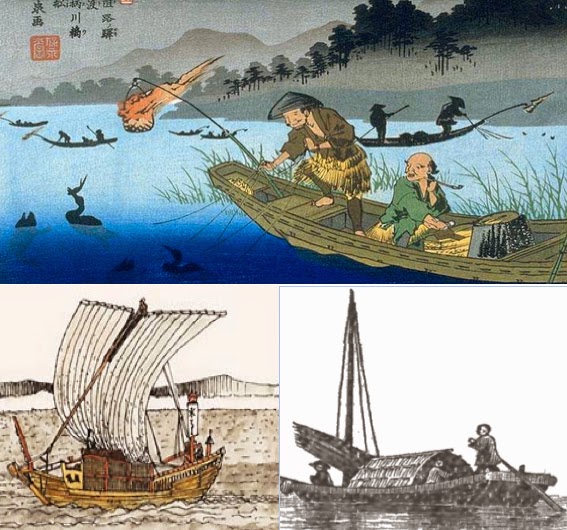
Top: Typical Japanese B.C. fishing
vessel; Bottom Left: 15th Century Japanese fishing vessel; Bottom
Right: 13th Century Chinese Sampan. Would be very difficult for one
of these vessels to have made it across the Pacific during many months of
drifting
Lastly,
whether or not a Japanese fisherman, who maybe never in his life made a
ceramic, got blown off course and driven thousands of miles away, landed on a
foreign land, mingled with another culture, and either made or showed them how
to make pottery designs from his homeland, seems a far reach. Why would a
simple fisherman know anything about ceramics, and why would he think to show
another people thousands of miles from home about his knowledge of other
designs, and why would another culture adopt a foreign design, again, a huge
stretch. One would think he would be more inclined toward survival (learning
how to fish in a foreign land where fish patterns might be different, currents
and fish habitats different, and where techniques of nets, hooks, and lines might be
different).
To
believe that a simple fishing boat’s misfortune of weather and conditions
brought ceramic samples of pottery some seven thousand miles across the ocean
seems beyond reality—had it been a sample of netting, fishing pole, hook, etc.,
one might consider the possibility, but ceramics?
However,
Jones made a valuable point when he concluded with: “Even though it is now
necessary to seek more carefully the landing places of the Book of Mormon
peoples, we do have a tested tool to help us prove this or any other point...a validity test which may be briefly
defined as having three parts: first, the
trait or complex or traits must be as old or older in the donor culture as the
recipient culture; second, there
should be antecedents in the donor culture and none in the recipient;
third, the physical form of the trait
should not be restricted by the limitations of the material from which it is
made or the use to which it is put.

Stated
differently, these three points should show
appropriate dates, i.e., Peru is
older than Mesoamerica by radiocarbon dated sites and artifacts; antecedents in the older culture, but not in
the newer one, i.e., the Jaredites, Mulekites and Nephites came from a land
(Jerusalem) where antecedents should be found, but none in the Land of Promise;
and lastly, physical traits should not be
restricted, i.e., there should be allowances for differences in available
materials between the earlier and the latter (“save it were not built
of so many precious things; for they were not to be found upon the land”). It
would do well for all who write about the Land of Promise to keep these three
points (tools) in mind.
The pyramid of Puñay in the foreground, showing the steps or terraces
on one side of the pyramid
Another spectacular site that
meets the Jaredite time frame in the Land Northward is that of a pyramid
nestled on the peak of a mountain top in the Andes about 80 miles east of the
city of Guayaquil, in Ecuador, which is about 60 miles east of Santa Elena
Peninsula and 80 miles from the Pacific coast, lies the ruins of an ancient
pyramid dated about 2400 B.C., having been built 4657 years ago. Located about
1060 feet above sea level, it is the highest pyramid in the world and was only
discovered in 2002. The area is famous for its verdant valleys,
thick clouds, and stunning sunsets, and the view from the pyramids would have
provided its ancient occupants a breath-taking view.
The mountain top location near the Jaredite landing place of Santa Elena Peninsula brings to mind Mormon's statement "It being the place of their first landing. And they came from there up into the south wilderness" (Alma 22:30-31).
Called Puñay, the pyramid is
1475 feet long, 130 feet tall and built somewhat in the shape of the ancient
sacred Guacamaya (left), otherwise
known as the Macaw, a bird sacred to almost all ancient Andean cultures. The
pyramid is believed to have been constructed by the Cañari people, who carried
stones and mud for the construction from mines in nearby valleys surrounding
the mountain (certainly a process well known to the builders of the Tower in Mesopotamia from which the Jaredites had come, and would have been familiar with finding and transporting building stones). At the top of the structure are twin truncated pyramids which are
similar to many other pyramids in the Andes of South America, as well as those
in Mesoamerica.
One of the reasons
that Puñay has remained undiscovered for so long is because of erosion and the
build up of biomass on the surface of the site. This has slightly affected the
temple’s structure making it appear to be an extension of the mountain when
viewed from afar.
One of the structures on top of the shorter
pyramid (taken from on top of the taller pyramid)
Today there are numerous holes
visible in the structure, having been dug by grave robbers and looters some 50
to 70 years ago. This is, at least in part, due to an old Kichwa myth about a lost pyramid containing golden
artifacts located somewhere in the Ecuadorian highlands lured both
archeologists and grave robbers to the area in search of Puñay. In 2002
Christian Aguirre, a teacher in the School of Ecotourism ay the University
Politecnica de Chimborazo, helped “rediscover” the pyramid. He also conducted
the first archeological study of the temples dimensions and created a
topographical map of the site, which showed the temple has the formation of a
giant Macaw.
The mountain top at Puñay (today called meditation
point), as seen by tourists. The view is spectacular and the area draws
visitors from all over the Region, though it is a two-day climb from nearby
Killa Wasi (House of the Moon) B&B Hostel in Alausi
Referred to as the
Lost Pyramid of Puñay, it sits in an area where few would have normally
traveled, too far to the east for the normal passage around the Bay of Guayaquil
from the south to the north, and not near much else in the mountains after they
rose to their height during the Crucifixion. It is considered an enigma among
all major archaeological sites in the Americas, sitting as it does on the peak
of this “mystical” mountain. It is considered by archaeologist as being unique
among all other pyramids in the world, and is believed to have been an ancient
observatory where Amautas and Yacchas (Andean wiseman and priests)
would unite to heal and praise the gods.
Top: View of the valley below Puñay;
Bottom: View across the Valley showing the morning fog rolling in. The early
inhabitants would have had an ideal location for beauty, relaxation and peace
What is interesting
about this site is that it matches Jaredite information:
1. Located in the Land Northward (north of
the narrow neck area of the Bay of Guayaquil)
2. Located in the south near the Jaredite
landing site (Ether 7:6)
3. Located in the mountains (“came up unto
the land of Moron Ether” 7:5; “up unto the land of Moron Ether 14:11)
4. Located near the Land of Desolation
(Ether 7:6)
5. Located among hills (Ether 7:9)
6. Unique pyramid. Puñay (Moron?)
was a unique style of building, unlike any other in the land (north or south),
matching the idea that the Jaredites would have known different type of
buildings than the Nephites
7. The country to the east is all mountainous and hilly (Various hills
are mentioned to the east of Moron)
This area of Puñay
is very beautiful with spectacular views of mountains and valleys, and
certainly would have drawn a group of people; especially a group like the
Jaredites, for it was far enough from the ocean that, after spending 344 days
cooped up in tossing barges, etc., would have been very appealing as a location
for settling down with wide open views, plenty of fresh mountain air, and lots
of room to roam.

Unless we read
something into the scriptural record that is not there, like other people in
the Land of Promise other than the Jaredites, Mulekites and Nephites, as
Mesoamericanists are wont to do, and unless we ignore the scriptural reference
of the land being held from occupation after the Flood (Ether 13:2), as
Mesoamericanists are also wont to do, Jaredites were the only people living in
the Land of Promise between the Flood (2344 B.C.) and the arrival of Lehi (600
B.C.). Any people there, no matter the name science calls them, had to be the
Jaredites. Now if the scriptural record is accurate on that point, and Hugh
Nibley, John L. Sorenson and many others think it is not, then any group of
people occupying the Land Northward during that period of time would have to be
Jaredites.
On the other hand,
Hugh Nibley said that “worldly discoveries are going to bury the Church in
criticism if members of the Church don’t take it upon themselves to become a
people of learning.” While he intended that statement for the Book of Abraham,
it should be considered for all the scriptural record. And it should apply as
much to the Book of Ether as any other. The point being that we need to learn
all we can about the circumstances surrounding the Land of
Promise, especially during
Jaredite times, since it is typically the least studied work in the record.
However, it is
difficult to study the scriptural record when on the other hand we are being
told that there were other people in the Land of Promise other than those
mentioned in the record. Personally, I accept the Book of Mormon the way it is
written and for the material found within it—I do not look for other peoples to
be there when there is absolutely no reference or suggestion that any were
there. Nibley and Sorenson’s views come from the fact that they are supporters
of Mesoamerica and, as such, know that in Mesoamerica there were other people
besides those they consider to have been the Nephites and Jaredites—thus they
are forced to make room for others and do so through the altering of the
scriptural record and the criticizing of Latter-day Saints who take a
simplistic approach to the Book of Mormon, i.e., that it contains
information about people in the land of Promise during the Jaredite-Nephite
era.
When the record
states very clearly that the Land of Promise (Western Hemisphere, the American
continent, both North and South America) was kept free from other groups and
nations since the Flood and held in reserve for those who the Lord would bring,
I see no reason to disregard that nor think it is not correct.
Therefore, any people
occupying the Land Northward (basically Ecuador) during the Jaredite time would
seem most likely to be Jaredites, no matter what name or culture archaeologists
want to apply to them. This blog is dedicated to that principle and the
information stated in it. To this end the last few articles about Jaredites
(and the Nephites before that) are the same people as those illustrated in the
Book of Mormon.
Continuing from the previous
post about the new find in the central mountains of Ecuador of a 26 story high
pyramid covered by a layer of mud soil and verdant growth. The discovery
astounded the discoverers for its remarkable advanced stone cutting, fitting
and workmanship that dated well into B.C. time.
The so-called Hummingbird Pyramid, an innocent-looking hill covered by
mud soil and growth, discovered in La Maná, Ecuador, among 17 ancient pyramidal
temples along the Calope River
Referred to as the Hummingbird
Pyramid after the great variety of local hummingbird species whose
rhythmic wing beats symbolized psychoacoustic influences among all ancient
cultures of the Andes, the site sits in a large plain in the foothills
of the Andes, surrounded by mountains, rainforest and jungle where the
Nhungañan branch of the Andes mountain range crosses, with climates from
subtropical in the tops of the mountains to tropical in the lowlands—in the
heart of the Jaredite Land Northward. The area has a rich diversity of
reptiles, snakes (false coral and reef), equiz snake, among other
poisonous species, reminding one of the incident where “there came forth poisonous serpents
also upon the face of the land, and did poison many people. And it came to pass
that their flocks began to flee before the poisonous serpents, towards the land
southward, which was called by the Nephites Zarahemla”
(Ether 9:31).
Immense forests,
giant banana plantings, cassava, cocoa, snuff and coffee are grown today, it
was a strategic geographical location where numerous rivers, including the
Guadual, Quindigua, Hugshatambo, Guasaganda, Manuilita, and the San Pablo,
which originates in the northern part and is the longest and mightiest of this
network, though having only a 12 mile length. Also the southwesterly Warbler
river estuaries El Moral, Chilingo and Calope rivers flow here, with copious
waterfalls in the mountains.
Top: Looking upward
along the pyramid facing of the hill’s slope that is partially overgrown with
brush and trees; Bottom: Close up of the irregularly fitted and angular cut
stones (note yellow arrow)
The pyramid had lain buried beneath the jungle for
centuries, perhaps millennia, when it was first discovered while exploring low mountains along the Calope River by Alexander Putney
and his partner Suzanne Benoit in November 2013.
This large pyramid
complex comprises 17 ancient monumental buildings that, after years of
exploration of the Calope River and Seven Cascades vicinity have uncovered more
than 30 sites spread over a large area that confirm the hidden presence of
these 17 major stone monuments. It is believed the Hummingbird Pyramid is
directly linked to an entire complex of monuments by an ascending causeway that
extends from the pyramid's apex for over 650 feet before beginning a gradual
incline to a much larger pyramid, also
deeply buried in soil. The two sides of Hummingbird that have so far been seen
extend more than 265 feet in height partially covered by rich kaolin
clay beds and dense cloud forests. In fact, when first encountered, it looked
like the rest of the jungle around it except for a few blocks of cut and dress
stones laying about.

Top: Cut and dressed stones drew the
attention of jungle explorers who began to look for the cause of this obvious
“man-made” work; Bottom: This turned out to be a facing of stacked stone
sloping up the side of a hill
The ruins of this
ancient pyramid had been partially exposed by the dynamite of road workers and
the erosive action of water, uncovering large sections of basalt foundations
along two sides of the 26-story structure. The La Maná region had drawn
attention for decades after the Head of the Ecuadorian Ministry of Mines, Dr.
E. Guillermo Sotomayor (who died in 2009) had made the surprise discovery of a
cache of hundreds of ancient relics that included dozens of magnetic stone
artifacts with inlaid designs that fluoresce under ultraviolet light.
A micrograph of the crystal/metal matrix of
geopolymer samples from near the facing of the Hummingbird Pyramid
In fact, the
pyramidal area has crystal/metal geopolymer rock on the near facing, which reveals
a beautiful mosaic of exotic granulated components that were mixed and poured
thousands of years ago forming the geopolymer stones seen today. This might
have been similarly done as the geopolymer techniques used today to form
monolithic materials, like metakaolin and reactive silica under the presence of
strong alkaline soluitons. Such nanosized Leucite crystals were probably
prepared by heating a powder mexiture of metalaolin with other elements and
fired at elevated temperatures. Whatever the method, it sounds reminiscent of “touch these stones, O Lord, with thy finger,
and prepare them that they may shine forth in darkness; and they shall shine
forth unto us in the vessels which we have prepared, that we may have light
while we shall cross the sea” (Ether 3:4).
Millions of interlocking basalt blocks
comprising the bulk of the Hummingbird Pyramid and its causeway reveal a highly
specialized architectural technology for enhanced seismic integrity and
resistance to water erosion. In addition to the extreme density and superhard
crystal/metal composition of the artificial stone, the many interlocking forms
and angular internal construction features were painstakingly molded by many
generations of pyramid-builders who had perfected the art of monumental construction
in the most challenging of equatorial environments.
Yellow Arrows point to the extreme angles of
the block cuts in all directions for tectonic purposes to withstand
earthquakes
Prevention and control of
landsliding was of paramount concern, and dictated the crucial angularity of
highly complex stonework being uncovered at several excavation sites on the
Hummingbird Pyramid. Giant megalithic blocks were apparently only cast within
the deeper sections of the monument's foundations, whereas the surfaces of this
massive pyramidal building were primarily cast in smaller multifaceted forms.
Seams in the stonework display a clear tendency toward rhomboidal grid
patterns.
Angular cut stones in odd shapes were used to offset earthquakes,
volcano activity and shifting earth slides. The tectonic technique would have
been extremely unusual for its time and far advanced for any age. Even today
few builders utilize such techniques, even in earthquake country
To this day, landslides represent
a major hazard to life in these low mountain areas that were densely populated
during the Paleolithic Era. Sections of paved walkway and other water-worn
exterior surfaces of the Hummingbird Pyramid uncovered thus far are puzzle-like
mosaics of much smaller interlocking blocks that would have allowed minor
damage to occur during adverse meteorological conditions while preventing the
catastrophic collapse of larger sections of the steeply-angled building.
Once again, such advanced
tectonic techniques for the period of time in which the Jaredites lived would
have been unlikely under normal circumstances, however as indicated earlier and
in the last post, such knowledge is envisioned by spiritual giants such as the
brother of Jared, and other righteous people. And after Jared and his brother
died, Orihah did walk humbly before the Lord, and did remember how great
things the Lord had done for his father, and also taught his people how great
things the Lord had done for their fathers…and did execute judgment upon the
land in righteousness all his days, whose days were exceedingly many” (Ether
6:30; 7:1).
Unfortunately, the
record we have of the Jaredites centers on their wars and difficulties,
failings and repentance, so we do not know of their advances and inventions,
their way of life, or the types of buildings they constructed. Yet we know of
their prosperity, which is recorded time and again, and we can see how the
Jaredite kingdom, over 1600 years, would have advanced in many ways.
Not a lot is known about the
Jaredites from the scriptural record. 500 pages are written surrounding the
Nephites, covering a period of about 1000 years, while only 21 pages make up
the Book of Ether, covering a period of about 1600 years. What we do know is
that the Jaredites landed in the land promised around 2100 B.C., according to the dates of the patriarchs, less
than 250 years after the waters receded from the Flood.
Between that time and their
final battle, where Coriantumr killed Shiz to end the Jaredite kingdom (left), this
civilization of remarkable skills and abilities moved across the Land
Northward, from the narrow neck of land in the south (Ether 10:20), to the great
sea in the north (Ether 15:8), and from the Sea West where they landed to the
Sea East (Ether 9:3; 14:26).
Founded by Jared and his
brother, the latter being a man “highly favored of the Lord” (Ether 1:34), who
had such strong faith that he actually moved the mountain Zerin (Ether 12:30), the Lord could keep nothing from him (Ether 3:26), and who
possessed more faith than any man (Ether 3:9); who was given a vision of the
entire earth history, from beginning to end of time (Ether 3:25); and a man of
such stature in the eyes of the Lord “he could no longer be kept without the
veil” (Ether 12:21). He helped forge a Jaredite kingdom that lasted longer than
any other in history, though at the end internal conflict, pride, and avarice
destroyed them.
However, during that millennium
they ruled over the land with some righteousness, they accomplished magnificent
things. The Nephite expedition who was sent to find Zarahemla by king Limhi
stumbled across the Jaredite ruins centuries after their demise and remarked at
their remains of buildings of every kind, and a people who were once as
“numerous as the hosts of Israel” (Ether 8:8), with a written language that was
recorded on gold plates (Ether 8:9). They were a large (Ether 8:8) and mighty
people (Ether 13:15; 15:26), building mighty cities (Ether 9:23; 15:2), whose
population numbered in the millions (Ether 15:2).
What is important to understand
when we look at accomplishments of past societies, that those directed by God
and inspired to their accomplishments, such as when he told the Jaredites that
he would lead them to a promised land: “And
there will I bless thee and thy seed, and raise up unto me of thy seed, and of
the seed of thy brother, and they who shall go with thee, a great nation. And
there shall be none greater than the nation which I will raise up unto me of
thy seed, upon all the face of the earth. And thus I will do unto thee because
this long time ye have cried unto me” (Ether 1:43), or
later when he told Lehi, who wrote of it: “Wherefore, I, Lehi, have obtained a promise, that
inasmuch as those whom the Lord God shall bring out of the land of Jerusalem
shall keep his commandments, they shall prosper upon the face of this land; and
they shall be kept from all other nations, that they may possess this land unto
themselves. And if it so be that they shall keep his commandments they shall be
blessed upon the face of this land, and there shall be none to molest them, nor
to take away the land of their inheritance; and they shall dwell safely
forever” (2 Nephi 1:9).

Stonework that marvels even builders of
today, set without mortar that not even a razor black can fit between the rocks
In such cases, we can
expect that the people the Lord led to a new land would be blessed beyond
measure, and given abilities, knowledge and understanding to accomplish great
things provided they worshipped him.
All we need to do is
look around at the marvelous things that were accomplished by these early
civilizations, the Jaredites and Nephites, and to the remarkable abilities they
possessed beyond that of their age. These accomplishments are such, that even
modern man, with all his technology marvels at the accomplishments of these
early peoples.
Of course, the
archaeologists and anthropologists who discover their achievements have no way
of understanding how they were able to do such things—some even attributing it
to extra-terrestrial beings. However, we should understand that when people
are good and godly, the holy ghost inspires them to accomplish remarkable
things. There was so much righteousness with the brother of Jared, with Nephi,
at that time, the manifestations of the Holy Ghost and the inspiration of that
power that is given to righteous men enable them to accomplish things far
beyond their own mortal powers.
We have covered time and again
the remarkable accomplishments the Nephites made with the buildings of such
things as Sacsayhuaman, where stones were cut into fitted shapes and walls,
structures, temples, etc., built beyond what most believe would have been the
capability of the time. We can also see such work among the Jaredites, even at
a much earlier age.
The Lord simply inspired them to
brilliance, with ideas and inventions that were brilliant, many of which have
not been duplicated since until the 20th century. While the physical
accomplishments of the early peoples we identify as the Nephites have been identified and discussed for nearly a century now, that of the Jaredites is only
just now becoming better understood as archaeology moves into the Ecuadorian
mountains and jungles, uncovering some of the last
Andean ruins to be discovered.
Take, as an example, the
discovery in November, 2013, of a totally unknown ancient megalithic pyramid
complex located in the central jungles of Ecuador in an area called La Maná, in
the Province of Cotopaxi.
The pristine area before man; Bottom: The huge plain surrounded by
huge rainforests and covered with modern buildings and the city of La Maná in
Ecuador
The Jaredites “did cast up mighty heaps of earth to
get ore, of gold, and of silver, and of iron, and of copper”
(Ether 10:23). It is interesting that this area is called La Maná,
a name taken from the “manna,” the food God sent the Israelites every
day in the wilderness, because of the gold wealth of the area and the enormous
influx of people who came to remove the large presence of gold in the country.
For centuries the people of Ecuador have shared wild
sounding stories of legendary ancient cities supposedly lost to the jungles.
Many of these stories are based around the reasonable hypothesis that a number
of settlements have been swallowed up by the expansion of jungle areas, and the
stories are kept alive by the tantalizing prospect of large amounts
of gold hidden in these few urbanized areas that did not fall to Spanish
hands. The recent discovered pyramid in Ecuador dubbed the “Hummingbird
Pyramid,” where local legends claim there was once a civilization here that was known for the giant size of its
people—until recently, only thought to be a myth, however, this site consists
of bones that are from humans of extreme height, well over six feet tall in
some cases.
Now, it appears these legends are at least
somewhat based in fact. The total size of the complex located is uncertain. A
layer of soil has built up and covered structures at the site and then tropical
foliage has taken root, making buildings indistinguishable from the background
of jungle plants. By good fortune, a landslide induced either by heavy rain or
by an earthquake brought down all of the material covering one side of a large
pyramidal structure, believed to be some 265 feet square with walls rising to
about 260 feet (26 stories)—several such pyramid sites in the area are believed
to follow astronomical alignment.
Two workers trying to climb the 45º-angled
side of the slanting pyramid; Bottom: Scientists working on the
discovery project estimates that the large megalithic stone blocks are each
around two tons in weight with many hundreds making up the pyramid, and were
cut into irregular shapes and sizes, cleverly interlocking and possibly
cemented into place
(See the next post, "Who Were teh Jaredites? PtII," for more information on the Jaredites landing and the ancient people of La Maná
Not
long ago in a discussion, an acquaintance, annoyed at a scriptural response to
his question I gave him, said half in disgust, “Oh, you’re a literalist.” I told him that, if by that comment he
meant I accept the scriptural record the way it is written and go by it, I told
him “yes.”

When
it comes to the Book of Mormon and the scriptural record of the Book of Mormon,
I am very much a literalist. I believe, without question, that the Book of Mormon
was inspired by the Lord, that both the original writers of it and the
abridgers (Mormon and Moroni) were inspired as to what they chose to include in
the work, from the doctrines and spiritual experiences listed, to the
descriptions (to help us better understand the circumstances, settings and
doctrines outlined) were included for our benefit, knowledge and enlightenment.
I do not agree with Hugh Nibley, John L. Sorenson, and many other theorists,
that some of the Book of Mormon is true, but other parts are either inaccurate,
misleading or need to be interpreted differently. I simply do not see the
Spirit acknowledging what Joseph Smith wrote as being incorrect, hard to
understand, or misleading, such as Mormon thinking of a north-south land that
meant something different to him than to us—if the Spirit worked that way, then
what is the use of having the Spirit guide an direct if that guidance and
direction is going to be misleading.
Do
scriptures sometimes mean more than we think they do? Quite often. Do
scriptures mean something other than what they say? No. We may need a deeper
understanding of the background of a thought or idea, such as understanding the
parables spoken to an agrarian society people if we are an urban society reader,
but the wordage of the scripture is not misleading or incomprehensible to the
average person who reads it.
Why
certain scholars think they are smarter and more capable of understanding the
scriptural record than others has always been a mystery. As Nephi clearly told
us, “For my soul
delighteth in plainness; for after this manner doth the Lord God work among the
children of men. For the Lord God giveth light unto the understanding; for he
speaketh unto men according to their language, unto their understanding”
(2 Nephi 31:3)
Since
the Lord talks to us in our language for our understanding, how can someone
claim that the scriptural record of the Book of Mormon must be understood by
scholars who then need to tell us what things mean. Hugh Nibley continually
said that members of the Church needed to stop looking at the simplicity of the
Book of Mormon, yet Nephi clearly said that his “soul delighteth in plainness
and after this manner doth the Lord work among the children of men.”
Will
study and pondering give us deeper meanings and greater understanding?
Absolutely. Will study and pondering show us errors in the scriptures? No.
Errors occur when man’s thinking assumes man is smarter than God and other
people and only he knows what is meant, and therefore tells others of his
“discoveries.”

Did
Mormon or Moroni ever include their own thinking in their abridgements? Obviously,
(Alma 3:13; 22:35; Ether 2:13; 6:1 9:1; 13:1), but they were also guided by the
Spirit (Words of Mormon 1:7; 3:16, 20; Ether 4:5; 5:1); Nephi was constrained
by the Spirit (1 Nephi 4:10; 7:15; 2 Nephi 28:1), and the Spirit stopped his
utterance (2 Nephi 32:7), and talked to him directly (1 Nephi 4:11-12, 18;
11:2, 4, 8, 11). Judging from these and the numerous other indications of the
workings of the Spirit in conjunction with the scriptural record, to think that
the Spirit allowed any errors, mistakes, misleading, or inaccurate comments into the scriptural record, or ignored problems,
inaccuracies, or errors into the abridgements or translation, does not seem
likely.
It
is also just as unlikely that Hugh Nibley and John L. Sorenson’s
comments that the scriptural record needs scholars to
interpret it for us, or that what we first read is not correct, but that we
need to look beyond the obvious for more correct meanings.
When Mormon said that
the time of grace for the Nephites was past, did he not understand the doctrine
of which he spoke? Did he misquote that and make an error? The man that speaks
of living and working and writing by the Spirit tells us of the descriptions of
the land he walked over and fought upon for 65 years—did he not know what he
was talking about when he described it for us? When he inserted his
descriptions of the land, did he not know which was north and south, which was
east and west? Did he not know where he had been, what land was located where
in relationship to each other? Did he just stumble through those descriptions? If
so, then what makes us think he did not stumble through the doctrines and
spiritual matters of which he wrote? How can we be certain he understood the
workings of God, the teachings of the Lord, the utterances of the Spirit when
he did not know the directions of his land, or where different areas were
located?
Can we trust the
words of Mormon on this when he couldn’t even describe a “narrow neck of land”
of which it took a Nephite a day and a half to cross without leading to numerous
present-day historians and theorists dissecting that and coming up with a score
of different meanings?
And what about Nephi?
Was he so unlearned that he did not know where he traveled, did not know the
direction of that travel when he wrote about it? Was he so inept that he could
not tell where his ship went and how it was driven? Did he knot know what
“driven forth before the wind” meant? Did he deliberately or accidentally mean
to mislead us when he talked about winds and currents, i.e., in being the
motive power of his ship and determining its direction? Did he not know enough
about the land upon which he landed and walked about to not describe it
correctly when he wrote about it?
Was Jacob so out of touch
with the spirit that when he spoke in a two-day conference (2 Nephi 9:54) to
the Nephites that he really did not understand that his home, the land of
promise was an island when he said it was? (2 Nephi 10:20). And if he did not know that, or was
told that in a vision by the Lord, then why on earth would he say that was
their home? Was he trying to cause confusion for those who would later read his
words? And in speaking that before all the Nephites gathered at the Conference,
did not one wonder why he knew that and they did not? Would not someone have
said something requiring him to further explain his meaning. When he told them
they had traveled over a sea and upon that very sea was the island upon which
they landed, would someone not have asked how he came by that understanding if
it was not common knowledge among them? If that was a surprise to them,
wouldn’t it have required a further explanation on such an important subject as
all of them not being cut off from the Lord?

It seems amazing to
me that so many writers (theorists) accept the doctrines, but not the
descriptions. It also seems that in the writing, the one goes with the
other—you cannot separate one part of the writing from the other. Why Olive can
accept the doctrines yet show us that the alignment Mormon wrote about of the
lands from south to north (Nephi, Zarahemla, Bountiful, Desolation Land of Many
Waters) were actually not in that alignment, but on a line west to east with
Zarahemla, Bountiful, Sea East, Cumorah and Land of Many Waters; the same could
be said for John L. Sorenson’s Mesoamerica east to west alignment. Funny they
think Mormon got the doctrines right, but not the land alignment. It is sad,
though, that so many people agree with them and ignore Mormon’s perfectly clear
descriptions.
I would rather be a
literalist than try to determine which things Mormon got right and which ones
he got wrong. How much easier it is to simply accept that he knew what he was
talking about in everything, or in nothing, rather than to try and pick and choose which is correct and which isn't.