Continuing with the previous
post regarding the “waters of Sidon” and how they are used differently than the
“river Sidon” by Mormon in the scriptural record.
First of all, it cannot be said
that because the “river Sidon” is mentioned 26 times in Alma prior to the
crucifixion, and not once after that time (like the Sea East and the Narrow
Neck of Land are not mentioned after the destruction) that these areas did not exist after the destruction mentioned in
3 Nephi; however, it does suggest a possibility that the damage that “changed
the face of the entire land” (3 Nephi 8:12) might have altered the river Sidon,
its course, or its existence and such a fact cannot be arbitrarily ruled out.
What is definite, is that
the “river Sidon” and the “head of the river Sidon” are terms not mentioned
after the destruction that followed the crucifixion and the only mention of the
word “Sidon” in the scriptural record after this destruction period found in
Mormon 1:10, does not suggest that the river Sidon still existed, only that
there was a place Mormon called “the waters of Sidon.” In the previous post on
this subject, the meaning of “waters” was described.
Now, as far as the scriptural
record is concerned, the term “waters of Sidon” is mentioned seven times in
Alma, rather than the “river Sidon.” Those
exceptions are: “waters of Sidon” (Alma 2:34), though in the same sentence he
uses River Sidon. Why the difference? He follows this up a few verses later
(Alma 3:3) with “waters of Sidon” but again in the exact same sentence uses
River Sidon. Does this mean the Lamanites were slain on the banks of the river,
but thrown into the waters, that perhaps formed a lake, marsh, or swamp? We do
not know if there is a difference, but as a friend and scholar of the Book of Mormon used to tell me of the
scriptures, “you have to evaluate each word—each word has meaning.” This suggests that there is a
reason Mormon used “waters” and not “river” in some of these sentences.
Another
use of “waters of Sidon” is found in that “many
were baptized in the waters of Sidon and were joined to the Church of God”
(Alma 4:4). Here again is a corollary to baptism like in the “Waters of
Mormon.” Now one might want to keep in mind that all of these statements
evidently have to do with the same general area of the Sidon. On the other
hand, another mention of the Waters of Sidon is found in “Lehi and his men and they were driven by Lehi into the Waters of Sidon,
and they crossed the waters of Sidon. And Lehi retained his armies upon the bank
of the river Sidon that they should not cross” (Alma 43:40). And also in
the same area is “the Lamanites began to
flee before them; and they fled even to the waters of Sidon” (Alma
43:50)—why not “fled to the river Sidon”?
We
are not making this case—but a case could be made that all of this is in the
same general area, and that there was a lake or body of water called after 3
Nephi “the Waters of Sidon,” to differentiate it from the earlier river Sidon,
which possibly the river Sidon flowed into and out of, or that it flowed past
with water seeping into the lake area. The point is when there is another
possibility that the scriptures fit, we are not willing to make a commitment
that something else is the case. Even later when it says “they did cast their
dead into the waters of Sidon, and they have gone forth and are buried in the
depths of the sea” (Alma 44:22), it could mean that this lake or seepage area
drained into the river, at least before 3 Nephi.
It
also might be of note that the name “Sidon” is mentioned only in the Book of
Alma (plus once in Mormon), while “river Sidon” is mentioned 27 times in Alma,
and “waters of Sidon” is mentioned only 7 times in Alma and once in Mormon, and
the latter seem to refer to the same general area as though the “waters of
Sidon” might be a singular place, while the river flows from mountains to sea.
A
South American historian told me that he had spent several years studying the
terms “up to the Land of Nephi” and “down to the Land of Zarahemla” and had not
come to a conclusion about what exactly those terms meant. Many of us are quick to jump to conclusions, however, sometimes common phrases carry deeper meanings that we at first attribute to them. Take, as an example, the meaning of Moses term in Genesis: "And God made the firmament, and divided the waters which were under the firmament from the waters which were above the firmament: and it was so" (Genesis 1:7). Much has been written and discussed about this statement, yet few satisfactory answers seem available.
The
point is, there is not a single mention
of a river Sidon after 3 Nephi, and the only mention of Sidon is in regard to
the Waters of Sidon. Thus one, in good conscience, cannot claim the River Sidon
continued after the destruction of tumbling mountains and valleys that rose
into mountains “whose height is great.” The changes that such dramatic changes
might have altered the flow of a river seems too great to dismiss out of hand.
It
might also be added that on occasion, some of the comments on this subject we
receive state: “When Mormon moved from
the Land Northward with his Father to the land of Zarahemla and that soon after
a war broke out in the borders of the land, by the head of the River Sidon.”
However, it seems a little odd that a war would break out high up in the
mountains where the head of the river Sidon was located. First of all, we know
this area was at a much higher elevation than the Land of Zarahemla—and at a
common elevation with the Land of Nephi, so what were the Nephites doing up in
that area for a war to break out there?
On
the other hand, if the term “waters of Mormon” had reference to a standing body
of water, such as a lake, pond, lagoon or even a seepage or swamp, where
perhaps the river once flowed at a lower elevation, such as along the borders
of Zarahemla and Gideon in the Valley of Gideon, it would make sense that a war
could break out there where Lamanite armies were infiltrating northward into
the Land of Zarahemla, and along what used to be the eastern seaboard or coast
where the cities of Moroni, Lehi, and Morianton once stood and northward to Mulek,
Omner and Gid in the northern coastal area and were often the subject of Lamanite
attacks in the past (Alma 51:26) as well as the city of Nephihah (Alma 59;
59:5). It might be assumed that the three northern cities were much further
northward, since the citizens of the three southern cities (Moroni, Lehi and
Morianton) fled to Nephihah for protection when the Lamanites attacked, but
when the three northern cities (Mulek, Omner and Gid) were attacked, they did
not flee to Nephihah, suggesting that city was too far away. While this is
simply a guess, we might say that the distance between these two groups of
cities might have been as much as 200 miles.
Since
the “head of Sidon” or even “the river Sidon” is not in any way mentioned in
Mormon 1:10 or at all after the cataclysmic destruction in 3 Nephi, it seems
very possible not only did the river not exist, but that the “waters of Mormon”
as indicated were at a much lower elevation, and along the path the Lamanties
took to attack the eastern cities, which now would not have been along the
coast, for that sea, too, is not mentioned, and very possibly had been replaced
in the east by the rise of the range of mountains prophesied by Samuel the
Lamanite (Helaman 14:23) where mountains rose out of valleys “whose height is
great,” and covering a large enough area in both the Land Northward and the
Land Southward to be a “sign” to all the occupants of the Land of Promise, “to
the intent that they might believe that these signs and these wonders should
come to pass upon all the face of this land, to the intent that there should be
no cause for unbelief among the children of men” (Helaman 14:28).
One
reader on this subject wrote: “I feel
that you are rejecting too much information that exists right in front of you.”
Yet, nowhere after 3 Nephi 9, and the description of the destruction that
“changed the face of the entire land” is the word Sidon mentioned in connection
to a river or its head (headwaters), only the “waters of Sidon.”
The
river Sidon is simply not mentioned anywhere after that destruction. Nor can it
be said that the statement in Mormon 1:10 makes a claim of a “river.” The
scripture simply does not say “river” or “head” or “headwaters” or “source” or
anything to lead one to believe that the river Sidon is being described by
Mormon there.
(See the next post, “The River Sidon, or its Head, is
Mentioned After the Destruction in 3 Nephi – Part III, to see how the question
“What other river in the Book of Mormon
land fits so well?”)
Friday, October 20, 2017
Thursday, October 19, 2017
The River Sidon, or its Head, is Never Mentioned After the Destruction in 3 Nephi – Part I
From time to time we get comments
about our stand that the Sidon River is not mentioned after the destruction which
occurred during the Crucifixion of the Savior. As an example, some of the
comments are: “…a war broke out in the
border of the land by the head of the River Sidon” (Mormon 1:10); or “But the prophet knew where the head of the
River was because it was mentioned in Mormon 1:10”; or “…it was the one by the head of the River Sidon”; or “It was obvious. The river was still there,
and still flowed unchanged since its beginning”; or “Judging by Mormon
1:10, the Sidon River still flowed much as it had been before the catastrophes
mentioned in 3 Nephi 8 and 9”; or “Some
have felt that during the judgments poured out in AD 34, when “the whole face
of the land was changed” (3 Nephi 8:12), the river Sidon changed also perhaps
even disappeared. Yet to judge from Mormon’s comment three hundred years later,
the river remained in his day, as did many cities and towns.”
Perhaps this is a good time to clarify Mormon 1:10 and the stance we take that the destruction, which occurred in 3 Nephi 8 and 9, possibly suggests that both the Sea East, the Narrow Neck of Land, and the River Sidon, did not exist, at least in their earlier form or path, after the crucifixion, since they are never again mentioned, having been listed prominently and in some cases, frequently, before that cataclysmic event.
The problem is often that people read the scriptural record, and insert in their mind’s eye what they think it says or want it to say, when in reality it does not say that at all! Take, for instance, the first of these comments, that “a war broke out in the border of the land by the head of the River Sidon” and referencing Mormon 1:10 as the source of the comment.
However, that source does not say “river” or “head” but merely Sidon, i.e., “the waters of Sidon,” waters being a rather generic term and not related to river any more than it is related to lake or ocean. Let us take a look at Mormon’s statement word for word:
“And it came to pass that the war began to be among them in the borders of Zarahemla, by the waters of Sidon” (Mormon 1:10, emphasis added). Notice that it says nothing about the “head” of the river Sidon as was stated in three of the comments above—it says waters.
Therefore, all we know is:
1. “Now the Lamanites and the Lemuelites and the Ishmaelites were called Lamanites, and the two parties were Nephites and Lamanites. And it came to pass that the war began to be among them in the borders of Zarahemla, by the waters of Sidon” (Mormon 1:10)
2. In the eastern border of the land of Zarahemla, presumably where that border ran by the Land of Gideon (Alma 6:7), and where the battle with the Amlicites took place to the east of the valley in the hill Amnihu (Alma 2:15), after the crucifixion there was a body of water called Sidon.
We know nothing more than that. Putting our own interpretation onto the scriptural reference is neither scholarly nor educational, and certainly not helpful.
So what does “waters” mean? In Noah Webster’s 1828 American Dictionary of the English Language, which lists the English of the New England area where both Webster and Joseph Smith lived in the time frame involved in the translation, the word “waters” is defined as:
“The ocean; a sea; a lake; a river; any great collection of water; as in the phrases, to go by water to travel by water.”
In today’s dictionaries we find a very similar meaning: “a stretch or area of water, such as a river, sea, or lake,” and considered to be synonymous with “sea” and “ocean.” It is also stated that: “Often, waters is an impure state as obtained from a mineral spring,” also “content of a river, inlet, etc.,” “waters moving in waves,” “the seas bordering a particular area.” In addition, “any body of sea or seas regarded as sharing some common quality, as in the “waters of…”
In scripture, we find “the Waters of Mormon are defined as: “The Waters of Mormon, in the 18th chapter of the Book of Mosiah (in The Book of Mormon), is a body of water where about two hundred Nephites were baptized.” It is interesting at the similarity of this statement in Mosiah as it reads: “they came to a place which was called Mormon, having received its name from the king, being in the borders of the land having been infested…” (Mosiah 18:4), and “Behold, here are the waters of Mormon (for thus were they called) and now as you are desirous to come into the fold of God, and to be called his people…” (Mosiah 18:8), and “they were baptized in the waters of Mormon and were filled with the grace of God” (Mosiah 18:16).
There is nothing in these scriptures to suggest that the Waters of Mormon were part of anything more than a standing body of water, a lake, pond, lagoon or inland sea. In the same way, there is nothing in Mormon 1:10 to suggest the Waters of Sidon was anything more than a lake, pond, lagoon or inland sea.
In fact, throughout the scriptural record, there is nothing to suggest that waters means anything other than an ocean, sea, or large combination of waters, i.e., several oceans or several seas running into one another, such as Irreantum, meaning “Many Waters,” and in fact at least the Arabian Sea and the Indian Ocean, but probably also the Pacific Ocean and Southern Ocean.
Now, let’s be realistic about this. Not only is there nothing in the scriptural record to suggest that the “waters of Sidon” referred to a river in Mormon 1:10; there is also nothing in the record to suggest it was not a river. In fact, the word “Sidon” is found 34 times in Alma, and one time in Mormon and nowhere else—of the 34 times in Alma, 22 times it is mentioned as the “river Sidon,” 4 times as the “Head of the River Sidon,” 1 time as “Head of Sidon,” and 1 time as just “Sidon.” It is also mentioned 7 times as the “Waters of Sidon.”
For those who want it to be a “river,” there is nothing to favor or preclude that point; however, it is simply a matter of choice, i.e., whether you choose to add the word “river” to the “waters of Mormon.” On the other hand, there might be sufficient to suggest that the “waters of Mormon” meant something other than “river.”
The “waters of Sidon” could just as easily have become a great lake, or a huge waterfall that now fell into the Sea East, some other standing body of water. It could also be a separate body of water than a river, if the river Sidon still flowed, i.e., it could be a gathering of water, such as a lake, where the river Sidon flowed into and out of, or it could have been a seepage of a previous river area that was diverted, or the outflow altered, or it could be an area by which the river flowed. In any event, Mormon chose to call it the “waters of Sidon,” not the “river Sidon,” and we simply do not know why.
On the one hand, a person could make it be anything they want because the wordage is not conclusive; however, Mormon 1:10 cannot be claimed to say “River Sidon” when it does not. It may be implying, but at the same time, it may be exactly what the words claim, a body of water then named Sidon.
What we do know from Mormon 1:10 is that the “waters of Sidon” sound as if they are in the same general area as the river once flowed. Naturally, water has to have some source, but it could be that while water flowed down from the mountains into these waters of Sidon, that the river from these waters elsewhere did not exist, or was not the same. It seems interesting that Mormon chose the wordage “Waters” of Sidon when throughout the entire Chapter of Alma (Sidon is mentioned nowhere else but Mormon 1:10) he used Sidon River with only a few exceptions.
(See the next post, “The River Sidon, or its Head, is Never Mentioned After the Destruction in 3 Nephi – Part II, to see how the term “waters of Sidon” are used differently than the “river Sidon” is used in the scriptural record by Mormon)
Perhaps this is a good time to clarify Mormon 1:10 and the stance we take that the destruction, which occurred in 3 Nephi 8 and 9, possibly suggests that both the Sea East, the Narrow Neck of Land, and the River Sidon, did not exist, at least in their earlier form or path, after the crucifixion, since they are never again mentioned, having been listed prominently and in some cases, frequently, before that cataclysmic event.
The problem is often that people read the scriptural record, and insert in their mind’s eye what they think it says or want it to say, when in reality it does not say that at all! Take, for instance, the first of these comments, that “a war broke out in the border of the land by the head of the River Sidon” and referencing Mormon 1:10 as the source of the comment.
However, that source does not say “river” or “head” but merely Sidon, i.e., “the waters of Sidon,” waters being a rather generic term and not related to river any more than it is related to lake or ocean. Let us take a look at Mormon’s statement word for word:
“And it came to pass that the war began to be among them in the borders of Zarahemla, by the waters of Sidon” (Mormon 1:10, emphasis added). Notice that it says nothing about the “head” of the river Sidon as was stated in three of the comments above—it says waters.
Therefore, all we know is:
1. “Now the Lamanites and the Lemuelites and the Ishmaelites were called Lamanites, and the two parties were Nephites and Lamanites. And it came to pass that the war began to be among them in the borders of Zarahemla, by the waters of Sidon” (Mormon 1:10)
2. In the eastern border of the land of Zarahemla, presumably where that border ran by the Land of Gideon (Alma 6:7), and where the battle with the Amlicites took place to the east of the valley in the hill Amnihu (Alma 2:15), after the crucifixion there was a body of water called Sidon.
We know nothing more than that. Putting our own interpretation onto the scriptural reference is neither scholarly nor educational, and certainly not helpful.
So what does “waters” mean? In Noah Webster’s 1828 American Dictionary of the English Language, which lists the English of the New England area where both Webster and Joseph Smith lived in the time frame involved in the translation, the word “waters” is defined as:
“The ocean; a sea; a lake; a river; any great collection of water; as in the phrases, to go by water to travel by water.”
In today’s dictionaries we find a very similar meaning: “a stretch or area of water, such as a river, sea, or lake,” and considered to be synonymous with “sea” and “ocean.” It is also stated that: “Often, waters is an impure state as obtained from a mineral spring,” also “content of a river, inlet, etc.,” “waters moving in waves,” “the seas bordering a particular area.” In addition, “any body of sea or seas regarded as sharing some common quality, as in the “waters of…”
In scripture, we find “the Waters of Mormon are defined as: “The Waters of Mormon, in the 18th chapter of the Book of Mosiah (in The Book of Mormon), is a body of water where about two hundred Nephites were baptized.” It is interesting at the similarity of this statement in Mosiah as it reads: “they came to a place which was called Mormon, having received its name from the king, being in the borders of the land having been infested…” (Mosiah 18:4), and “Behold, here are the waters of Mormon (for thus were they called) and now as you are desirous to come into the fold of God, and to be called his people…” (Mosiah 18:8), and “they were baptized in the waters of Mormon and were filled with the grace of God” (Mosiah 18:16).
There is nothing in these scriptures to suggest that the Waters of Mormon were part of anything more than a standing body of water, a lake, pond, lagoon or inland sea. In the same way, there is nothing in Mormon 1:10 to suggest the Waters of Sidon was anything more than a lake, pond, lagoon or inland sea.
In fact, throughout the scriptural record, there is nothing to suggest that waters means anything other than an ocean, sea, or large combination of waters, i.e., several oceans or several seas running into one another, such as Irreantum, meaning “Many Waters,” and in fact at least the Arabian Sea and the Indian Ocean, but probably also the Pacific Ocean and Southern Ocean.
Now, let’s be realistic about this. Not only is there nothing in the scriptural record to suggest that the “waters of Sidon” referred to a river in Mormon 1:10; there is also nothing in the record to suggest it was not a river. In fact, the word “Sidon” is found 34 times in Alma, and one time in Mormon and nowhere else—of the 34 times in Alma, 22 times it is mentioned as the “river Sidon,” 4 times as the “Head of the River Sidon,” 1 time as “Head of Sidon,” and 1 time as just “Sidon.” It is also mentioned 7 times as the “Waters of Sidon.”
For those who want it to be a “river,” there is nothing to favor or preclude that point; however, it is simply a matter of choice, i.e., whether you choose to add the word “river” to the “waters of Mormon.” On the other hand, there might be sufficient to suggest that the “waters of Mormon” meant something other than “river.”
The “waters of Sidon” could just as easily have become a great lake, or a huge waterfall that now fell into the Sea East, some other standing body of water. It could also be a separate body of water than a river, if the river Sidon still flowed, i.e., it could be a gathering of water, such as a lake, where the river Sidon flowed into and out of, or it could have been a seepage of a previous river area that was diverted, or the outflow altered, or it could be an area by which the river flowed. In any event, Mormon chose to call it the “waters of Sidon,” not the “river Sidon,” and we simply do not know why.
On the one hand, a person could make it be anything they want because the wordage is not conclusive; however, Mormon 1:10 cannot be claimed to say “River Sidon” when it does not. It may be implying, but at the same time, it may be exactly what the words claim, a body of water then named Sidon.
What we do know from Mormon 1:10 is that the “waters of Sidon” sound as if they are in the same general area as the river once flowed. Naturally, water has to have some source, but it could be that while water flowed down from the mountains into these waters of Sidon, that the river from these waters elsewhere did not exist, or was not the same. It seems interesting that Mormon chose the wordage “Waters” of Sidon when throughout the entire Chapter of Alma (Sidon is mentioned nowhere else but Mormon 1:10) he used Sidon River with only a few exceptions.
(See the next post, “The River Sidon, or its Head, is Never Mentioned After the Destruction in 3 Nephi – Part II, to see how the term “waters of Sidon” are used differently than the “river Sidon” is used in the scriptural record by Mormon)
Wednesday, October 18, 2017
Revisiting the School of the Prophets and the Revelation that Established it – Part III
Continuing from the previous post, regarding who wrote the
lessons delivered in the School of the Prophets. We concluded the last post on
the meeting held in the translation room of the Kirtland
Temple on the same day following the receiving of Section 88 of the D&C.
Now, another point Reynolds makes in his lengthy article that was sent to us by one of our readers is that Joseph Smith was not in Kirtland at the time of the School of the Prophets, which was held in the Winter of 1833 and until the Spring of 1834, so could not have written the Lessons in the school
According to Bruce A. Van Orden, in his article Sidney Rigdon (Encyclopedia of Mormonism, p1233), states: “In 1834 Rigdon assisted in recruiting volunteers for Zion's Camp and, while Joseph was away on that undertaking, had charge of affairs in Kirtland, including the construction of the temple. He was a leading teacher at the Kirtland school and helped arrange the revelations for publication in the 1835 edition of the Doctrine and Covenants. Under the Prophet's direction, Sidney helped compose and deliver many of the doctrinally rich Lectures on Faith. He often preached long, extravagant biblically based sermons, notably one at the dedication of the Kirtland Temple. In the persecution that followed the failure of the Kirtland Safety Society, Rigdon, along with Joseph Smith and other Saints, fled for their lives to Far West, Missouri, in 1838. There Rigdon delivered two famous volatile speeches, the Salt Sermon and the Independence Day oration, both of which stirred up fears and controversy in Missouri and contributed to the Extermination Order and the Battle of Far West. With Joseph and Hyrum Smith, Rigdon was taken prisoner and locked up in Liberty Jail, but was released early because of severe apoplectic seizures” (emphasis in original).
Note the comment above: “Under the Prophet's direction, Sidney helped compose and deliver many of the doctrinally rich Lectures on Faith. Not only is this consistent with Church leadership of today, it is consistent with Joseph Smith’s leadership of his day, and suggests to us that Sidney Rigdon did not, on his own, create and write the Lectures on Faith that were delivered in the School of the Prophets.
Also stated in Van Orden’s article, found in the Harold B. Lee Library, he states: “In the summer of 1831, Joseph, Sidney, and other leaders journeyed to Independence, Missouri, which a revelation identified as the location of the latter-day Zion and the New Jerusalem. Sidney was instructed to dedicate the land of Zion for the gathering of the Saints and to write a description of the country for publication.
Upon their return to Ohio, Joseph and Sidney resumed the translation of the scriptures, and on February 16, 1832, they jointly received the vision of the degrees of glory that is now Doctrine and Covenants Section 76. In March 1832 they were brutally attacked by a mob and tarred and feathered. Sidney received head injuries that occasionally affected his emotional stability for the rest of his life. His friend Newel K. Whitney said that thereafter he was "either in the bottom of the cellar or up in the garrett window" (Daryl Chase, Sidney Rigdon: Early Mormon, University of Chicago,1931, p115).
Rigdon took an active part in the founding of Nauvoo and in 1839 accompanied Joseph Smith to Washington, D.C., to present the grievances of the Saints to the federal government. He was elected to the Nauvoo City Council and served also as city attorney, postmaster, and professor of Church history in the embryonic university projected for the city. Despite his many appointments, however, he was nearly silent during this time and often sick. He was accused of being associated with John C. Bennett and other enemies of the Church in their seditious plans to displace Joseph Smith, but this he always denied. He did not endorse the principle of plural marriage, although he never came out in open opposition to it.
Joseph Smith eventually lost confidence in Rigdon and in 1843 wished to reject him as a counselor, but because of the intercession of Hyrum Smith, retained him in office.” This is included not to demean Sidney Rigdon, but to show, even in his most important assignments, he was involved with Joseph Smith, not in absence from him.
Continuing with the scribes, George W. Robinson, a son-in-law of Sidney Rigdon, became general recorder in 1837 (HC 2:513). He accompanied Joseph Smith in visiting Church settlements in northern Missouri and kept a brief record captioned "The Scriptory Book of Joseph Smith, Jr.," so named because it was a repository for various “scripts,” or written texts, most of which recorded in April 1838 that document the events leading up to the excommunications of Church leaders Oliver Cowdery and David Whitmer. Robinson was released in 1840 when he moved across the river from Nauvoo.
It is also known that added to these men who acted as scribe to Joseph, the Prophet used numerous others for his letters, journals, personal history and business records, making the total 14 in all—a list that sounds like a “Who’s Who” of early Mormon history, i.e., W. W. Phelps, William Clayton, James Mulholland, George W. Robinson, Willard Richards, Warren Parrish, Thomas Bullock, and Robert B. Thompson—with only Bullock, Richards and Clayton staying in the Church the entire time.
All of these men helped to create a “monumental amount of history” to which we owe a great deal and to which both the early Church and today rely on to better understand the workings of Joseph Smith’s time and the doctrines of the Church as have been passed down to us.
Temple on the same day following the receiving of Section 88 of the D&C.
Now, another point Reynolds makes in his lengthy article that was sent to us by one of our readers is that Joseph Smith was not in Kirtland at the time of the School of the Prophets, which was held in the Winter of 1833 and until the Spring of 1834, so could not have written the Lessons in the school
However, Joseph was in Kirtland in December
1832 when he received the 88th Section of the D&C, in which the
“Solemn Assembly” (D&C 88:70) was introduced to the Prophet by the Lord,
what was later called the School of the Prophets, to which was immediately
called the conference of High Priests that
assembled in the translating room in Kirtland, Ohio, on the very same day—27
December 1832, to discuss the revelation and the school, as outlined above.
Consequently,
we should recognize that the revelation, in which the School was commanded by
the Lord to Joseph Smith, and the meeting Joseph called of the Church
leadership to discuss the revelation and its various parts, including the
School, was discussed, occurred under the direction of Joseph Smith in
Kirtland, Ohio.According to Bruce A. Van Orden, in his article Sidney Rigdon (Encyclopedia of Mormonism, p1233), states: “In 1834 Rigdon assisted in recruiting volunteers for Zion's Camp and, while Joseph was away on that undertaking, had charge of affairs in Kirtland, including the construction of the temple. He was a leading teacher at the Kirtland school and helped arrange the revelations for publication in the 1835 edition of the Doctrine and Covenants. Under the Prophet's direction, Sidney helped compose and deliver many of the doctrinally rich Lectures on Faith. He often preached long, extravagant biblically based sermons, notably one at the dedication of the Kirtland Temple. In the persecution that followed the failure of the Kirtland Safety Society, Rigdon, along with Joseph Smith and other Saints, fled for their lives to Far West, Missouri, in 1838. There Rigdon delivered two famous volatile speeches, the Salt Sermon and the Independence Day oration, both of which stirred up fears and controversy in Missouri and contributed to the Extermination Order and the Battle of Far West. With Joseph and Hyrum Smith, Rigdon was taken prisoner and locked up in Liberty Jail, but was released early because of severe apoplectic seizures” (emphasis in original).
Note the comment above: “Under the Prophet's direction, Sidney helped compose and deliver many of the doctrinally rich Lectures on Faith. Not only is this consistent with Church leadership of today, it is consistent with Joseph Smith’s leadership of his day, and suggests to us that Sidney Rigdon did not, on his own, create and write the Lectures on Faith that were delivered in the School of the Prophets.
Also stated in Van Orden’s article, found in the Harold B. Lee Library, he states: “In the summer of 1831, Joseph, Sidney, and other leaders journeyed to Independence, Missouri, which a revelation identified as the location of the latter-day Zion and the New Jerusalem. Sidney was instructed to dedicate the land of Zion for the gathering of the Saints and to write a description of the country for publication.
Upon their return to Ohio, Joseph and Sidney resumed the translation of the scriptures, and on February 16, 1832, they jointly received the vision of the degrees of glory that is now Doctrine and Covenants Section 76. In March 1832 they were brutally attacked by a mob and tarred and feathered. Sidney received head injuries that occasionally affected his emotional stability for the rest of his life. His friend Newel K. Whitney said that thereafter he was "either in the bottom of the cellar or up in the garrett window" (Daryl Chase, Sidney Rigdon: Early Mormon, University of Chicago,1931, p115).
Rigdon took an active part in the founding of Nauvoo and in 1839 accompanied Joseph Smith to Washington, D.C., to present the grievances of the Saints to the federal government. He was elected to the Nauvoo City Council and served also as city attorney, postmaster, and professor of Church history in the embryonic university projected for the city. Despite his many appointments, however, he was nearly silent during this time and often sick. He was accused of being associated with John C. Bennett and other enemies of the Church in their seditious plans to displace Joseph Smith, but this he always denied. He did not endorse the principle of plural marriage, although he never came out in open opposition to it.
Joseph Smith eventually lost confidence in Rigdon and in 1843 wished to reject him as a counselor, but because of the intercession of Hyrum Smith, retained him in office.” This is included not to demean Sidney Rigdon, but to show, even in his most important assignments, he was involved with Joseph Smith, not in absence from him.
Continuing with the scribes, George W. Robinson, a son-in-law of Sidney Rigdon, became general recorder in 1837 (HC 2:513). He accompanied Joseph Smith in visiting Church settlements in northern Missouri and kept a brief record captioned "The Scriptory Book of Joseph Smith, Jr.," so named because it was a repository for various “scripts,” or written texts, most of which recorded in April 1838 that document the events leading up to the excommunications of Church leaders Oliver Cowdery and David Whitmer. Robinson was released in 1840 when he moved across the river from Nauvoo.
It is also known that added to these men who acted as scribe to Joseph, the Prophet used numerous others for his letters, journals, personal history and business records, making the total 14 in all—a list that sounds like a “Who’s Who” of early Mormon history, i.e., W. W. Phelps, William Clayton, James Mulholland, George W. Robinson, Willard Richards, Warren Parrish, Thomas Bullock, and Robert B. Thompson—with only Bullock, Richards and Clayton staying in the Church the entire time.
All of these men helped to create a “monumental amount of history” to which we owe a great deal and to which both the early Church and today rely on to better understand the workings of Joseph Smith’s time and the doctrines of the Church as have been passed down to us.
According to Nick Newman,
(“Scribes Recorded Prophet’s Words,” Deseret
News, Faith Section, January 28, 2010), “Despite their
contributions, the Prophet said the one thing that hampered the keeping of his
history was that so many of his scribes fell away or died.” The list is
saddening: Whitmer, Rigdon, Parrish and Robinson all left the church, never to
return.
Cowdery, Williams and Phelps were ex-communicated but came back into full fellowship, though Williams was ex-communicated in absentee while on a special unknown mission for Joseph Smith, and wrongly accused, which the Prophet reinstated immediately upon returning from his absence. And Thompson and Mulholland died in Illinois. As a side note, Whitmer even took some of the documents with him on the way out of the church. This leaves only Richards, Bullock and Clayton stayed in the church the whole time.
What is remarkable in all of this is that despite all the problems, the fact Joseph had to rely on so many others to write down his thoughts, ideas, directions and history, and getting it all recorded to fulfil the revelations and commandments that he do so, yet not having enough hours in the day to accomplish it all himself, and not having the writing and grammar skill that is far more common in our day than his, he still accomplished and compiled a record, albeit through others, that has lasted this nearly ninety years, providing us with a consistent and understandable record of all these events.
Where we should be grateful for its existence, some tend to want to quibble over who did what and exactly how. This is not only true of the Book of Mormon and early Church history, but also of the Biblical scriptures and ther numerous events of antiquity—consequently, whose actual handwriting on any one document, lesson, or record should never be the point of any commnet, since it is so well known that Joseph had all these scribes that recorded his writing for him.
Cowdery, Williams and Phelps were ex-communicated but came back into full fellowship, though Williams was ex-communicated in absentee while on a special unknown mission for Joseph Smith, and wrongly accused, which the Prophet reinstated immediately upon returning from his absence. And Thompson and Mulholland died in Illinois. As a side note, Whitmer even took some of the documents with him on the way out of the church. This leaves only Richards, Bullock and Clayton stayed in the church the whole time.
What is remarkable in all of this is that despite all the problems, the fact Joseph had to rely on so many others to write down his thoughts, ideas, directions and history, and getting it all recorded to fulfil the revelations and commandments that he do so, yet not having enough hours in the day to accomplish it all himself, and not having the writing and grammar skill that is far more common in our day than his, he still accomplished and compiled a record, albeit through others, that has lasted this nearly ninety years, providing us with a consistent and understandable record of all these events.
Where we should be grateful for its existence, some tend to want to quibble over who did what and exactly how. This is not only true of the Book of Mormon and early Church history, but also of the Biblical scriptures and ther numerous events of antiquity—consequently, whose actual handwriting on any one document, lesson, or record should never be the point of any commnet, since it is so well known that Joseph had all these scribes that recorded his writing for him.
Obviously, then, in
the case of early LDS record keeping, it was not perfect by any means, and
consisted of the personal input of numerous people while Joseph dictated and
assigned the process, but the Joseph Smith Papers “have been very careful to
try and understand all of these things on their own terms in the context in
which they were originally created. This can be very important in terms of
understanding some things in church history.” What we have today is a very
complicated though imperfect record, but the its very existence testifies to
the importance Joseph Smith placed upon it and the constant calling of his
scribes to carry out the work he dictated and assigned them.
Our apologies for making this subject so long, but it seemed prudent to quote all these Church sources in some detail to show that what one person might think is a “smoking gun” as Reynolds claims in his article, is simply what it really is, one person’s opinion, albeit based on some lengthy research, but still just speculation or assumptions that seem to deliberately ignore what everyone at the time well understood—Joseph Smith wrote little but directed and dictated much. Consequently, when you have numerous people more or less saying the same thing, chances are there is some weight behind it—not always, but in this case, Reynolds’ singular opinion has no more credence than another person’s opinion, or in this case, many people’s opinions who are not aligned with the subject in any way, but have each approached the subject from their own viewpoints and their own research based on known facts.
Tuesday, October 17, 2017
Revisiting the School of the Prophets and the Revelation that Established it – Part II
Continuing from the previous post,
regarding who wrote the lessons delivered in the School of the Prophets. We
concluded the last post on the meeting held in the translation room of the
Kirtland Temple on the same day following the receiving of Section 88 of the
D&C.
A further revelation was received in which the Keys to Administer the School were given in D&C 90:6-8).
This should impart to all an understanding that whatever ended up being taught in the School of the Prophets was basically the result of the Lord’s direction and Joseph Smith’s organization and creation of the school and its curriculum, enlisting the help of his counselors, Sidney Rigdon and Frederick G. Williams, as well as certain others.
It is always important to understand fully the workings of the Priesthood and that it is not something that underlings usurp from time to time, i.e., act without direction from higher authority. The Prophet directs the affairs of the First Presidency; the First Presidency directs the affairs of the Quorum of the Twelve; The Twelve direct the affairs of the Church in general; a Stake President for his stake, and a Bishop for his Ward.
For Noel Beldon Reynolds, a political science professor at BYU, to claim that Sidney Rigdon wrote the Lessons pertaining to the School of the Prophets, as stated by the reader, suggests that he did so without direction and completely on his own, is without merit. Such is simply not the way the Church has ever acted and does not act today. The fact that Reynolds uses a writing expert to evaluate the written words of the Lessons and claim they were all written by Sidney Rigdon does not address the reality of who created the information in the first place.
After all, Joseph Smith rarely wrote matters himself, using numerous scribes and secretaries over his life to write down his dictations and directions, including his correspondence, experiences and history. He used such people as Frederick G. Williams, a counselor in his initial First Presidency, he also used his wife, Emma, to scribe for his translation, etc. According to Nick Newman, in Scribes recorded Prophet’s words, from the Church History Library, “Joseph Smith was not an accomplished writer. As [he] transitioned into his role as Prophet of God, capable men served as his personal scribes, assistants and secretaries until at the time of his death, he had amassed an entire office staff. In his collection of 10 journals alone, which consist of 1,500 pages, a mere 35—or 2 percent—are in the Prophet's own handwriting.”
Alex Baugh, professor of church history and doctrine at BYU added, “In Joseph Smith's day, for men of prominence—and in his capacity as president of the church—it was absolutely vital that he had the proper individuals under him who could take accurate notes, dictation and make transcriptions…it was almost impossible for Joseph to keep his own personal record. He needed help." And Robin Jensen, co-editor of the Joseph Smith Papers Revelations series, says “the need for record keeping and scripture drove the Prophet to choose the scribes he did.”
Mark Ashurst-McGee, co-editor of the JSP's Journals series, added: “According to the Joseph Smith Papers: Journals, Vol. 1, Joseph wrote in a journal for nine days, then not again for 10 months…He understands the importance of record keeping, feels strongly about it, and understands its part of the mission of the church, but he doesn't love it…And that's why he starts getting scribes to help him. He's so busy. And (having scribes) builds up more and more in the history of the early church, so that by the time he dies, he has an office staff."
In addition, according to the scholars that have spent much of their time pouring over Joseph Smith’s life and his history in the early church, each appointed scribe had unique talents that fit their callings—each made contribution that was well-suited to that person's abilities. As Baugh said: "The Lord got the right scribe at the right time."
An example of the Lord’s involvement in the picking of Joseph’s scribes is pointed out in the incident of Martin Harris, a financially well-to-do farmer, who helped the Prophet with the translation of the Large Plates encompassing the first 116 translated pages of the Book of Mormon. As Newman point out; “He used his education in scribing duties and his farm to subsidize the printing of the book.” When Harris lost those first 116 pages, the Lord told Joseph to wait a while until He could provide another scribe: “Stop and stand still until I command thee, and I will provide means whereby thou mayest accomplish the thing which I have commanded thee" (D&C 5:34). And according to his mother, Lucy Mac Smith, Joseph responded to the revelation, saying: “I trust his promise will be verified” (Biographical Sketches of Joseph Smith the Prophet and His Progenitors for Many Generations, S.W. Richards, Liverpool, England, 1853, p126).
As Church History then points out: following Martin Harris came Oliver Cowdery on April 5, 1829, a well-educated 22-year-old school teacher arriving in Harmony after the school term ended.
Then came the 27-year old German farmer John Whitmer from Fayette, about thirty miles southeast of Palmyra, who helped move Joseph and Oliver to the Whitmer home in Fayette, and offered the assistance of one of his brothers, 26-year old John as a scribe, who assisted in the remainder of the work, and later became one of the Eight Witnesses.
When the Church was organized the following year, on April 6, 1830, the Lord instructed Joseph Smith, “There Shall a Record be kept among you”(D&C 21:1), and To Oliver Cowdery was appointed the first Church historian (Howard C. Searle, “Historians, Church,” in Daniel H. Ludlow, ed., Encyclopedia of Mormonism, 5 vols., Macmillan, New York, 1992), 2:589).
According to John Whitmer’s history (1831-1834 p22), regarding the fact that Joseph’s revelations formed a significant part of the historical record, wrote that during the early days of the Church, “the Lord blessed his disciples greatly, and he gave Revelation after Revelation, which contained doctrine, instructions, and prophecies.”
We should note that in July 1830, Joseph Smith “began to arrange and copy the revelations that he had received thus far,” with Whitmer acting as scribe (Lyndon W. Cook, The Revelations of the Prophet Joseph Smith: A Historical and Biographical Commentary of the Doctrine and Covenants, Deseret Book, Salt Lake City, 1985, pp37–38).
Following Whitmer came Sidney Rigdon, the Campbellite preacher-turned-counselor to the Prophet, who was one of Joseph Smith’s closest friends and advisers, one of the Church’s most persuasive orators in the first decade, and counselor in the First Presidency from 1832 to 1844. He knew the Bible so well, that in 1830 he was called to scribe for the Prophet on his "new translation" of the Bible then under way.
Frederick G. Williams was the primary scribe for the Kirtland Revelation Book, the second revelation book, what is today called the Doctrine and Covenants. In the summer of 1833, Sidney Rigdon and Frederick G. Williams were formally set apart as counselors to Joseph Smith in the First Presidency. Sidney had already been called as a counselor to Joseph a year earlier, before there was a First Presidency.
(See the next post, “Revisiting the School of the Prophets and the Revelation that Established it – Part III,” regarding who wrote the lessons in the School of the Prophets)
A further revelation was received in which the Keys to Administer the School were given in D&C 90:6-8).
This should impart to all an understanding that whatever ended up being taught in the School of the Prophets was basically the result of the Lord’s direction and Joseph Smith’s organization and creation of the school and its curriculum, enlisting the help of his counselors, Sidney Rigdon and Frederick G. Williams, as well as certain others.
It is always important to understand fully the workings of the Priesthood and that it is not something that underlings usurp from time to time, i.e., act without direction from higher authority. The Prophet directs the affairs of the First Presidency; the First Presidency directs the affairs of the Quorum of the Twelve; The Twelve direct the affairs of the Church in general; a Stake President for his stake, and a Bishop for his Ward.
For Noel Beldon Reynolds, a political science professor at BYU, to claim that Sidney Rigdon wrote the Lessons pertaining to the School of the Prophets, as stated by the reader, suggests that he did so without direction and completely on his own, is without merit. Such is simply not the way the Church has ever acted and does not act today. The fact that Reynolds uses a writing expert to evaluate the written words of the Lessons and claim they were all written by Sidney Rigdon does not address the reality of who created the information in the first place.
After all, Joseph Smith rarely wrote matters himself, using numerous scribes and secretaries over his life to write down his dictations and directions, including his correspondence, experiences and history. He used such people as Frederick G. Williams, a counselor in his initial First Presidency, he also used his wife, Emma, to scribe for his translation, etc. According to Nick Newman, in Scribes recorded Prophet’s words, from the Church History Library, “Joseph Smith was not an accomplished writer. As [he] transitioned into his role as Prophet of God, capable men served as his personal scribes, assistants and secretaries until at the time of his death, he had amassed an entire office staff. In his collection of 10 journals alone, which consist of 1,500 pages, a mere 35—or 2 percent—are in the Prophet's own handwriting.”
Alex Baugh, professor of church history and doctrine at BYU added, “In Joseph Smith's day, for men of prominence—and in his capacity as president of the church—it was absolutely vital that he had the proper individuals under him who could take accurate notes, dictation and make transcriptions…it was almost impossible for Joseph to keep his own personal record. He needed help." And Robin Jensen, co-editor of the Joseph Smith Papers Revelations series, says “the need for record keeping and scripture drove the Prophet to choose the scribes he did.”
Mark Ashurst-McGee, co-editor of the JSP's Journals series, added: “According to the Joseph Smith Papers: Journals, Vol. 1, Joseph wrote in a journal for nine days, then not again for 10 months…He understands the importance of record keeping, feels strongly about it, and understands its part of the mission of the church, but he doesn't love it…And that's why he starts getting scribes to help him. He's so busy. And (having scribes) builds up more and more in the history of the early church, so that by the time he dies, he has an office staff."
In addition, according to the scholars that have spent much of their time pouring over Joseph Smith’s life and his history in the early church, each appointed scribe had unique talents that fit their callings—each made contribution that was well-suited to that person's abilities. As Baugh said: "The Lord got the right scribe at the right time."
An example of the Lord’s involvement in the picking of Joseph’s scribes is pointed out in the incident of Martin Harris, a financially well-to-do farmer, who helped the Prophet with the translation of the Large Plates encompassing the first 116 translated pages of the Book of Mormon. As Newman point out; “He used his education in scribing duties and his farm to subsidize the printing of the book.” When Harris lost those first 116 pages, the Lord told Joseph to wait a while until He could provide another scribe: “Stop and stand still until I command thee, and I will provide means whereby thou mayest accomplish the thing which I have commanded thee" (D&C 5:34). And according to his mother, Lucy Mac Smith, Joseph responded to the revelation, saying: “I trust his promise will be verified” (Biographical Sketches of Joseph Smith the Prophet and His Progenitors for Many Generations, S.W. Richards, Liverpool, England, 1853, p126).
As Church History then points out: following Martin Harris came Oliver Cowdery on April 5, 1829, a well-educated 22-year-old school teacher arriving in Harmony after the school term ended.
Then came the 27-year old German farmer John Whitmer from Fayette, about thirty miles southeast of Palmyra, who helped move Joseph and Oliver to the Whitmer home in Fayette, and offered the assistance of one of his brothers, 26-year old John as a scribe, who assisted in the remainder of the work, and later became one of the Eight Witnesses.
When the Church was organized the following year, on April 6, 1830, the Lord instructed Joseph Smith, “There Shall a Record be kept among you”(D&C 21:1), and To Oliver Cowdery was appointed the first Church historian (Howard C. Searle, “Historians, Church,” in Daniel H. Ludlow, ed., Encyclopedia of Mormonism, 5 vols., Macmillan, New York, 1992), 2:589).
According to John Whitmer’s history (1831-1834 p22), regarding the fact that Joseph’s revelations formed a significant part of the historical record, wrote that during the early days of the Church, “the Lord blessed his disciples greatly, and he gave Revelation after Revelation, which contained doctrine, instructions, and prophecies.”
We should note that in July 1830, Joseph Smith “began to arrange and copy the revelations that he had received thus far,” with Whitmer acting as scribe (Lyndon W. Cook, The Revelations of the Prophet Joseph Smith: A Historical and Biographical Commentary of the Doctrine and Covenants, Deseret Book, Salt Lake City, 1985, pp37–38).
Following Whitmer came Sidney Rigdon, the Campbellite preacher-turned-counselor to the Prophet, who was one of Joseph Smith’s closest friends and advisers, one of the Church’s most persuasive orators in the first decade, and counselor in the First Presidency from 1832 to 1844. He knew the Bible so well, that in 1830 he was called to scribe for the Prophet on his "new translation" of the Bible then under way.
Frederick G. Williams was the primary scribe for the Kirtland Revelation Book, the second revelation book, what is today called the Doctrine and Covenants. In the summer of 1833, Sidney Rigdon and Frederick G. Williams were formally set apart as counselors to Joseph Smith in the First Presidency. Sidney had already been called as a counselor to Joseph a year earlier, before there was a First Presidency.
(See the next post, “Revisiting the School of the Prophets and the Revelation that Established it – Part III,” regarding who wrote the lessons in the School of the Prophets)
Monday, October 16, 2017
Revisiting the School of the Prophets and the Revelation that Established it – Part I
A reader commented recently,
evidently to our comment that Joseph Smith created the School of the Prophets,
and presented the Second Lesson, etc., by stating: “Sidney Rigdon wrote
lectures on faith, not Joseph Smith.” He goes on to list a website: LDS
Perspectives Podcast, “Mystery Solved: Who Wrote the Lectures on Faith?” by
Noel Beldon Reynolds, a political science professor at BYU, where he has served
as an associate academic vice president and as director for the Foundation for
Ancient Studies (FARMS). If this is an issue with any of our
readers, take a look at Reynolds rationale: http://www.ldsperspectives.com/2017/07/12/lectures-faith/
Actually, it seems a little presumptuous
to make definitive claims about the school of the prophets, or much about it,
since we don’t know very much about specific details other than what was
taught. As an example, we don’t even know why the school of the prophets was so
named, or what inspired its name, other than it is mentioned three times in the
revelation (D&C 88:127, 136 and 137). However, initially, the reference was
not to the school of the prophets, but to the calling or organizing of a
“solemn assembly” (D&C 88:70), and in this assembly they were “to teach one
another the doctrine of the kingdom” (D&C 88:77), then again in vs 117
“call your solemn assembly, as I have commanded you,” with vs 118 specific:
“And as all have not faith, seek ye diligently and teach one another words of wisdom; yea, seek ye out of the best books words of wisdom; seek learning, even by study and also by faith,” and again in the following verse “Organize yourselves; prepare every needful thing; and establish a house, even a house of prayer, a house of fasting, a house of faith, a house of learning, a house of glory, a house of order, a house of God” (D&C 88:119, emphasis added).
So why the term “School of the Prophets,” since Joseph Smith was the only active prophet at the time these schools were given (until the Salt Lake period and then Brigham Young was the only prophet). Of course, the Quorum of the Twelve are prophets, seers and revelators, but their keys were not active. By contrast, in the Old Testament there was an assemblage called the “sons of the prophets” (2 Kings 2:3,5,7,15; 4:1,38; 5:22; 6:1)—in the Hebrew, the word here translated as “sons” can also be translated as “member (of a guild, order or class)” and shows that the term “sons of the prophets” was not about literal descent, but about a member of a prophetic guild or order. Jeremiah described these “sons” as assembling in communal halls before a master, for instruction, in a somewhat type of future training purpose.
In Joseph Smith’s school of the prophets, he was directed through revelation by the Lord to establish and direct it. Joseph was the President and appointed Orson Hyde as the teacher. Subjects were: Theology, which was regularly taught, also English Grammar, and other subjects. At times, Sidney Rigdon lectured on grammar. In fact, the “lectures on theology” (referred to as the Theological School) were the Lectures on Faith that were developed for the school, and were regularly delivered, and absorbed for the most part everything else of a temporal nature, and the attendees gave the most studious attention to the all-important object of qualifying themselves as messengers of Jesus Christ, to be ready to do His will in carrying glad tidings to all that would open their eyes, ears, and hearts.
When the school was divided into two groups, certain members were appointed to speak at each meeting. Sidney Rigdon was the main teacher, however, others were also called upon. Heber C. Kimball said of this: “a certain number were appointed to speak at each meeting. On one occasion I was called upon to speak on the principle of faith. Several brethren spoke before me, and quoted every passage mentioned in the Scriptures on the subject. I referred to an original circumstance which took place in my family.”
Later, women and children were invited to attend. At this time a grammar school was organized and commended in Kirtland, Ohio, taught by Sidney Rigdon and William E. McLellin, and held especially for the young Elders of the Church, many of whom lacked the necessary education as representatives of the Church and missionaries to preach the gospel to the world (Journal History 22 Dec).
The school at this point was conducted under the direction of Joseph Smith, Frederick G. Williams, Sidney Rigdon and Oliver Cowdery. At this time, the subjects had been expanded to include penmanship, arithmetic, grammar and geography. Noah Webster’s 1828 dictionary was used as the standard dictionary. A Hebrew School was added and a combined curricula offered 11 subjects.
For those who do not know the story of the beginning of the School of the Prophets, Joseph Smith said: “On the evening of the 21st of September, A.D. 1823, while I was praying unto God, and endeavoring to exercise faith in the precious promises of Scripture, on a sudden a light like that of day, only of a far purer and more glorious appearance and brightness, burst into the room indeed the first sight was as though the house was filled with consuming fire; the appearance produced a shock that affected the whole body; in a moment a personage stood before me surrounded with a glory yet greater than that with which I was already surrounded. This messenger proclaimed himself to be an angel of God, sent to bring the joyful tidings that the covenant which God made with ancient Israel was at hand to be fulfilled, that the preparatory work for the second coming of the Messiah was speedily to commence; that the time was at hand for the Gospel in all its fullness to be preached in power, unto all nations that a people might be prepared for the Millennial reign. I was informed that I was chosen to be an instrument in the hands of God to bring about some of His purposes in this glorious dispensation” (History of the Church, Vol.4: pp.536 )
A major purpose of the School of the Prophet was to increase the faith of Church members: “And as all have not faith, seek ye diligently and teach one another words of wisdom; yea, seek ye out of the best books words of wisdom; seek learning, even by study and also by faith” (D&C 88:118)
The Setting in which the School of the Prophets was established—The world in which the School of the Prophets emerged was a world at the beginning of monumental change. In his book entitled The Birth of the Modern, Paul Johnson (1991) has insightfully described the period between 1815 and 1830 as a time in the “which the matrix of the modern world was largely formed” (p. xvii). Matrix here means “womb” or “mold.”
As for the development of the curriculum and the lesson detail, it is important to understand the workings of the First Presidency of the day and specifically the Prophet and President of the Church, Joseph Smith. This is seen when following the revelation (D&C 88), a conference of High Priests assembled in the translating room in Kirtland, Ohio, on 27 December 1832. During this meeting the following was covered and discussed:
First Revelation (D&C 88:1-126)
• Call for the organization of a school was given (70-77, 117-119)
• The mission statement was set forth (77-80)
• The curriculum was categorized (79).
• Rules of personal student conduct were revealed (120-126)
Second Revelation (D&C 88:127-133)
• Rules for classroom conduct
Third Revelation (D&C 88: 134-141)
• Ritual for initiation
(See the next post, “Revisiting the School of the Prophets and the Revelation that Established it – Part II,” regarding who wrote the lessons in the School of the Prophets)
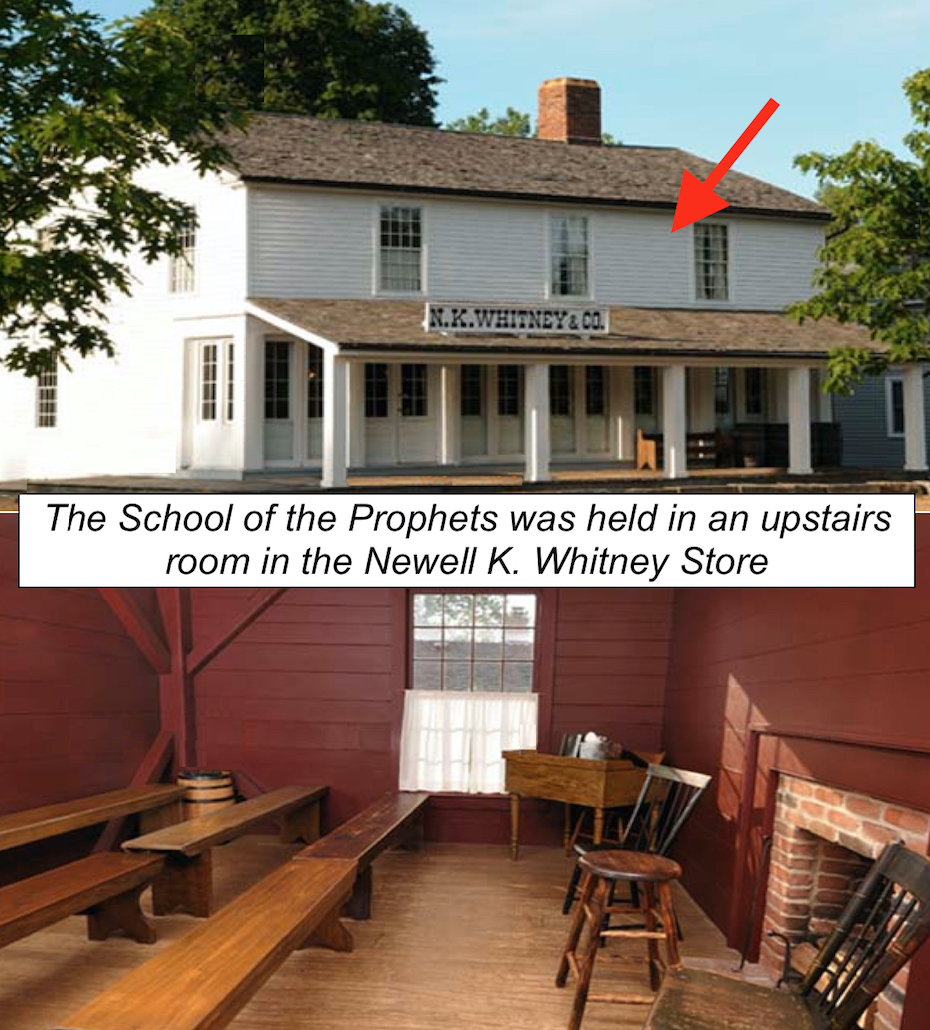
On a recent trip to Kirtland just outside of Cleveland, Ohio, we visited the Newell K. Whitney store and entered the room where the School of the Prophets was held. The room was small, filled with very uncomfortable benches upon which the participants sat for hours while studying and listening to the instruction
“And as all have not faith, seek ye diligently and teach one another words of wisdom; yea, seek ye out of the best books words of wisdom; seek learning, even by study and also by faith,” and again in the following verse “Organize yourselves; prepare every needful thing; and establish a house, even a house of prayer, a house of fasting, a house of faith, a house of learning, a house of glory, a house of order, a house of God” (D&C 88:119, emphasis added).
So why the term “School of the Prophets,” since Joseph Smith was the only active prophet at the time these schools were given (until the Salt Lake period and then Brigham Young was the only prophet). Of course, the Quorum of the Twelve are prophets, seers and revelators, but their keys were not active. By contrast, in the Old Testament there was an assemblage called the “sons of the prophets” (2 Kings 2:3,5,7,15; 4:1,38; 5:22; 6:1)—in the Hebrew, the word here translated as “sons” can also be translated as “member (of a guild, order or class)” and shows that the term “sons of the prophets” was not about literal descent, but about a member of a prophetic guild or order. Jeremiah described these “sons” as assembling in communal halls before a master, for instruction, in a somewhat type of future training purpose.
In Joseph Smith’s school of the prophets, he was directed through revelation by the Lord to establish and direct it. Joseph was the President and appointed Orson Hyde as the teacher. Subjects were: Theology, which was regularly taught, also English Grammar, and other subjects. At times, Sidney Rigdon lectured on grammar. In fact, the “lectures on theology” (referred to as the Theological School) were the Lectures on Faith that were developed for the school, and were regularly delivered, and absorbed for the most part everything else of a temporal nature, and the attendees gave the most studious attention to the all-important object of qualifying themselves as messengers of Jesus Christ, to be ready to do His will in carrying glad tidings to all that would open their eyes, ears, and hearts.
When the school was divided into two groups, certain members were appointed to speak at each meeting. Sidney Rigdon was the main teacher, however, others were also called upon. Heber C. Kimball said of this: “a certain number were appointed to speak at each meeting. On one occasion I was called upon to speak on the principle of faith. Several brethren spoke before me, and quoted every passage mentioned in the Scriptures on the subject. I referred to an original circumstance which took place in my family.”
Later, women and children were invited to attend. At this time a grammar school was organized and commended in Kirtland, Ohio, taught by Sidney Rigdon and William E. McLellin, and held especially for the young Elders of the Church, many of whom lacked the necessary education as representatives of the Church and missionaries to preach the gospel to the world (Journal History 22 Dec).
The school at this point was conducted under the direction of Joseph Smith, Frederick G. Williams, Sidney Rigdon and Oliver Cowdery. At this time, the subjects had been expanded to include penmanship, arithmetic, grammar and geography. Noah Webster’s 1828 dictionary was used as the standard dictionary. A Hebrew School was added and a combined curricula offered 11 subjects.
For those who do not know the story of the beginning of the School of the Prophets, Joseph Smith said: “On the evening of the 21st of September, A.D. 1823, while I was praying unto God, and endeavoring to exercise faith in the precious promises of Scripture, on a sudden a light like that of day, only of a far purer and more glorious appearance and brightness, burst into the room indeed the first sight was as though the house was filled with consuming fire; the appearance produced a shock that affected the whole body; in a moment a personage stood before me surrounded with a glory yet greater than that with which I was already surrounded. This messenger proclaimed himself to be an angel of God, sent to bring the joyful tidings that the covenant which God made with ancient Israel was at hand to be fulfilled, that the preparatory work for the second coming of the Messiah was speedily to commence; that the time was at hand for the Gospel in all its fullness to be preached in power, unto all nations that a people might be prepared for the Millennial reign. I was informed that I was chosen to be an instrument in the hands of God to bring about some of His purposes in this glorious dispensation” (History of the Church, Vol.4: pp.536 )
A major purpose of the School of the Prophet was to increase the faith of Church members: “And as all have not faith, seek ye diligently and teach one another words of wisdom; yea, seek ye out of the best books words of wisdom; seek learning, even by study and also by faith” (D&C 88:118)
The Setting in which the School of the Prophets was established—The world in which the School of the Prophets emerged was a world at the beginning of monumental change. In his book entitled The Birth of the Modern, Paul Johnson (1991) has insightfully described the period between 1815 and 1830 as a time in the “which the matrix of the modern world was largely formed” (p. xvii). Matrix here means “womb” or “mold.”
As for the development of the curriculum and the lesson detail, it is important to understand the workings of the First Presidency of the day and specifically the Prophet and President of the Church, Joseph Smith. This is seen when following the revelation (D&C 88), a conference of High Priests assembled in the translating room in Kirtland, Ohio, on 27 December 1832. During this meeting the following was covered and discussed:
First Revelation (D&C 88:1-126)
• Call for the organization of a school was given (70-77, 117-119)
• The mission statement was set forth (77-80)
• The curriculum was categorized (79).
• Rules of personal student conduct were revealed (120-126)
Second Revelation (D&C 88:127-133)
• Rules for classroom conduct
Third Revelation (D&C 88: 134-141)
• Ritual for initiation
(See the next post, “Revisiting the School of the Prophets and the Revelation that Established it – Part II,” regarding who wrote the lessons in the School of the Prophets)
Sunday, October 15, 2017
Are the Differences in Theories Reduced to Only One Issue?
According to Jonathan Neville, there seems to him that the
“apparent foundational geographic differences between the Mesoamericanists and
the North Americanists are twofold:(1) the nature and location of the narrow strip of
wilderness and (2) the direction of flow of the river Sidon.”
This statement, without a doubt is about the most simplistic and irresponsible thing either theorist, Mesoamerican or North Americanist could say.
In fact, there are so many differences it is hard to imagine them listed in a single article, but then again, there are so many differences between both theories and the scriptural record of the Book of Mormon, it is almost humorous to attempt to list them all in even a series of articles.
In an interesting misunderstanding of facts, and a view into the narrow thinking of theorists, it is written in this discussion: “According to the Book of Mormon, if the narrow strip of wilderness was mountainous and ran from a west sea to an east sea and if the river Sidon flowed north, then the Heartland (North American) Model is false. Conversely, if the narrow strip of wilderness was not mountainous and if the Sidon flowed south, then the Mesoamerican Model is false. It is that simple, and Neville agrees with this premise (page 314 and by personal conversation).”
Only a Mesoamerican or North Americanist theorist could reduce the large number of scriptural references to the descriptions and understanding of the Land of Promise to a single issue—the flow of the Sidon River. However, even this singular issue is poorly described, for the River Sidon no matter which way it flowed, was in a highland area or right near it that was the Land of Nephi, which occupied a higher elevation than the Land of Zarahemla, yet in the Heartland or North American models the land around their Zarahemla is all flat, and the Mississippi River is a flat valley its entire length, which eliminates this area from any possible consideration.
So let us take further examples:
1. The direction of the land:
Mesoamericanists have a distinct east-west orientation with their land extension; North Americanists have a more or less east west land divided off from the overall huge land mass of North America.
2. The height of mountains:
Mesoamericanists have mountains, two ranges, one in the Land Northward and one in the Land Southward, but neither range has any peaks over 15,000 feet, and most are far shorter; North Amerianists, have no mountains at all within the designated areas of their Land of Promise; and even in the entire eastern half of the continent (east of the Rocky Mountains), no mountains are high enough to even mention, especially in light of Samuel the Lamanites prophesy, which the Lord told him to utter, that the Land of Promise would have mountains, “whose height is great.”
3. Two unknown animals to Joseph Smith in 1829:
Mesoamericanists can only point to the sloth and tapir as unknown animals at the time, but neither are beasts of burden, and could not possible be ranked with the elephant as equally important to man over the horse and ass. North Americanists have no unknown animals to point out. Sometimes they try to use the Buffalo and Mountain Goat, neither of which are domesticatable and neither are beasts of burden, and probably at least one, or probably both, would have been known to Joseph Smith.
4. Growing climate to match Jerusalem:
Mesoamerica is a tropical climate and neither wheat nor barley will grow there, let alone olive trees and numerous other seeds that Lehi brought from the Mediterranean Climate of Jerusalem. North Americanists, especially the Great Lakes, has a humid subtropical climate (Koppen Cfa), which is 4º-7º warmer overnight than surrounding areas, but still a far cry from the Mediterranean Climate of Jerusalem where olive trees and numerous other Jerusalem seeds and grains would not have grown.
5. The Land of Bountiful being north of the Land of Zarahemla:
Mesoamericanists have the Land of Bountiful to the north of the Land of Zarahemla (though actually east on their map). North Americanists have the Land of Bountiful to the east of their Land of Zarahemla. Neither case does the location agree with the scriptural record.
6. The West Sea reachable by sailing:
Mesoamericanists have their West Sea as the Pacific Ocean which is to the south of their Land of Promise. North Americanists have their West Sea either as a Great Lake or as the Mississippi River, neither of which could be reached by deep ocean sailing ships in 600 B.C., let alone by submersible barges in 2100 B.C.
7. The West Sea:
Again, Mesoamericanists have their West Sea to the south of their Land of Promise. North Americanists have two West Seas, one in the north is Lake Michigan, which is nowhere near their Land of Nephi, and is to the north of the Land of Zarahemla. The other is in the south, south of the Land of Zarahemla, and is actually the confluence of the Ohio and Mississippi rivers. Now, geologists and potamologists agree that the Mississippi River was never very wide, though it changed course continually over the several millennia of its existence and therefore could never have been a lake, sea, or anything other than a river of around a mile or so in width.
8. Narrow strip of wilderness:
Mesoamerica has a narrow strip of wilderness that runs almost from the Seas East to the Sea West, from the Caribbean Sea to the Pacific Ocean, except for a short distance. North Americanists do not have a narrow strip running from sea to sea, but from their Sea East (Lake Ontario) to the Mississippi River, not a sea (and their River Sidon). In addition, the narrow strip was mountainous, a much higher elevation than the land of Zarahemla, and their narrow strip is flat, along the Allegheny and Ohio rivers.
9. Land of Nephi Stretching from Sea to Sea:
Mesoamericanists have their Land of Nephi stretching from the Caribbean Sea to the Pacific Ocean, which is almost a north-south plane, instead of east-west. North Americanists have their Land of Nephi (“Lamanite Lands”) stretching east and west from the Susquehanna River in the east to the Mississippi River in the west—neither are seas.
10. Distance from Lehi-Nephi (City of Nephi) to the City of Zarahemla:
Mesoamericanists claim the two cities were about 21 days travel apart, at 15 miles a day, that would be 315 miles, or 20 miles a day would be 420 miles; yet their map shows the two cities about 200 miles apart—that would mean traveling at about 10 miles per day. If we use that criteria, then the narrow neck of land, in a day and a half, would be only 15 miles wide. It seems when theorists want a narrow distance, they give one statistic, but when they need a longer distance, they use another. North Americanists show a distance on their map of 550 miles between the two cities (one on the Tenessee River, the other across from Nauvoo along the Mississippi).
The point is, that a single issue, no matter what it is, cannot be the criteria of determining the location of the Land of promise. Where Lehi landed and where Nephi settled is not a matter of a single issue, but a compilation of all of the descriptive information given us by Mormon in his abridgement, and Nephi in his travels and Jacob in his description of the overall land. When we take all of those descriptions into account, along with those Moroni left us in his abridgement of the Jaredite record, which actual scriptural references overall number more than 45 and as much in some ways as 65 or more, we begin to create an image and of the land and able to follow Nephi’s course and landing site, his trek to escape his brothers, where he settled, and where the Nephite Nation was located. Any attempt to reduce this list of a handful of ideas is bound to fail, since Mormon’s descriptions are rich with information that enable us to know where the Land of Promise was actually located.
This statement, without a doubt is about the most simplistic and irresponsible thing either theorist, Mesoamerican or North Americanist could say.
In fact, there are so many differences it is hard to imagine them listed in a single article, but then again, there are so many differences between both theories and the scriptural record of the Book of Mormon, it is almost humorous to attempt to list them all in even a series of articles.
In an interesting misunderstanding of facts, and a view into the narrow thinking of theorists, it is written in this discussion: “According to the Book of Mormon, if the narrow strip of wilderness was mountainous and ran from a west sea to an east sea and if the river Sidon flowed north, then the Heartland (North American) Model is false. Conversely, if the narrow strip of wilderness was not mountainous and if the Sidon flowed south, then the Mesoamerican Model is false. It is that simple, and Neville agrees with this premise (page 314 and by personal conversation).”
Only a Mesoamerican or North Americanist theorist could reduce the large number of scriptural references to the descriptions and understanding of the Land of Promise to a single issue—the flow of the Sidon River. However, even this singular issue is poorly described, for the River Sidon no matter which way it flowed, was in a highland area or right near it that was the Land of Nephi, which occupied a higher elevation than the Land of Zarahemla, yet in the Heartland or North American models the land around their Zarahemla is all flat, and the Mississippi River is a flat valley its entire length, which eliminates this area from any possible consideration.
So let us take further examples:
1. The direction of the land:
Mesoamericanists have a distinct east-west orientation with their land extension; North Americanists have a more or less east west land divided off from the overall huge land mass of North America.
2. The height of mountains:
Mesoamericanists have mountains, two ranges, one in the Land Northward and one in the Land Southward, but neither range has any peaks over 15,000 feet, and most are far shorter; North Amerianists, have no mountains at all within the designated areas of their Land of Promise; and even in the entire eastern half of the continent (east of the Rocky Mountains), no mountains are high enough to even mention, especially in light of Samuel the Lamanites prophesy, which the Lord told him to utter, that the Land of Promise would have mountains, “whose height is great.”
3. Two unknown animals to Joseph Smith in 1829:
Mesoamericanists can only point to the sloth and tapir as unknown animals at the time, but neither are beasts of burden, and could not possible be ranked with the elephant as equally important to man over the horse and ass. North Americanists have no unknown animals to point out. Sometimes they try to use the Buffalo and Mountain Goat, neither of which are domesticatable and neither are beasts of burden, and probably at least one, or probably both, would have been known to Joseph Smith.
4. Growing climate to match Jerusalem:
Mesoamerica is a tropical climate and neither wheat nor barley will grow there, let alone olive trees and numerous other seeds that Lehi brought from the Mediterranean Climate of Jerusalem. North Americanists, especially the Great Lakes, has a humid subtropical climate (Koppen Cfa), which is 4º-7º warmer overnight than surrounding areas, but still a far cry from the Mediterranean Climate of Jerusalem where olive trees and numerous other Jerusalem seeds and grains would not have grown.
5. The Land of Bountiful being north of the Land of Zarahemla:
Mesoamericanists have the Land of Bountiful to the north of the Land of Zarahemla (though actually east on their map). North Americanists have the Land of Bountiful to the east of their Land of Zarahemla. Neither case does the location agree with the scriptural record.
6. The West Sea reachable by sailing:
Mesoamericanists have their West Sea as the Pacific Ocean which is to the south of their Land of Promise. North Americanists have their West Sea either as a Great Lake or as the Mississippi River, neither of which could be reached by deep ocean sailing ships in 600 B.C., let alone by submersible barges in 2100 B.C.
7. The West Sea:
Again, Mesoamericanists have their West Sea to the south of their Land of Promise. North Americanists have two West Seas, one in the north is Lake Michigan, which is nowhere near their Land of Nephi, and is to the north of the Land of Zarahemla. The other is in the south, south of the Land of Zarahemla, and is actually the confluence of the Ohio and Mississippi rivers. Now, geologists and potamologists agree that the Mississippi River was never very wide, though it changed course continually over the several millennia of its existence and therefore could never have been a lake, sea, or anything other than a river of around a mile or so in width.
8. Narrow strip of wilderness:
Mesoamerica has a narrow strip of wilderness that runs almost from the Seas East to the Sea West, from the Caribbean Sea to the Pacific Ocean, except for a short distance. North Americanists do not have a narrow strip running from sea to sea, but from their Sea East (Lake Ontario) to the Mississippi River, not a sea (and their River Sidon). In addition, the narrow strip was mountainous, a much higher elevation than the land of Zarahemla, and their narrow strip is flat, along the Allegheny and Ohio rivers.
9. Land of Nephi Stretching from Sea to Sea:
Mesoamericanists have their Land of Nephi stretching from the Caribbean Sea to the Pacific Ocean, which is almost a north-south plane, instead of east-west. North Americanists have their Land of Nephi (“Lamanite Lands”) stretching east and west from the Susquehanna River in the east to the Mississippi River in the west—neither are seas.
10. Distance from Lehi-Nephi (City of Nephi) to the City of Zarahemla:
Mesoamericanists claim the two cities were about 21 days travel apart, at 15 miles a day, that would be 315 miles, or 20 miles a day would be 420 miles; yet their map shows the two cities about 200 miles apart—that would mean traveling at about 10 miles per day. If we use that criteria, then the narrow neck of land, in a day and a half, would be only 15 miles wide. It seems when theorists want a narrow distance, they give one statistic, but when they need a longer distance, they use another. North Americanists show a distance on their map of 550 miles between the two cities (one on the Tenessee River, the other across from Nauvoo along the Mississippi).
The point is, that a single issue, no matter what it is, cannot be the criteria of determining the location of the Land of promise. Where Lehi landed and where Nephi settled is not a matter of a single issue, but a compilation of all of the descriptive information given us by Mormon in his abridgement, and Nephi in his travels and Jacob in his description of the overall land. When we take all of those descriptions into account, along with those Moroni left us in his abridgement of the Jaredite record, which actual scriptural references overall number more than 45 and as much in some ways as 65 or more, we begin to create an image and of the land and able to follow Nephi’s course and landing site, his trek to escape his brothers, where he settled, and where the Nephite Nation was located. Any attempt to reduce this list of a handful of ideas is bound to fail, since Mormon’s descriptions are rich with information that enable us to know where the Land of Promise was actually located.
Saturday, October 14, 2017
Jaredites and their Language – Part III
Continuing from the previous post
regarding the language of the Jaredites and its possible connection to the
language of the Hebrews.
Opposed to Edenics and Mozeson’s work is Mark Liberman, of the University of Pennsylvania Linguistics Department, who has written of this: “I’m not aware of any respected academics who accept the Edenics theory.” Liberman dismissed Edenics as “crank etymology," and added that Mozeson’s theory “seems to be that God was a sort of weak cryptographer, who didn’t actually create any new languages after Babel but simply mixed up the old ones in ways that he has figured out how to decrypt.” Liberman went on to say, “Mozeson is not the first person with eccentric theories of etymology.
Then there is Goropius Becanus, who was a Dutch physician, linguist, and humanist in the 16th century born Jan Gerartsen van Gorp, “who theorized that Antwerpian Brabantic”—a Dutch-Flemish dialect—“spoken in the region between the Scheldt and Meuse Rivers, was the original language spoken in Paradise.”
For Liberman, the word connections that Mozeson finds are “mostly coincidences. For example, according to the OED, modern English ‘eye’ is from Old English éage, corresponding to Old Frisian âge, Old Saxon ôga, Old High German ouga, Old Norse auga and Gothic augo. Meanwhile, ‘fruit’ is from Old French fruit, Latin frūctus—frugv root of fruī to enjoy. In those cases, the well-documented earlier forms are much less similar to the alleged Hebrew cognates."
As for ‘wine,’ there may be a connection, but even if there is one, Liberman claims that the direction is not clear. “There’s strong evidence from archaeology and biology as well as from historical linguistics that Mozeson’s theory is not true.” Furthermore, Liberman added, “his methodology can be used to ‘prove’ that any randomly selected language is the parent of all other languages.”
Mozeson is hardly chastened by the attacks against him. “The extremes to which the academic establishment goes to hiding the Hebrew origin of words are often absurd,” he said, lashing out at his critics. “There are some English words that even the etymologists can’t deny have Hebrew origins—most of these have a Jewish religious context. Anything beyond this they can’t bear to admit. Take for example the word ‘amen’ (agreement or assent). The Oxford dictionary grudgingly admits that it originates from the Hebrew amen. Yet when it comes to the related word ‘amenable’ (open and responsive to suggestion), Oxford claims the source is from the Latin minari, to threaten. Who here is feeling threatened by whom?”
Another linguist, F. Merritt Ruhlen, Anthropological Sciences and Human Biology at Stanford University and co-director of the Santa Fe Institute Program on the Evolution of Human Languages, is also working on a Mother Tongue effort, and believes that “good evidence for a proto language existed in the ancient past and that it is possible to identify some lexical characteristics of that language through comparative analysis of today’s language families” (The Origin of Language: Tracing the Evolution of the Mother Tongue, John Wiley & Sons, Hoboken NJ, 1994/1996).
It should be noted that Mozeson incorporates another, though subltle, departure from mainstream linguistics, and that is the reconstruction of Edenics by comparison of cognates (i.e., similar word forms found in different languages) in many languages at once. Nor is such a method unknown in linguistics and is the kind of method Ruhlen uses, as did his predecessor Joseph H. Greenberg, also of Stanford, the latter’s work in linguistic typology and the genetic classification of languages, and worked as a Codebreaker during World War II, and was a recipient of the highest award for a Linguistics, the Gold Medal of Philology.
Mozeson points to the obvious cognation of some English words with Hebrew words and supported by other languages, such as Chinese and Eskimo. However, to mainstream scholars any relation between Hebrew and non-semitic languages "is anathema." In fact, Mozeson states of this: “They ought to be called cognates, but linguists would never concede that the English and Hebrew words share a common ancestry.”
It is of interest that Mozeson notes Noah Webster, original publisher of Webster’s dictionary, included numerous Hebrew roots for English words, but most of these were later expunged in efforts to modernize the lexicon. According to Mozeson, “Etymologists would have us believe that language was created via a process of evolution over thousands of years, even though no primitive languages have ever been discovered.
It was none other than Naom Chomsky who famously proved that language had to come about spontaneously. Chomsky and other Generative linguists like him have shown that 5,000 to 6,000 languages in the world, despite their different grammars, do share a set of syntactic rules and principles. In a 1998 New York Times interview, Chomsky explained his theory saying, “Imagine that some divine super engineer, in a single efficient strike, endowed humans with the power of language where formerly they had none.”
And Mozeson can cite a number of leading academics who support somewhat related theories. These include Michael Astour, author of Hellenosemitica; Martin Bernal, author of Black Athena; William Worrell; French scholar Albert Cuny; Danish scholar Hermann Moller, and others.
Perhaps the strongest support for Mozeson’s own work came from ancient-language expert Cyrus Gordon of New York University, one of the true giants in the fields of Biblical studies and ancient Near Eastern Studies, as well as world famous semioticist (study of signs and symbols and their use or interpretation), who sent Mozeson a personal note stating: “Your work is full of interesting comparisons—many of them new to me. The subject has a huge bibliography. … You must know that down to recent centuries, Hebrew as the original language and mother of all languages was a widely held view among intellectuals.”
Incredibly, due the controversial nature of Mozeson’s theories, Gordon regretted that he could not publicly support Mozeson’s work, saying that such a move would jeopardize the careers of the students who received their doctorates from him. Mozeson says that for 25 years he agreed to keep Gordon’s esteem for his work secret so as not to harm the professor’s students. (A small portion of it appeared in The Origin of Speeches). "Only now that an entire generation of academics has passed," he said, "did he agree to show the full letter."
In fact several academics who wrote approbations for Mozeson’s work in The Origin of Speeches and The Word refused to be interviewed for recent articles. According to Hezy Laing, “Not everyone, however, has been apprehensive about speaking out about a link between Hebrew and Western languages. While Mozeson is frustrated by the summary dismissal of his ideas, he takes comfort in the fact that other major “unifying” theories bitterly opposed by the academic establishment gradually became accepted due to the weight of evidence.”
As an example, it has only been in the last couple of decades that scientists have become more accepting of a super continent, now considering Pangaea as having existed. In addition, for more than a century scientist also disputed that humanity had common ancestry, but new DNA evidence reveals that Homo Sapiens do in fact share mutual ancestry and perhaps even a mutual ancestor. As Laing stated: “Since we know all humanity comes from the same people it makes sense to assume we shared a common language too.” As far as Mozeson is concerned, the only issue that remains to be determined, he said, is: What was the structure of that primordial language?
Certainly, the case for it being Hebrew, or a form of it originally, does make a lot of sense.
Opposed to Edenics and Mozeson’s work is Mark Liberman, of the University of Pennsylvania Linguistics Department, who has written of this: “I’m not aware of any respected academics who accept the Edenics theory.” Liberman dismissed Edenics as “crank etymology," and added that Mozeson’s theory “seems to be that God was a sort of weak cryptographer, who didn’t actually create any new languages after Babel but simply mixed up the old ones in ways that he has figured out how to decrypt.” Liberman went on to say, “Mozeson is not the first person with eccentric theories of etymology.
Then there is Goropius Becanus, who was a Dutch physician, linguist, and humanist in the 16th century born Jan Gerartsen van Gorp, “who theorized that Antwerpian Brabantic”—a Dutch-Flemish dialect—“spoken in the region between the Scheldt and Meuse Rivers, was the original language spoken in Paradise.”
For Liberman, the word connections that Mozeson finds are “mostly coincidences. For example, according to the OED, modern English ‘eye’ is from Old English éage, corresponding to Old Frisian âge, Old Saxon ôga, Old High German ouga, Old Norse auga and Gothic augo. Meanwhile, ‘fruit’ is from Old French fruit, Latin frūctus—frugv root of fruī to enjoy. In those cases, the well-documented earlier forms are much less similar to the alleged Hebrew cognates."
As for ‘wine,’ there may be a connection, but even if there is one, Liberman claims that the direction is not clear. “There’s strong evidence from archaeology and biology as well as from historical linguistics that Mozeson’s theory is not true.” Furthermore, Liberman added, “his methodology can be used to ‘prove’ that any randomly selected language is the parent of all other languages.”
Mozeson is hardly chastened by the attacks against him. “The extremes to which the academic establishment goes to hiding the Hebrew origin of words are often absurd,” he said, lashing out at his critics. “There are some English words that even the etymologists can’t deny have Hebrew origins—most of these have a Jewish religious context. Anything beyond this they can’t bear to admit. Take for example the word ‘amen’ (agreement or assent). The Oxford dictionary grudgingly admits that it originates from the Hebrew amen. Yet when it comes to the related word ‘amenable’ (open and responsive to suggestion), Oxford claims the source is from the Latin minari, to threaten. Who here is feeling threatened by whom?”
Another linguist, F. Merritt Ruhlen, Anthropological Sciences and Human Biology at Stanford University and co-director of the Santa Fe Institute Program on the Evolution of Human Languages, is also working on a Mother Tongue effort, and believes that “good evidence for a proto language existed in the ancient past and that it is possible to identify some lexical characteristics of that language through comparative analysis of today’s language families” (The Origin of Language: Tracing the Evolution of the Mother Tongue, John Wiley & Sons, Hoboken NJ, 1994/1996).
It should be noted that Mozeson incorporates another, though subltle, departure from mainstream linguistics, and that is the reconstruction of Edenics by comparison of cognates (i.e., similar word forms found in different languages) in many languages at once. Nor is such a method unknown in linguistics and is the kind of method Ruhlen uses, as did his predecessor Joseph H. Greenberg, also of Stanford, the latter’s work in linguistic typology and the genetic classification of languages, and worked as a Codebreaker during World War II, and was a recipient of the highest award for a Linguistics, the Gold Medal of Philology.
Mozeson points to the obvious cognation of some English words with Hebrew words and supported by other languages, such as Chinese and Eskimo. However, to mainstream scholars any relation between Hebrew and non-semitic languages "is anathema." In fact, Mozeson states of this: “They ought to be called cognates, but linguists would never concede that the English and Hebrew words share a common ancestry.”
It is of interest that Mozeson notes Noah Webster, original publisher of Webster’s dictionary, included numerous Hebrew roots for English words, but most of these were later expunged in efforts to modernize the lexicon. According to Mozeson, “Etymologists would have us believe that language was created via a process of evolution over thousands of years, even though no primitive languages have ever been discovered.
It was none other than Naom Chomsky who famously proved that language had to come about spontaneously. Chomsky and other Generative linguists like him have shown that 5,000 to 6,000 languages in the world, despite their different grammars, do share a set of syntactic rules and principles. In a 1998 New York Times interview, Chomsky explained his theory saying, “Imagine that some divine super engineer, in a single efficient strike, endowed humans with the power of language where formerly they had none.”
And Mozeson can cite a number of leading academics who support somewhat related theories. These include Michael Astour, author of Hellenosemitica; Martin Bernal, author of Black Athena; William Worrell; French scholar Albert Cuny; Danish scholar Hermann Moller, and others.
Perhaps the strongest support for Mozeson’s own work came from ancient-language expert Cyrus Gordon of New York University, one of the true giants in the fields of Biblical studies and ancient Near Eastern Studies, as well as world famous semioticist (study of signs and symbols and their use or interpretation), who sent Mozeson a personal note stating: “Your work is full of interesting comparisons—many of them new to me. The subject has a huge bibliography. … You must know that down to recent centuries, Hebrew as the original language and mother of all languages was a widely held view among intellectuals.”
Incredibly, due the controversial nature of Mozeson’s theories, Gordon regretted that he could not publicly support Mozeson’s work, saying that such a move would jeopardize the careers of the students who received their doctorates from him. Mozeson says that for 25 years he agreed to keep Gordon’s esteem for his work secret so as not to harm the professor’s students. (A small portion of it appeared in The Origin of Speeches). "Only now that an entire generation of academics has passed," he said, "did he agree to show the full letter."
In fact several academics who wrote approbations for Mozeson’s work in The Origin of Speeches and The Word refused to be interviewed for recent articles. According to Hezy Laing, “Not everyone, however, has been apprehensive about speaking out about a link between Hebrew and Western languages. While Mozeson is frustrated by the summary dismissal of his ideas, he takes comfort in the fact that other major “unifying” theories bitterly opposed by the academic establishment gradually became accepted due to the weight of evidence.”
As an example, it has only been in the last couple of decades that scientists have become more accepting of a super continent, now considering Pangaea as having existed. In addition, for more than a century scientist also disputed that humanity had common ancestry, but new DNA evidence reveals that Homo Sapiens do in fact share mutual ancestry and perhaps even a mutual ancestor. As Laing stated: “Since we know all humanity comes from the same people it makes sense to assume we shared a common language too.” As far as Mozeson is concerned, the only issue that remains to be determined, he said, is: What was the structure of that primordial language?
Certainly, the case for it being Hebrew, or a form of it originally, does make a lot of sense.
Subscribe to:
Posts (Atom)