
Thursday, May 25, 2017
4th Nephi Code Video: Is This Where Lehi Landed?
This
is our fourth video. Please take a look at it and if you enjoy the
video please "like it," and subscribe to our You-Tube Channel and share
with your friends and family. And, if you are interested, let us know
what you think of our video since we have plans for more. Thank you.

Wednesday, May 24, 2017
A Compendium of the Doctrines of the Gospel 1886 – Lehi’s Landing – Part II
Continuing
from the previous post regarding the original Franklin D. Richards Compendium
reference book of Church doctrinal facts in which he quotes Frederick G.
Williams comment about Lehi landing at 30º South Latitude.
 Now,
another note also on page 54, states: “Orson Pratt held that view (of Lehi
landing in South America). In his Remarkable
Visions, the first edition of which we understand, was published in 1840,
consequently some time before the martyrdom of the Prophet, he says that Lehi landed
upon the western coast of South America,’ and in 1874, when he was Church
Historian, in an article written for an encyclopedia, Pratt expressed the same
thought more fully, stating that the landing took place, ‘as is believed, not
far from the 30th degree south latitude.’ The expression, ‘as is
believed,’ we take to mean that Orson Pratt did not advance a theory of his own
on the question, but stated what was held to be true among his associates, or
some of them, as well as by himself.”
Now,
another note also on page 54, states: “Orson Pratt held that view (of Lehi
landing in South America). In his Remarkable
Visions, the first edition of which we understand, was published in 1840,
consequently some time before the martyrdom of the Prophet, he says that Lehi landed
upon the western coast of South America,’ and in 1874, when he was Church
Historian, in an article written for an encyclopedia, Pratt expressed the same
thought more fully, stating that the landing took place, ‘as is believed, not
far from the 30th degree south latitude.’ The expression, ‘as is
believed,’ we take to mean that Orson Pratt did not advance a theory of his own
on the question, but stated what was held to be true among his associates, or
some of them, as well as by himself.”


Now, whether or
not the above information was recorded as an opinion rather than a revelation,
is not known, however, a greater statement by Pratt was given two years earlier
in the Tabernacle in Salt Lake City on Sunday Afternoon, February 11, 1872, and
reported by David W. Evans in the Journal of Discourses under the title:
“Nephite America—The Day of God's Power—The Shepherd of Israel,” in which he
opened his remarks by saying: “It is quite unexpected
to me to be called upon this afternoon to address this congregation; but
inasmuch as I have been solicited so to do I cheerfully comply with the
request. It has also been suggested that there would be
several strangers present this afternoon who would desire to hear some of the
evidences in relation to the Book of Mormon, and although it is a subject on
which we have spoken during the week just passed.”
He then goes on to discuss the Book of Mormon, beginning with Lehi’s travels, saying: “from the Lord they traveled southwest from the city of Jerusalem, and after reaching the Red Sea they continued along its eastern borders and afterwards bent their course eastward, arriving at the Indian Ocean. There they were commanded by the Almighty to build a vessel, the pattern of which was given to them by revelation, building it as Noah built the Ark—under the direction of the Almighty. On board this vessel they embarked, and were guided by the Almighty across the great Indian Ocean…they came round our globe, crossing not only the Indian Ocean, but what we term the great Pacific Ocean, landing on the western coast of what is now called South America. As near as we can judge from the description of the country contained in this record the first landing place was in Chile, not far from where the city of Valparaiso now stands.”

He then goes on to discuss the Book of Mormon, beginning with Lehi’s travels, saying: “from the Lord they traveled southwest from the city of Jerusalem, and after reaching the Red Sea they continued along its eastern borders and afterwards bent their course eastward, arriving at the Indian Ocean. There they were commanded by the Almighty to build a vessel, the pattern of which was given to them by revelation, building it as Noah built the Ark—under the direction of the Almighty. On board this vessel they embarked, and were guided by the Almighty across the great Indian Ocean…they came round our globe, crossing not only the Indian Ocean, but what we term the great Pacific Ocean, landing on the western coast of what is now called South America. As near as we can judge from the description of the country contained in this record the first landing place was in Chile, not far from where the city of Valparaiso now stands.”

Valparaiso, the coastal city nearest the Chilean capitol of Santiago,
was relatively well known in the eastern United States by 1872, and was the
furthest north ships rounding the Cape on their way to Indonesia, the
Philippines and Japan sailed before turning westward across the Pacific to pick
up the northern rim of the South Pacific Gyre
For explanation, Valparaiso (33.03º
south) is 200 miles south of the 30º south latitude, and in 1872, Valparaiso
(29.9º south)—on the coast—and near the capitol of Santiago, Chile—just
inland—was known in the eastern U.S., though the Bay of Coquimbo and La Serena
had not yet been publicized in the States at that time. Pratt then recounts the
separation of the Nephites and Lamanites, and the former group moving away,
saying: “Being so severely persecuted by the Lamanites, the Nephites were
commanded of the Lord to depart from their midst, that is to leave the first
place of colonization in the country which the Spanish now call Chile. They
came northward from their first landing place traveling, according to the
record, as near as I can judge, some two thousand miles. The Lamanites remained
in possession of the country on the South. The Nephites formed a colony not far
from the head waters of the river Amazon, and they dwelt there some four
centuries, increasing and spreading forth in the land. The Lamanites, in the
South and in the middle portions of South America, also spread forth and
multiplied, and became a very strong and powerful nation.
Now, two years after the 1840
disclosure of Lehi sailing down to the Southern Ocean and across to Chile, a
contrary view was expressed in the Times
and Seasons, September 15, 1842, nor is it certain who wrote this second
article, though it was written while the prophet was still alive and reading
each Church publication rather carefully it might be assumed. This second
article states: “…Lehi went down by the Red Sea to the great Southern Ocean,
and crossed over to this land, and landed a little south of the Isthmus of
Darien, and improved the country…”
The Compendium article concludes with: “It should be noted that this
statement ‘a little south of the Isthmus of Darien’ would put the landing
somewhere in Columbia or Equador (sic), but a considerable distance from
Coquimbo, Chile, 30 degrees south latitude.

Top: The area of Panama, once called Darien, now the term “Darien”
refers to that area of Panama that joins Colombia and the mainland of South
America called the Darien Gap; Bottom: As can be seen, this area referred to as
the Darien Gap is a heavy jungle—no one lives or works here and not even the 18,650
mile long Pan American Highway, which runs continuously from Tierra del Fuego
at the tip of South America to Alaska crosses this 100-mile long Gap
Now, of this latter thought, it
should also be noted that the Isthmus of Darien (the entire country of Panama)
is not today referred to as the Darien Gap, but rather this is a narrow area in
the country of Panama, and involves that part of land connecting Panama with
Colombia in South America—more specifically, that area of Panama just to the
north of the South American continent, lying between the Caribbean Sea and the
Pacific Ocean. This area is almost impassable, and inaccessible, having defeated travelers for
centuries, and uncrossed by man through the interior in any fashion—even today
with off-road four wheelers except for one well-funded and well-equipped effort
by vehicle in a Land Rover, dubbed the Affectionate
Cockroach and a Jeep, which took nearly five months, averaging just 656
feet per hour (that is barely over two football fields long).

Trying to get through the Darien Gap in a 4-wheel off-road vehicle—it
was slow, averaging less than ¼ of a mile per hour for five months to cover 100
miles
In the past, major settlements of the
Spanish, Dutch, and Scottish all failed to open up or travel through this area,
let along settlement of any type. To think that Nephites, including women and
children traveled on foot north and south through this uninhabitable and
inhospitable undeveloped swampland jungle between where they landed and Central
America is without merit of any kind since the only way around the Gap is by
sea—not through it.
Thus, we are left with the comment,
written by Frederick G. Williams, that Lehi landed 30º South Latitude, in the
area now known as Coquimbo Bay and La Serena, Chile.
By the way, as an afterthought, the
time capsule was recovered on August 13, 1993. Unfortunately, the papers inside
were damaged by moisture and condensation inside the foundation stone over the
136-year period, as was the original manuscript of the Book of Mormon, placed
by the Prophet Joseph in the cornerstone of the Nauvoo House hotel in 1841,
when the cornerstone was opened in the 1870s by Emma Smith's second husband.
Moisture had damaged much of the manuscript, causing the Church today to store
artifacts, publications and other mementos in cornerstone boxes for modern-day
temples in airtight and watertight stainless steel boxes. In the church's early
days, the actual hollowed-out stones themselves were used.
However, the point of all of this should be that in the 1830s Joseph Smith and/or Frederick G. Williams wrote on a paper that Lehi landed at the 30º South Latitude on the western shores of Chile. Because this area just so happens to contain all the criteria and descriptive nature of Nephi's findings in 1 Nephi 18:23-25 upon landing, one can only wonder how these men in frontier Illinois decided upon that particular spot which also happens to be one of very few landing sites in all of western South America, unknown in New England at the time, and having one of only two Mediterranean Climates where the seeds brought from Jerusalem would have grown in 600 B.C. Such unbelievable coincidences would never make anyone's truth list, yet they did write this down in 1830s though no one in Illinois at the time had ever been to Western South America.
However, the point of all of this should be that in the 1830s Joseph Smith and/or Frederick G. Williams wrote on a paper that Lehi landed at the 30º South Latitude on the western shores of Chile. Because this area just so happens to contain all the criteria and descriptive nature of Nephi's findings in 1 Nephi 18:23-25 upon landing, one can only wonder how these men in frontier Illinois decided upon that particular spot which also happens to be one of very few landing sites in all of western South America, unknown in New England at the time, and having one of only two Mediterranean Climates where the seeds brought from Jerusalem would have grown in 600 B.C. Such unbelievable coincidences would never make anyone's truth list, yet they did write this down in 1830s though no one in Illinois at the time had ever been to Western South America.
Tuesday, May 23, 2017
A Compendium of the Doctrines of the Gospel 1886 – Lehi’s Landing Part I
It
might be of interest to know that one of the granite cornerstones that the
Salt Lake Temple stands on is hollow, and inside there’s something of a time
capsule that includes a handful of key Church books, including one: A
Compendium of the Doctrines of the Gospel by apostle Franklin D.
Richards and co-author James A. Little, published in 1882, which is one of those
books. It was sufficiently authoritative that James E. Talmage, listed it
among the capstone’s contents, and referred to it as just Compendium. It’s
also one of only seven works from the 19th century that makes the Encyclopedia
of Mormonism’s list of doctrinally significant books.
 In
the late 1800s, Franklin D. Richards (above), who was a carpenter, businessman and
newspaper editor, served as an Apostle in the Church for 50 years, and later as
President of the Quorum until his death in 1899. He was one of the two men who
survived the mob attack at Carthage Jail when Joseph and Hyrum were killed, and
served in the Utah Territorial Legislature, was President of the British
Mission then later president of the European Mission, editor of the Millennial
Star and finally as Church Historian while an Apostle. Both his son (George F.
Richards) and grandson (LeGrand Richards) also served as Apostles, and another
grandson, Franklin D. Richards served as Assistant to the Quorum of the Twelve
and later as a member of the Presidency of the Seventy. His book Compendium had 19 editions published
between 1882 and 2010 and held by 82 libraries around the world.
In
the late 1800s, Franklin D. Richards (above), who was a carpenter, businessman and
newspaper editor, served as an Apostle in the Church for 50 years, and later as
President of the Quorum until his death in 1899. He was one of the two men who
survived the mob attack at Carthage Jail when Joseph and Hyrum were killed, and
served in the Utah Territorial Legislature, was President of the British
Mission then later president of the European Mission, editor of the Millennial
Star and finally as Church Historian while an Apostle. Both his son (George F.
Richards) and grandson (LeGrand Richards) also served as Apostles, and another
grandson, Franklin D. Richards served as Assistant to the Quorum of the Twelve
and later as a member of the Presidency of the Seventy. His book Compendium had 19 editions published
between 1882 and 2010 and held by 82 libraries around the world.
What is so important about Compendium? It is the first reasonably comprehensive, topically organized doctrinal exposition the Church ever produced. It took 74 key gospel topics and provided a succinct statement regarding each, along with key scriptural and other references establishing the stated doctrine. It would be like the Topical Guide, Bible Dictionary, Index, and True to the Faith all rolled into one, released for the first time ever.
Today, of course, anyone who wants to know the Church’s doctrine on baptism or spiritual gifts or the second coming can Google it, look it up in any number of books, check the various study helps in the scriptures, etc. But lest we forget, the Topical Guide and Bible Dictionary date back only to 1979. The Book of Mormon itself first received an index in Talmage’s 1920 edition, and Reynolds’ Complete Concordance of the Book of Mormon was only published in 1900. In the earliest days of the Church, you had the text of the scriptures (if you were lucky enough to have access to the Pearl of Great Price or its constituent works) and some periodicals or pamphlets.
 So if,
in 1881, you asked “what is the Church’s doctrine on” any particular
gospel subject, and “what are the key scripture reference, talks, etc.
establishing that doctrine?” you were courting a substantial research
project. But with the 1882 publication of Compendium, Deseret News
for the first time in Church history, that information was at any reader’s fingertips.
As a default source of such
information for decades, with reprints as late as 1925, the importance of Compendium as
a doctrinal standard can hardly be overstated—although it may seem this is
attempting to do so. Yet, it is obviously one of those books no one seems to
have heard about. Certainly no one has ever published a brilliant paper
on its doctrinal impact that we have ever heard about (the original
leather-bound volume, now very rare, was 336 pages and is now owned by the
corporation of the Presiding Bishop of the Church and is part of the Church
History Library.
So if,
in 1881, you asked “what is the Church’s doctrine on” any particular
gospel subject, and “what are the key scripture reference, talks, etc.
establishing that doctrine?” you were courting a substantial research
project. But with the 1882 publication of Compendium, Deseret News
for the first time in Church history, that information was at any reader’s fingertips.
As a default source of such
information for decades, with reprints as late as 1925, the importance of Compendium as
a doctrinal standard can hardly be overstated—although it may seem this is
attempting to do so. Yet, it is obviously one of those books no one seems to
have heard about. Certainly no one has ever published a brilliant paper
on its doctrinal impact that we have ever heard about (the original
leather-bound volume, now very rare, was 336 pages and is now owned by the
corporation of the Presiding Bishop of the Church and is part of the Church
History Library.
Before going into one of its contents, we might include here a comment from Leon C. Dalton, who wrote in his work “Routes to the Promised land” which appeared in the Liahona, The Elders Journal, August 8,1944, page 102. "Regarding pilot charts, which depict averages in prevailing winds and currents, air and sea temperatures, wave heights, ice limits, visibility, barometric pressure, and weather conditions at different times of the year, with the information used to compile these averages obtained from oceanographic and meteorologic observations over many decades during the late 18th and 19th centuries, and based on the fact that in temperate zones speed of ocean currents is 8 to 10 knots per hour, but in tropical regions, it is 10 to 15 knots, due to a more forceful convergence and lighter density of water."
 It is also a fact that current velocity is fastest
near the surface. And in the Indian Ocean there is a seasonal change in the
northern part due in part that there is an absence of a cold current there, but
no such seasonal change of currents in southern part of the Indian Ocean. As an
example, Columbus’ ships covered an average of 150 miles a day crossing the
Atlantic Ocean in 1492.
It is also a fact that current velocity is fastest
near the surface. And in the Indian Ocean there is a seasonal change in the
northern part due in part that there is an absence of a cold current there, but
no such seasonal change of currents in southern part of the Indian Ocean. As an
example, Columbus’ ships covered an average of 150 miles a day crossing the
Atlantic Ocean in 1492.
This led Dalton to write in 1944: “An examination of the pilot charts of the world reveals that if the Nephites embarked in late summer, after the harvest, they would have two or three months of northerly winds (winds out of the north blowing toward the south) for about 100 days, and if they floated at the normal rate of from three to five miles per hour, they would reach a south latitude of about 40 degrees in that length of time, or slightly south of the line connecting Cape Town, South Africa and Melbourne, Australia.


What is so important about Compendium? It is the first reasonably comprehensive, topically organized doctrinal exposition the Church ever produced. It took 74 key gospel topics and provided a succinct statement regarding each, along with key scriptural and other references establishing the stated doctrine. It would be like the Topical Guide, Bible Dictionary, Index, and True to the Faith all rolled into one, released for the first time ever.
Today, of course, anyone who wants to know the Church’s doctrine on baptism or spiritual gifts or the second coming can Google it, look it up in any number of books, check the various study helps in the scriptures, etc. But lest we forget, the Topical Guide and Bible Dictionary date back only to 1979. The Book of Mormon itself first received an index in Talmage’s 1920 edition, and Reynolds’ Complete Concordance of the Book of Mormon was only published in 1900. In the earliest days of the Church, you had the text of the scriptures (if you were lucky enough to have access to the Pearl of Great Price or its constituent works) and some periodicals or pamphlets.
Before going into one of its contents, we might include here a comment from Leon C. Dalton, who wrote in his work “Routes to the Promised land” which appeared in the Liahona, The Elders Journal, August 8,1944, page 102. "Regarding pilot charts, which depict averages in prevailing winds and currents, air and sea temperatures, wave heights, ice limits, visibility, barometric pressure, and weather conditions at different times of the year, with the information used to compile these averages obtained from oceanographic and meteorologic observations over many decades during the late 18th and 19th centuries, and based on the fact that in temperate zones speed of ocean currents is 8 to 10 knots per hour, but in tropical regions, it is 10 to 15 knots, due to a more forceful convergence and lighter density of water."

A
United States Coast Pilot chart book, one of several available today that
charts in great detail the course of ocean currents and wind velocities
throughout the entire coastal waters of the U.S.; also Ocean Atlas, one of
numerous such offerings for offshore waters in the deep ocean showing currents
and wind velocities for mariners
This led Dalton to write in 1944: “An examination of the pilot charts of the world reveals that if the Nephites embarked in late summer, after the harvest, they would have two or three months of northerly winds (winds out of the north blowing toward the south) for about 100 days, and if they floated at the normal rate of from three to five miles per hour, they would reach a south latitude of about 40 degrees in that length of time, or slightly south of the line connecting Cape Town, South Africa and Melbourne, Australia.

Lehi’s
Course (Yellow Arrow) following the northerly winds (blowing south) in the
Northern Indian Ocean down through the Southern Indian Ocean to the Prevailing
Westerlies of the Southern Ocean
“Here they would encounter the ‘Prevailing
Westerlies’ (winds blowing west to east) as they would here enter the ocean
currents that trail eastward around the globe the year around. These currents
continue their eastward course until they encounter 56 degrees continue on
around the earth, while those striking the Chilean coast are deflected
northward along the shoreline, turning seaward again at about 35º south
latitude during the warm months, but continuing northward to about 20º during
the winter…”
Regarding the book Compendium under the subject matter of “Where Lehi Landed,” in the 1912 edition, (p 289), under the heading “Lehi’s Travels—Revelation to Joseph the Seer,” and in reference to 1 Nephi 18:23, it states: “The course Lehi and his company traveled from Jerusalem to the place of their destination: They traveled nearly a south-southeast direction until they came to the nineteenth degree of north latitude; then nearly east to the Sea of Arabia, then sailed in a southeast direction and landed on the continent of South America, in Chile, thirty degrees south latitude.”
Now some have questioned whether or not this was a revelation. As an example, the text continues: “Reynolds and Sjodahl have a note on this in their Book of Mormon Geography, p 54: ‘In the library connected with the office of the Church Historian, Salt Lake City, there is a sheet of paper on which the statement is written that the landing was in 30 degrees south. That would be in Chile, about where the citiy of Coquimbo now is situated. The statement is handwritten by Frederick G. Williams, at one time counselor to the Prophet, and it is found on a sheet on which the revelation of D&C 7 also has been copied. That revelation was given in the year 1829. The presumption, therefore is that the lines relating to the landing of Lehi were also penned at an early date, and certainly before the year 1837, when Frederick G. Williams was removed from his position as counselor. If this is correct, the statement of Williams would undoubtedly reflect the views of the Prophet Joseph on that question.”
(See the next post, “A Compendium of the Doctrines of the Gospel 1886 – Lehi’s Landing – Part II,” for more information on early Church Leaders views and the type of information that was available in the Church publications before Mesoamerica and Limited Geography concept was introduced through BYU archaeology)
Regarding the book Compendium under the subject matter of “Where Lehi Landed,” in the 1912 edition, (p 289), under the heading “Lehi’s Travels—Revelation to Joseph the Seer,” and in reference to 1 Nephi 18:23, it states: “The course Lehi and his company traveled from Jerusalem to the place of their destination: They traveled nearly a south-southeast direction until they came to the nineteenth degree of north latitude; then nearly east to the Sea of Arabia, then sailed in a southeast direction and landed on the continent of South America, in Chile, thirty degrees south latitude.”
Now some have questioned whether or not this was a revelation. As an example, the text continues: “Reynolds and Sjodahl have a note on this in their Book of Mormon Geography, p 54: ‘In the library connected with the office of the Church Historian, Salt Lake City, there is a sheet of paper on which the statement is written that the landing was in 30 degrees south. That would be in Chile, about where the citiy of Coquimbo now is situated. The statement is handwritten by Frederick G. Williams, at one time counselor to the Prophet, and it is found on a sheet on which the revelation of D&C 7 also has been copied. That revelation was given in the year 1829. The presumption, therefore is that the lines relating to the landing of Lehi were also penned at an early date, and certainly before the year 1837, when Frederick G. Williams was removed from his position as counselor. If this is correct, the statement of Williams would undoubtedly reflect the views of the Prophet Joseph on that question.”
(See the next post, “A Compendium of the Doctrines of the Gospel 1886 – Lehi’s Landing – Part II,” for more information on early Church Leaders views and the type of information that was available in the Church publications before Mesoamerica and Limited Geography concept was introduced through BYU archaeology)
Monday, May 22, 2017
Did Nephi Have Help Building His Ship? – Part V
Continuing from the previous post
regarding what help, if any, Nephi had in building his ship other than his own
family and those in Lehi’s party.
Regarding how much help Nephi had in building his ship, keep in mind that not another single person is mentioned outside the Lehi party, so despite theorists wanting to bend the scriptures to agree with their points of vie3w, by adding people, let’s take a look at the crew Nephi had at his disposal:
 1. Nephi, Sam, Zoram, Laman, Lemuel,
and the two sons of Ishmael = 7 adult men;
1. Nephi, Sam, Zoram, Laman, Lemuel,
and the two sons of Ishmael = 7 adult men;
2. Probably two teenage sons for each of Ishmael’s sons = 4;
3. Seven wives, plus a couple of teenage girls = 9;
4. Perhaps 10 youngsters around the age of 6 or 7 (children of the five newly wedded couples), plus Jacob and Joseph = 12 (and unlike children of today, children anciently around these ages were often hard workers with daylong chores to perform);
5. Possible field workers, hands that kept the fields, crops, grounds, etc., of a farm outside Jerusalem of both Lehi and Ishmael, including possible distant family members making up their households = 10;
6. Possible household servants of both Lehi and Ishmael = 5; for a possible pool of about 29 adults; 6 teenagers; 12 older children, or 47 total. Of course, 15 of these are speculation (field workers and household servants), but we are still talking about sufficient numbers to work a ship that is “driven forth before the wind,” that would require very little attention.
Regarding how much help Nephi had in building his ship, keep in mind that not another single person is mentioned outside the Lehi party, so despite theorists wanting to bend the scriptures to agree with their points of vie3w, by adding people, let’s take a look at the crew Nephi had at his disposal:

Lehi and Ishmael’s families before Jacob and Joseph and any children of
the five new couples were born, and without any household servants and workers
2. Probably two teenage sons for each of Ishmael’s sons = 4;
3. Seven wives, plus a couple of teenage girls = 9;
4. Perhaps 10 youngsters around the age of 6 or 7 (children of the five newly wedded couples), plus Jacob and Joseph = 12 (and unlike children of today, children anciently around these ages were often hard workers with daylong chores to perform);
5. Possible field workers, hands that kept the fields, crops, grounds, etc., of a farm outside Jerusalem of both Lehi and Ishmael, including possible distant family members making up their households = 10;
6. Possible household servants of both Lehi and Ishmael = 5; for a possible pool of about 29 adults; 6 teenagers; 12 older children, or 47 total. Of course, 15 of these are speculation (field workers and household servants), but we are still talking about sufficient numbers to work a ship that is “driven forth before the wind,” that would require very little attention.
There is
also a specific event in the journey that should suggest no other professional
people had been hired to run or work the vessel and that appears when, after
many days of sailing, when Laman and Lemuel and the two sons of Ishmael tied up
Nephi (1 Nephi 18:11) and Liahona stopped working (1 Nephi 18:12). Nephi
states: “Wherefore, they knew not whither they should steer the ship, insomuch
that there arose a great storm, yea, a great and terrible tempest, and we were
driven back upon the waters for the space of three days; and they began to be
frightened exceedingly lest they should be drowned in the sea; nevertheless
they did not loose me. And on the
fourth day, which we had been driven back, the tempest began to be exceedingly
sore. And it came to pass that we were about to be swallowed up in the depths
of the sea” (1 Nephi 18:13-15).
 Now, one might think that if there were
experienced seamen or an experienced captain on board the ship that 1) it would
not matter that the brothers didn’t know how to steer the ship, and 2) they
would have had the ship under sufficient control in heavy weather to which they
would have been experienced. But as the narrative goes on to show, it was only
the releasing of Nephi that saved the day, because he knew how to steer the ship
and get the Liahona to work again (1 Nephi 18:21). What were the experienced seamen doing, twiddling their thumbs?
Now, one might think that if there were
experienced seamen or an experienced captain on board the ship that 1) it would
not matter that the brothers didn’t know how to steer the ship, and 2) they
would have had the ship under sufficient control in heavy weather to which they
would have been experienced. But as the narrative goes on to show, it was only
the releasing of Nephi that saved the day, because he knew how to steer the ship
and get the Liahona to work again (1 Nephi 18:21). What were the experienced seamen doing, twiddling their thumbs?
Nor does the statement Nephi made make any sense if there were professional seamen on board, when he stated about his brothers: “And there was nothing save it were the power of God, which threatened them with destruction, could soften their hearts; wherefore, when they saw that they were about to be swallowed up in the depths of the sea they repented of the thing which they had done, insomuch that they loosed me” (1 Nephi 18:20).
Experienced seaman could have cared less about whether Nephi was tied up or whether the brothers were at odds one with another. Experienced seamen would have known what to do in a terrible storm and it would not have mattered whether a compass was available or whether the brothers were scared to death—at most they would have laughed at the drama unfolding around them because they would have been concentrating on the weather and handling of the ship.
The problem always arises when theorists think they are more intelligent than the scriptural record, and more intelligent than Joseph Smith who translated it. Because of this, they feel they have to fill in the blanks, because in their intelligent thinking, it could not happen the way God tells us it happened, but would have had to have happened differently.

Potter and Wellington also stated
that “It is figured that at the time that Greek ships traveling between India,
Persia, Arabia and Egypt visited the harbor at Moscha, few places would have
provided Nephi with such a wealth of maritime tradition of sea traveling and
shipbuilding.” However, the Greeks were
not sailing into the area of Oman until the first century A.D. (George Fadio Hourani, John Carswell, Arab Seafaring in the Indian Ocean in
Ancient and Early Medieval Times, Princeton University Press, New Jersey,
1951, 1995, pp31-33). At least, we know that in the first century A.D., the ancient
Greeks called the Sea of Arabia the Erythra Thalassa, meaning “Red Sea,” and
the Romans called it Mare Erythreaem. In the third century, Flavius
Philostratus made this comment: "And they say that the sea called Erythra or
"red" is of a deep blue color, but that it was so named, as I said
before, from a King Erythras, who gave his own name to the sea in question” (Life of Apollonius of Tyana, Book III, chapter L,
Loeb Classical Library). In the Periplus of the Erythraean Sea, written
in the 1st century A.D., as well as in some ancient maps, the name of the sea
refers to the whole area of the northwestern Indian Ocean, including the Sea of
Arabia. In centuries past, the name "Erythraean Sea" was applied by
Cartographers to the Northwest part of the Indian Ocean, mainly the area around
Socotra, between Cape Guardafui and he coast of Hadhramaut, now called the Gulf
of Aden.
As to the Greeks, not only were they not in Khor Rori or this area before the first century B.C.., their traffic in the area withered away in the 3rd century A.D. after the fall of Rome. In fact, the earliest notice of the Greeks in the Indian Ocean is found in the Periplus of the Erythraean Sea or Periplus of the Red Sea (Latin: Periplus Maris Erythraei) is a Greco-Roman periplus (manuscript document that lists the ports and coastal landmarks, in order and with approximate intervening distances, that the captain of a vessel could expect to find along a shore), which was written in Greek, describing navigation and trading opportunities from Roman Egyptian ports along the coast of the Red Sea to the South western India.

Ancient Greeks were in awe of the
seas and deified the oceans, believing that man no longer belonged to himself when
once he embarked on a sea voyage. They believed that he was liable to be
sacrificed at any time to the anger of the great Sea God. The Greeks were still
fighting sea battles within the Aegean Sea as late as the 4th
century B.C., some two hundred years after Lehi left Jerusalem, and the
Mediteerranean Sea was still a dangerous place to sail in the third century
B.C., the first fire-based lighthouse not being built until between 285 and 247
B.C. in Alexandria. For the Greeks to have sailed to far away India via the Red
Sea and into the Indian Ocean would have been doubtful before the second or
first century B.C.
Since we know that Khor Rori was not occupied until around 300 B.C., it seems likely that the Greeks would not have been using this port much before the first century B.C., since the periplus was not written until the first to the third century A.D.

Nor does the statement Nephi made make any sense if there were professional seamen on board, when he stated about his brothers: “And there was nothing save it were the power of God, which threatened them with destruction, could soften their hearts; wherefore, when they saw that they were about to be swallowed up in the depths of the sea they repented of the thing which they had done, insomuch that they loosed me” (1 Nephi 18:20).
Experienced seaman could have cared less about whether Nephi was tied up or whether the brothers were at odds one with another. Experienced seamen would have known what to do in a terrible storm and it would not have mattered whether a compass was available or whether the brothers were scared to death—at most they would have laughed at the drama unfolding around them because they would have been concentrating on the weather and handling of the ship.
The problem always arises when theorists think they are more intelligent than the scriptural record, and more intelligent than Joseph Smith who translated it. Because of this, they feel they have to fill in the blanks, because in their intelligent thinking, it could not happen the way God tells us it happened, but would have had to have happened differently.

Greek ships at the time of Lehi were driven mostly by manpower (oars) with the sail a secondary convenience
As to the Greeks, not only were they not in Khor Rori or this area before the first century B.C.., their traffic in the area withered away in the 3rd century A.D. after the fall of Rome. In fact, the earliest notice of the Greeks in the Indian Ocean is found in the Periplus of the Erythraean Sea or Periplus of the Red Sea (Latin: Periplus Maris Erythraei) is a Greco-Roman periplus (manuscript document that lists the ports and coastal landmarks, in order and with approximate intervening distances, that the captain of a vessel could expect to find along a shore), which was written in Greek, describing navigation and trading opportunities from Roman Egyptian ports along the coast of the Red Sea to the South western India.

The Greeks were still fighting sea battles in the Aegean Sea as last as the 4th cetury B.C. and despite much print to the opposite, did not leave the Mediterranean until the voyage of Pytheas of Massalia in 325 B.C. to northwestern Europe. He wrote of this voyage and it was widely known in antiquity, but has not survived
Since we know that Khor Rori was not occupied until around 300 B.C., it seems likely that the Greeks would not have been using this port much before the first century B.C., since the periplus was not written until the first to the third century A.D.
Sunday, May 21, 2017
Did Nephi Have Help Building His Ship? – Part IV
Continuing from the previous post
regarding what help, if any, Nephi had in building his ship other than his own
family and those in Lehi’s party, and also continuing where we ended in the last post, according
to Agius, these shipwrights of today using the techniques of their great
ancestors, use:
 1. Mango (also known as bīfūn) for the ship’s planking and treenails (pegs and wooden
fastenings);
1. Mango (also known as bīfūn) for the ship’s planking and treenails (pegs and wooden
fastenings);
2. Salt-tolerant mangrove trees, common to the area, used for the boat frame (Theophrastus—a Greek native of Eresos in Lesbos and the successor to Aristotle—reported 2000 years ago that Mangrove was quite plentiful in this area);
3. Coconut tree (nargīl wood) was used for the hull, mast and rudder, as well as the lengths of rope;
4. Other local trees, the Delonix elata [Gul Mohur] and érîr, was used for the ribs, stem and sternpost;
5. Shalāmīn ayrīr or anīr, a tree that grows to 16 feet, and very pliable when laid underwater for six months, was used for bendable plank support, and if peeled could be used for rope nets;
6. Athab or ithebe (ficus) which grows up to 20 feet tall, was used for the frames;
7. Kilīt evergreen tree which grows up to 13 feet and used for oars;
8. The strong wood of the sidir tree (nebeq, Had nebk) was also used for the stem and sternpost;
 When finished, tar was spread on the
planks to hold them firmly in place and keep water out, then the outward planks
were covered with fish liver oil (Dionisius A. Agius, Seafaring in the Arabian Gulf and Oman: People of the Dhow,
Routledge, New York, 2005, pp31-33).
When finished, tar was spread on the
planks to hold them firmly in place and keep water out, then the outward planks
were covered with fish liver oil (Dionisius A. Agius, Seafaring in the Arabian Gulf and Oman: People of the Dhow,
Routledge, New York, 2005, pp31-33).
Potter and Wellington further state that “I had finished the ship” (1 Nephi 18:4) certainly did not mean that he built it all by himself. History tells us that the hanging gardens of Babylon were built by King Nebuchadnezzar for his wife, but we don’t think that he was down on his hands and knees doing the work. Nephi does not tell us how many people worked on the construction of his ship, only that “we did work timbers” (1 Ne. 18:1), and that at least on one occasion his workers were his reluctant brethren (1 Nephi 17:18).”
Funny, no one is suggesting Nephi built the ship all by himself. He had the help of at least five other adult men (brothers and the sons of Ishmael) and some teenagers who would have been the sons of Ishmael’s sons, and after eight years in the wilderness and probably at least a year at Bountiful, we are talking about several kids to do gopher work, seeing to the planting and harvesting of food, etc.
 Today, while iron nails have come to
replace the rope which held these floating vessels together in centuries past,
and brass propellers and engines now help mobilization, the approximately
year-long process of finishing a dhow has remained tried and true not only as a
commercial enterprise, but as an Omani expression of art, craftsmanship,
tradition and culture—it has remained tried and true with wooden beams being
cut, manipulated and shaped with saws, hammers, bows, awls, and a lion’s share
of the woodwork is done manually by hammer and chisel, and what one understands
when visiting this shipping sanctuary, is that these laborious undertakings
aren’t so much a task to complete, rather than a culture to preserve. Manual
tools are used more often than electric, manuals don’t exist, and the best way
to figure something out is to sit down with a decades-long veteran of this
seaside workshop.
Today, while iron nails have come to
replace the rope which held these floating vessels together in centuries past,
and brass propellers and engines now help mobilization, the approximately
year-long process of finishing a dhow has remained tried and true not only as a
commercial enterprise, but as an Omani expression of art, craftsmanship,
tradition and culture—it has remained tried and true with wooden beams being
cut, manipulated and shaped with saws, hammers, bows, awls, and a lion’s share
of the woodwork is done manually by hammer and chisel, and what one understands
when visiting this shipping sanctuary, is that these laborious undertakings
aren’t so much a task to complete, rather than a culture to preserve. Manual
tools are used more often than electric, manuals don’t exist, and the best way
to figure something out is to sit down with a decades-long veteran of this
seaside workshop.
 However, Nephi’s ship would not have
taken as many people to build as some theorists seem to think. A typical
standard medium sized 52 feet long 14 feet wide dhow, for example, takes one
shipwright and four to five workers a total of only three months to complete
using ancient building methods and materials. Building, a 100 feet long, 20
feet wide ship, which was about the size of Nephi’s ship, would have taken
approximately 9 months to build with the same crew: one shipwright and 5
workers, i.e., Nephi, and Laman, Lemuel, Sam, and the two sons of Ishmael. Plus
they would have had a handful of teenagers and older children to help do other
things, plus women to make the ropes, sails, and other paraphernalia. However,
for the benefit of the doubt, let’s add another three months or so since Laman
and Lemuel would not have been working fast or really very willingly, and
perhaps lacked some worker skills to the extent of slowing down the project,
which could have taken a year and a half, if necessary. There was no time
element involved of which we are apprised.
However, Nephi’s ship would not have
taken as many people to build as some theorists seem to think. A typical
standard medium sized 52 feet long 14 feet wide dhow, for example, takes one
shipwright and four to five workers a total of only three months to complete
using ancient building methods and materials. Building, a 100 feet long, 20
feet wide ship, which was about the size of Nephi’s ship, would have taken
approximately 9 months to build with the same crew: one shipwright and 5
workers, i.e., Nephi, and Laman, Lemuel, Sam, and the two sons of Ishmael. Plus
they would have had a handful of teenagers and older children to help do other
things, plus women to make the ropes, sails, and other paraphernalia. However,
for the benefit of the doubt, let’s add another three months or so since Laman
and Lemuel would not have been working fast or really very willingly, and
perhaps lacked some worker skills to the extent of slowing down the project,
which could have taken a year and a half, if necessary. There was no time
element involved of which we are apprised.
Despite all the understanding to the contrary, and evidently with an extraordinary lack of understanding, Potter and Wellington sum this up by stating; “However, his brothers were not working on the ship when it was being finished (1 Nephi 18:4).”
Now, other than wanting to limit the number of people helping him build the ship and further their view that outside workers were used, they misunderstand the simple meaning of Nephi’s words. After all, for a very long time, at least close to a year or perhaps even longer, Laman and Lemuel were working and grousing about their having to work on a project of which they had little, if any, faith, but in the end, when it was completed, they looked at the ship with a different view—it was finished and required no more of their effort, and it looked really good. Perhaps for the first time they realized that Nephi knew what he was doing. But to say they had not been working on the ship toward the end is without merit and has no supportive commentary anywhere in the scriptural record to suggest such a thing.
 Notwithstanding the simple truth the
scriptures tell us, Potter and Wellington, evidently unable to see beyond their
own experiences to the work of the Lord and the capability of Nephi, state:
“Still, it would have been impossible for a lone man to have outfitted and
finished a large ship by himself. Simply lifting the heavy timbers would have
required many men. If his brothers were not helping him build the finished
ship, then who was? We believe it was imperative that Nephi needed at least one
experienced shipwright to train and assist him, as well as, a number of other
workers.”
Notwithstanding the simple truth the
scriptures tell us, Potter and Wellington, evidently unable to see beyond their
own experiences to the work of the Lord and the capability of Nephi, state:
“Still, it would have been impossible for a lone man to have outfitted and
finished a large ship by himself. Simply lifting the heavy timbers would have
required many men. If his brothers were not helping him build the finished
ship, then who was? We believe it was imperative that Nephi needed at least one
experienced shipwright to train and assist him, as well as, a number of other
workers.”
Their doggedly worrying that bone back and forth reminds one of the Mesoamericanists who insist that other people were in the Land of Promise before, during and after the Nephites even though there is not one single reference or suggestion in the entire scriptures to indicate such a conclusion. Again, even though no other people are indicated other than who was in Lehi’s party, Potter and Wellington mention “other aspects related to the ship, such as, having a trained crew to sail the ship, and how to captain and command the ship. We won’t take time to discuss them, but it is quite interesting what Nephi had to learn to be the Captain, and he probably hired on several experienced seamen for the journey, which would have brought other bloodlines to the New World.”
One can only imagine at such creativity involving the scriptural record practiced by numerous theorists in order to make the scriptural record agree with their point of view and model.
(See the next post, “Did Nephi Have Help Building His Ship? – Part V,” for more information on this and a clearer understanding of why Nephi did not need outside help or assistance in building his ship and how much help he actually had)

Top
Left: Mango tree; Top Right: Mangrove trees; Bottom Left: Coconut Palm trees;
Bottom Right: Honey-producing Al Sidir tree (sapling)
2. Salt-tolerant mangrove trees, common to the area, used for the boat frame (Theophrastus—a Greek native of Eresos in Lesbos and the successor to Aristotle—reported 2000 years ago that Mangrove was quite plentiful in this area);
3. Coconut tree (nargīl wood) was used for the hull, mast and rudder, as well as the lengths of rope;
4. Other local trees, the Delonix elata [Gul Mohur] and érîr, was used for the ribs, stem and sternpost;
5. Shalāmīn ayrīr or anīr, a tree that grows to 16 feet, and very pliable when laid underwater for six months, was used for bendable plank support, and if peeled could be used for rope nets;
6. Athab or ithebe (ficus) which grows up to 20 feet tall, was used for the frames;
7. Kilīt evergreen tree which grows up to 13 feet and used for oars;
8. The strong wood of the sidir tree (nebeq, Had nebk) was also used for the stem and sternpost;

Potter and Wellington further state that “I had finished the ship” (1 Nephi 18:4) certainly did not mean that he built it all by himself. History tells us that the hanging gardens of Babylon were built by King Nebuchadnezzar for his wife, but we don’t think that he was down on his hands and knees doing the work. Nephi does not tell us how many people worked on the construction of his ship, only that “we did work timbers” (1 Ne. 18:1), and that at least on one occasion his workers were his reluctant brethren (1 Nephi 17:18).”
Funny, no one is suggesting Nephi built the ship all by himself. He had the help of at least five other adult men (brothers and the sons of Ishmael) and some teenagers who would have been the sons of Ishmael’s sons, and after eight years in the wilderness and probably at least a year at Bountiful, we are talking about several kids to do gopher work, seeing to the planting and harvesting of food, etc.

A modern crew building a dhow using traditional methods and materials,
taking up to a year to construct

Despite all the understanding to the contrary, and evidently with an extraordinary lack of understanding, Potter and Wellington sum this up by stating; “However, his brothers were not working on the ship when it was being finished (1 Nephi 18:4).”
Now, other than wanting to limit the number of people helping him build the ship and further their view that outside workers were used, they misunderstand the simple meaning of Nephi’s words. After all, for a very long time, at least close to a year or perhaps even longer, Laman and Lemuel were working and grousing about their having to work on a project of which they had little, if any, faith, but in the end, when it was completed, they looked at the ship with a different view—it was finished and required no more of their effort, and it looked really good. Perhaps for the first time they realized that Nephi knew what he was doing. But to say they had not been working on the ship toward the end is without merit and has no supportive commentary anywhere in the scriptural record to suggest such a thing.

Their doggedly worrying that bone back and forth reminds one of the Mesoamericanists who insist that other people were in the Land of Promise before, during and after the Nephites even though there is not one single reference or suggestion in the entire scriptures to indicate such a conclusion. Again, even though no other people are indicated other than who was in Lehi’s party, Potter and Wellington mention “other aspects related to the ship, such as, having a trained crew to sail the ship, and how to captain and command the ship. We won’t take time to discuss them, but it is quite interesting what Nephi had to learn to be the Captain, and he probably hired on several experienced seamen for the journey, which would have brought other bloodlines to the New World.”
One can only imagine at such creativity involving the scriptural record practiced by numerous theorists in order to make the scriptural record agree with their point of view and model.
(See the next post, “Did Nephi Have Help Building His Ship? – Part V,” for more information on this and a clearer understanding of why Nephi did not need outside help or assistance in building his ship and how much help he actually had)
Saturday, May 20, 2017
Did Nephi Have Help Building His Ship? – Part III
Continuing from the previous post
regarding what help, if any, Nephi had in building his ship other than his own
family and those in Lehi’s party.
Potter and Wellington go on to ask the question: “Why would the Lord suddenly start intervening in every matter, after having Nephi and his group suffer great afflictions for eight years in the desert where they nearly died and having them later almost drown in a great tempest at sea?
 Nephi seems to have had to suffer
through each ordeal the same as any man. The sun shone just as hot on him as
anyone else, the rain fell just as wet on him, and the wind blew just as hard.”
Nephi seems to have had to suffer
through each ordeal the same as any man. The sun shone just as hot on him as
anyone else, the rain fell just as wet on him, and the wind blew just as hard.”
Suffering through those hardships, developing the nature of a leader, preparing him to take command and charge when it would be required of him in the face of constant bickering and disagreement by his brothers and the sons of Ishmael, the hardships he faced refined his abilities to the point he could carry out the assignments the Lord gave him. There is no mystery in this. The Lord works the same way in most of our lives, some of us rise to the occasion, and some don’t, but the Lord is always preparing us for the future events of our lives. And so he did with Nephi. When the time came, Nephi was fully capable of carrying out his role without requiring shipwrights in an area where they did not exist and would not for two or three hundred years after Lehi left Bountiful in Nephi’s ship.
As though Potter and Wellington caught a glimpse of this, they write: “Like the desert journey, building a ship was part of Nephi’s development under the hand of the Lord. He, too, would have had to learn line upon line, precept upon precept, as all who had gone before him or would go after. The Lord seems to have made a pioneer par excellence of the faithful Nephi, who on his journey acquired all the basic skills necessary for the creation and settlement of an ancient society in the strangeness of the promised land.” Yet, they turn right around and disqualify it when they think the task was beyond the man the Lord raised up to carry out the task, when they add: “Building a ship required Nephi to learn from local tradesmen how to smelt ore to make tools, to cut stones to form anchors, to work wood within very tight specification, to weave sails, to fabricate rope, to mold pots for storing water, to tan hides for bellows and how to fasten the ship’s riggings. Culminating with the building of a great ship, Nephi’s journey was, we might say, his university. In the New World he became a ruler and teacher (2 Nephi 5:19), passing on to a new society a storehouse of knowledge that took civilizations thousands of years to acquire. Nephi personally taught his people the basic skills of metallurgy (2 Ne. 5:15), high quality wood working skills—manifested in the wilderness family’s ability to construct a temple of “exceedingly fine” workmanship (2 Nephi 5:16), building construction, and to work in all manner of woods (2 Nephi 5:15).”
 Yes, he did all that, but he did not
teach his people how to build ships as far as we know. Nor did he have anyone
teach him, other than the Lord, how to build his ship. What he taught his
people were the skills he developed over a lifetime and honed to perfection in
the construction of his ship. After all, the Lord was fully capable of teaching
Nephi what he needed to know, and seeing that he developed the skills during his
lifetime that would lead him to be able to carry out his assignments. Thus,
Nephi did not need outside help, and none is mentioned or even suggested in the
scriptural record that he had any or sought any.
Yes, he did all that, but he did not
teach his people how to build ships as far as we know. Nor did he have anyone
teach him, other than the Lord, how to build his ship. What he taught his
people were the skills he developed over a lifetime and honed to perfection in
the construction of his ship. After all, the Lord was fully capable of teaching
Nephi what he needed to know, and seeing that he developed the skills during his
lifetime that would lead him to be able to carry out his assignments. Thus,
Nephi did not need outside help, and none is mentioned or even suggested in the
scriptural record that he had any or sought any.
Isn’t it time we trust in the Lord to be able to do all that he needs to do, and to see that we develop, if we are willing, all that he needs in us, and accept his word in the scriptural record as it is written and not go around trying to add things that are not there?
Yet, Potter and Wellington go on to press their viewpoint: “Without a master shipwright it seems impossible to envision Nephi building a complex sailing ship. Here is a very short list of some of the essential competencies exercised in building the Sohar:
1. Forming the hull from preshaped planks.
2. Wood working: Tim Severin, a Marine archaeologist, who built a replica of an Arab ship and sailed it to China, noted of the effort it took to work just one twelve-foot-long garbord plank, “this piece was 3 inches thick, and it took us four days to twist, bend and chisel it into the right curve.
 3. Rope-working and sewing timbers:
Sevenin called the fifty-two-foot-long coconut hulk ropes pythons. These ropes
were then stretched and sewn into place using more rope by teams of men working
up and down the length of the planks. He noted that “the operation was very
precise there had to be exactly the right number of strings and at the correct
tension.”
3. Rope-working and sewing timbers:
Sevenin called the fifty-two-foot-long coconut hulk ropes pythons. These ropes
were then stretched and sewn into place using more rope by teams of men working
up and down the length of the planks. He noted that “the operation was very
precise there had to be exactly the right number of strings and at the correct
tension.”
4. Bending planks into exact shapes using steam boxes.
5. Caulking the ship and knowing how to mix the caulking compounds: Severin relates that his shipwrights “spent a week stuffing coconut fiber plugs into the stitch holes in the planking, a tedious but essential task. He estimates that they had drilled more than 20,000 holes in the planking, and if these holes were not pegged properly the ship would leak like a huge sieve.”
6. Oiling the ropes: Without oiling on the ropes of a sewn ship, the ropes and the ship will fall apart in a matter of months.
7. Antifouling coating: To protect against shipworms.
8. Outfitting the ship: Nephi needed to know how and where to anchor the masts. He then needed to install a complicated set of riggings and sails.”
However, the point is, Nephi had an expert shipwright in the Lord to teach him through visions, and "showing" him how to perform whatever tasks that might have been outside his pervue. He did not need another.
Yet, Potter and Wellington go on to ask: “One question, of course, is which of the species Nephi shaped for his ship (1 Nephi 18:1-2,6). We do not know. It is possible that Nephi somehow acquired teak logs floated from India, because sources earlier than Lehi speak of this kind of import for the work of shipwrights in the area of the Persian Gulf, hundreds of miles to the north. It is the judgment of George Hourani that "Arabia does not. . . produce wood suitable for building strong seagoing ships," and thus "the materials for building strong vessels had to be brought from India."
We do not know, of course, which wood or tree species Nephi may have used—he may have cut different trees for different parts of his ship as is common today among shipwrights who claim they are doing exactly what their great ancestors did—but suitable trees have been growing in the Dhofar region for millennia.
 In fact, when some theorists touting Khor Kharfot
or elsewhere claim there were no trees in Khor Rori area from which Nephi could
have built his ship, we should understand that the trees form part of the
luxuriant, tropical growth in Dhofar, Oman, along the Salalah Plain, and around
Khor Rori, were made up of Mango and Coconut palm trees, both of which could be
used to build the ship.
In fact, when some theorists touting Khor Kharfot
or elsewhere claim there were no trees in Khor Rori area from which Nephi could
have built his ship, we should understand that the trees form part of the
luxuriant, tropical growth in Dhofar, Oman, along the Salalah Plain, and around
Khor Rori, were made up of Mango and Coconut palm trees, both of which could be
used to build the ship.
Potter and Wellington add: “This is only a partial list of the scores of skills Nephi needed to master in order to construct a large sailing ship.”
Of course, the one thing Nephi had on his side in learning and performing all this was time. They had all he time in the world to accomplish the task the Lord set before them.
(See the next post, “Did Nephi Have Help Building His Ship? – Part IV,” for more information on this and a clearer understanding of why Nephi did not need outside help or assistance in building his ship)
Potter and Wellington go on to ask the question: “Why would the Lord suddenly start intervening in every matter, after having Nephi and his group suffer great afflictions for eight years in the desert where they nearly died and having them later almost drown in a great tempest at sea?

Laman and Lemuel tied up their brother Nephi onboard his ship and a
terrible storm broke out and the Liahona stopped working
Suffering through those hardships, developing the nature of a leader, preparing him to take command and charge when it would be required of him in the face of constant bickering and disagreement by his brothers and the sons of Ishmael, the hardships he faced refined his abilities to the point he could carry out the assignments the Lord gave him. There is no mystery in this. The Lord works the same way in most of our lives, some of us rise to the occasion, and some don’t, but the Lord is always preparing us for the future events of our lives. And so he did with Nephi. When the time came, Nephi was fully capable of carrying out his role without requiring shipwrights in an area where they did not exist and would not for two or three hundred years after Lehi left Bountiful in Nephi’s ship.
As though Potter and Wellington caught a glimpse of this, they write: “Like the desert journey, building a ship was part of Nephi’s development under the hand of the Lord. He, too, would have had to learn line upon line, precept upon precept, as all who had gone before him or would go after. The Lord seems to have made a pioneer par excellence of the faithful Nephi, who on his journey acquired all the basic skills necessary for the creation and settlement of an ancient society in the strangeness of the promised land.” Yet, they turn right around and disqualify it when they think the task was beyond the man the Lord raised up to carry out the task, when they add: “Building a ship required Nephi to learn from local tradesmen how to smelt ore to make tools, to cut stones to form anchors, to work wood within very tight specification, to weave sails, to fabricate rope, to mold pots for storing water, to tan hides for bellows and how to fasten the ship’s riggings. Culminating with the building of a great ship, Nephi’s journey was, we might say, his university. In the New World he became a ruler and teacher (2 Nephi 5:19), passing on to a new society a storehouse of knowledge that took civilizations thousands of years to acquire. Nephi personally taught his people the basic skills of metallurgy (2 Ne. 5:15), high quality wood working skills—manifested in the wilderness family’s ability to construct a temple of “exceedingly fine” workmanship (2 Nephi 5:16), building construction, and to work in all manner of woods (2 Nephi 5:15).”

Isn’t it time we trust in the Lord to be able to do all that he needs to do, and to see that we develop, if we are willing, all that he needs in us, and accept his word in the scriptural record as it is written and not go around trying to add things that are not there?
Yet, Potter and Wellington go on to press their viewpoint: “Without a master shipwright it seems impossible to envision Nephi building a complex sailing ship. Here is a very short list of some of the essential competencies exercised in building the Sohar:
1. Forming the hull from preshaped planks.
2. Wood working: Tim Severin, a Marine archaeologist, who built a replica of an Arab ship and sailed it to China, noted of the effort it took to work just one twelve-foot-long garbord plank, “this piece was 3 inches thick, and it took us four days to twist, bend and chisel it into the right curve.

Example of sewn planks and framework
4. Bending planks into exact shapes using steam boxes.
5. Caulking the ship and knowing how to mix the caulking compounds: Severin relates that his shipwrights “spent a week stuffing coconut fiber plugs into the stitch holes in the planking, a tedious but essential task. He estimates that they had drilled more than 20,000 holes in the planking, and if these holes were not pegged properly the ship would leak like a huge sieve.”
6. Oiling the ropes: Without oiling on the ropes of a sewn ship, the ropes and the ship will fall apart in a matter of months.
7. Antifouling coating: To protect against shipworms.
8. Outfitting the ship: Nephi needed to know how and where to anchor the masts. He then needed to install a complicated set of riggings and sails.”
However, the point is, Nephi had an expert shipwright in the Lord to teach him through visions, and "showing" him how to perform whatever tasks that might have been outside his pervue. He did not need another.
Yet, Potter and Wellington go on to ask: “One question, of course, is which of the species Nephi shaped for his ship (1 Nephi 18:1-2,6). We do not know. It is possible that Nephi somehow acquired teak logs floated from India, because sources earlier than Lehi speak of this kind of import for the work of shipwrights in the area of the Persian Gulf, hundreds of miles to the north. It is the judgment of George Hourani that "Arabia does not. . . produce wood suitable for building strong seagoing ships," and thus "the materials for building strong vessels had to be brought from India."
We do not know, of course, which wood or tree species Nephi may have used—he may have cut different trees for different parts of his ship as is common today among shipwrights who claim they are doing exactly what their great ancestors did—but suitable trees have been growing in the Dhofar region for millennia.

The luxuriant growth of trees and flora
in Dhofar near Khor Rori
Potter and Wellington add: “This is only a partial list of the scores of skills Nephi needed to master in order to construct a large sailing ship.”
Of course, the one thing Nephi had on his side in learning and performing all this was time. They had all he time in the world to accomplish the task the Lord set before them.
(See the next post, “Did Nephi Have Help Building His Ship? – Part IV,” for more information on this and a clearer understanding of why Nephi did not need outside help or assistance in building his ship)
Friday, May 19, 2017
Did Nephi Have Help Building His Ship? – Part II
Continuing from the previous post
regarding what help, if any, Nephi had in building his ship other than his own
family and those in Lehi’s party.
Nephi built his ship after the manner the Lord showed him. He mentioned no outside help, other than those of his family. After all, if Nephi was being shown by experienced shipwrights who were doing the technical work as Potter and Wellington claim, then why did Nephi’s brothers rebel as Nephi said: “And thus my brethren did complain against me, and were desirous that they might not labor, for they did not believe that I could build a ship; neither would they believe that I was instructed of the Lord” (1 Nephi 17:18). Surely that would have made no sense if there were experienced ship builders giving the instruction and showing how it should be done.
Isn’t it about time to accept the scriptural record the way it is written and not try to add things that are not included? It matters little what the common man can do, but what the common man can do with the help and aid of the Lord. Nephi’s experience, rather than to be belittled in such a manner, should be seen in the light of his great achievement under the tutelage of the Lord—a guidepost for us all!
One of the more important things that had to be achieved in the building of his ship was for Nephi to make sure the planks of the ship were joined with such exactness as to prevent leaks.
 It is believed that such planning
had to be within 1/64th of an inch of exactness. Of course, the question
is always raised as to how could Nephi have learned to do this if not at the
side of an experienced shipwright?
It is believed that such planning
had to be within 1/64th of an inch of exactness. Of course, the question
is always raised as to how could Nephi have learned to do this if not at the
side of an experienced shipwright?
It might be of interest to note that ancient wooden planes for smoothing wood planks has been in existence since B.C. times—exact tools with iron sole plates riveted to the wooden bodies, though most Roman planes were constructed of an iron cutter with a wooden body, push bar and wedge very similar to planes used today. Earlier Egyptian planes and other hand tools have also been found, along with the ancient adze, which early shipwrights used almost exclusively in building their small dhows.
 The adze (adz) is a cutting tool
shaped somewhat like an axe that dates back to the stone age. It can be any
tool with a sharp cutting edge, used for smoothing or carving wood in hand woodworking,
similar to an axe, but with the cutting edge perpendicular to the handle. Two
basic forms of an adze are the hand adze, a short handled tool swung with one
hand, and a foot adze, a long handled tool capable of powerful swings using
both hands, the cutting edge usually striking at foot or shin level. The blade
of an adze is set at right angles to the tool's shaft (like a hoe or plane) in
contrast to an axe’s blade, which is in plane with the shaft.
The adze (adz) is a cutting tool
shaped somewhat like an axe that dates back to the stone age. It can be any
tool with a sharp cutting edge, used for smoothing or carving wood in hand woodworking,
similar to an axe, but with the cutting edge perpendicular to the handle. Two
basic forms of an adze are the hand adze, a short handled tool swung with one
hand, and a foot adze, a long handled tool capable of powerful swings using
both hands, the cutting edge usually striking at foot or shin level. The blade
of an adze is set at right angles to the tool's shaft (like a hoe or plane) in
contrast to an axe’s blade, which is in plane with the shaft.
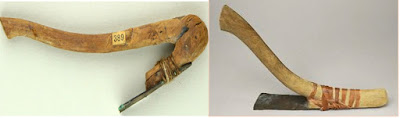
Most ancient ship builders used the adze, which is still used by old Omani shipwrights in Arabia today. Both ancient and modern adzes are hafted upon essentially the same patter—a short curved haft, the shape of which is sufficiently well indicated below, which was made of whale’s rib, deer antler, or shaped wood, as a sturdy tree branch.
 The shipwright's adze is lighter,
and more versatile than the carpenter's adze, and designed to be used in a
variety of positions, including overhead, as well as in front on waist and
chest level. It is imperative that the blade be extremely sharp, and the handle
be the right length for the person using it, and one who is experienced using
this tool can shape a piece of wood as easily as a baker ices a cake.
Anciently, this took was almost used solely in all kinds of carpenter work, but
especially by shipwrights in building boats and ships.
The shipwright's adze is lighter,
and more versatile than the carpenter's adze, and designed to be used in a
variety of positions, including overhead, as well as in front on waist and
chest level. It is imperative that the blade be extremely sharp, and the handle
be the right length for the person using it, and one who is experienced using
this tool can shape a piece of wood as easily as a baker ices a cake.
Anciently, this took was almost used solely in all kinds of carpenter work, but
especially by shipwrights in building boats and ships.
It is also important to keep in mind that the adze was a household tool for any worker and would have been found on Lehi’s farm outside of Jerusalem, and obviously used by Nephi and Sam as well as Laman and Lemuel in their work around the farm in any type of wood working. To think that ancient man in such a farm situation for much of their lives would not know how to use such tools, as well as forging knowledge at least in the making of tools used each day is foolhardy. There were no local Wal-Marts or Ace Hardware store--tools were hand made on the farm and used there.
It should also be understood that the Lord knew that Nephi would someday be called upon to build a ship that had to withstand deep ocean travel. During his early years, the Lord would have prepared him for that eventuality by seeing that he had the opportunity to develop such skills as would someday become necessary. Theorists seem to forget that the Lord has a Plan and operates that Plan, preparing those he needs to assist him in his work at different times well in advance so that when the time arrives, they are ready and able to carry out their roles. Moses was raised in the house of the Pharaoh for 40 years, then given another 40 years of preparation for his history changing task. Joseph Smith, and his father and those who came before underwent numerous trials in their preparation to mold him into the man needed to usher in the restoration.
When it came time for Nephi to build the ship, he was ready. He did not concern himself with how to do it or if he could, after seeing the images of the ship he was to build and how it was to be built, all he wanted to know was where the ore could be found to make the tools (1 Nephi 17:9) “to construct the ship after the manner which thou hast shown unto me?” (emphasis added).
This was not a new idea to Nephi. He had earlier been given a vision which he asked to see. As he stated: “For it came to pass after I had desired to know the things that my father had seen, and believing that the Lord was able to make them known unto me, as I sat pondering in mine heart I was caught away in the Spirit of the Lord, yea, into an exceedingly high mountain, which I never had before seen, and upon which I never had before set my foot” (1 Nephi 11:1, emphasis added).
While there is no question that a person needs to have the skills needed in which to carry out the instruction of the Lord, he also can develop or increase his ability, by seeing exactly how it is to be done. As any communication expert today knows, a picture is worth a thousand words--and to the prophet, a vision is worth a thousand pictures.
 The Lord did not just tell Nephi how
to do something, as so many theorists seem to think, but he “showed” him all
the things he had to do to build his ship. While Nephi had no knowledge of
building a ship, he did have knowledge and experience in building around his
father’s farm the items that such a farm requires. And though he may not have known why he was learning such skills, the Lord certainly did and made sure he had
ample opportunity to hone those building skills to the point that would be
needed.
The Lord did not just tell Nephi how
to do something, as so many theorists seem to think, but he “showed” him all
the things he had to do to build his ship. While Nephi had no knowledge of
building a ship, he did have knowledge and experience in building around his
father’s farm the items that such a farm requires. And though he may not have known why he was learning such skills, the Lord certainly did and made sure he had
ample opportunity to hone those building skills to the point that would be
needed.
But theorists always miss the point. As Potter and Wellington argue: “One could argue that it was no problem at all for the Lord could have simply supplied Nephi with all the materials, knowledge and skills he needed on request. We refer to this as the “storybook” version of Nephi’s ship. It is a scenario that we think grossly misrepresents how the Lord deals with his faithful servants and significantly undervalues what Nephi actually accomplished through applied faith and works, and it also leads to a mythological rather than factual understanding of the Book of Mormon. Besides, the storybook version makes no sense. If the Lord simply wanted to supply everything for Nephi, one miracle after another, why build a ship in the first place? Why not have them walk across the ocean?”
Such simplicity not only misses the point, but in and of itself ignores the training and development the Lord places in the path of those he needs to serve him in certain ways. When I was called to be on a stake high council right after being married, I didn’t even know what a high council was or how it operated—much to my chagrin because of the many protocol mistakes I initially made—let alone what work they did other than give talks in Sacrament meeting once in a while. But I had been prepared by the Lord to do certain things and develop certain skills which the Stake Presidency needed and utilized through me. And so it is with those the Lord calls.
He knew what Nephi would be required to do, knew what skills and abilities he would need, and knew He had a willing subject with which to teach in his developing years around his father’s farm. By the time those skills were needed, they were available, and with Nephi’s extremely positive attitude and trust in the Lord, he carried out his responsibilities without the need for outside help.
(See the next post, “Did Nephi Have Help Building His Ship? – Part III,” for more information on this and a clearer understanding of why Nephi did not need outside help or assistance in building his ship)
Nephi built his ship after the manner the Lord showed him. He mentioned no outside help, other than those of his family. After all, if Nephi was being shown by experienced shipwrights who were doing the technical work as Potter and Wellington claim, then why did Nephi’s brothers rebel as Nephi said: “And thus my brethren did complain against me, and were desirous that they might not labor, for they did not believe that I could build a ship; neither would they believe that I was instructed of the Lord” (1 Nephi 17:18). Surely that would have made no sense if there were experienced ship builders giving the instruction and showing how it should be done.
Isn’t it about time to accept the scriptural record the way it is written and not try to add things that are not included? It matters little what the common man can do, but what the common man can do with the help and aid of the Lord. Nephi’s experience, rather than to be belittled in such a manner, should be seen in the light of his great achievement under the tutelage of the Lord—a guidepost for us all!
One of the more important things that had to be achieved in the building of his ship was for Nephi to make sure the planks of the ship were joined with such exactness as to prevent leaks.

Left: Oldest wood plane found, dated to the early Roman period and made
of wood with a metal blade; Right Top: Egyptian plane; Right Bottom: Later
early planes of Europe
It might be of interest to note that ancient wooden planes for smoothing wood planks has been in existence since B.C. times—exact tools with iron sole plates riveted to the wooden bodies, though most Roman planes were constructed of an iron cutter with a wooden body, push bar and wedge very similar to planes used today. Earlier Egyptian planes and other hand tools have also been found, along with the ancient adze, which early shipwrights used almost exclusively in building their small dhows.

Left Top: Hafted jade adz; Top Right: Hatchet hafted as an adz; Left
Bottom: Hafted bone and stone adz; Hafted bone and iron adz
Most ancient ship builders used the adze, which is still used by old Omani shipwrights in Arabia today. Both ancient and modern adzes are hafted upon essentially the same patter—a short curved haft, the shape of which is sufficiently well indicated below, which was made of whale’s rib, deer antler, or shaped wood, as a sturdy tree branch.
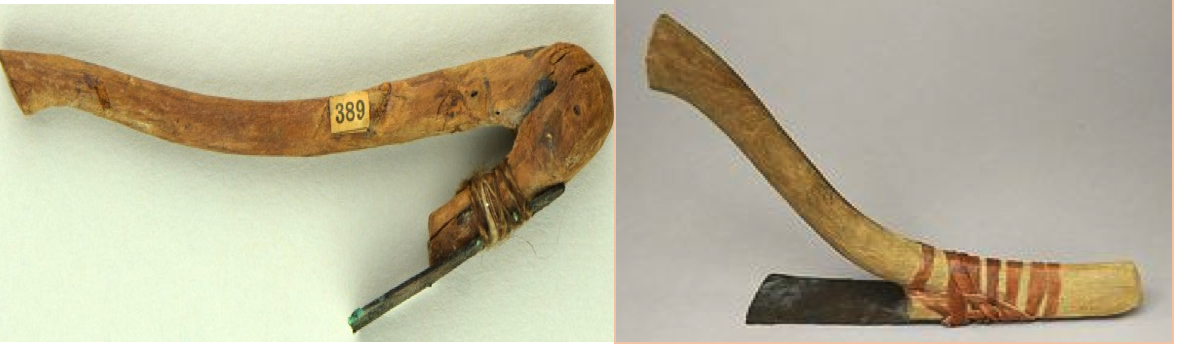
Ancient Egyptian adzes dating
to 2000 to 1500 B.C.
It is also important to keep in mind that the adze was a household tool for any worker and would have been found on Lehi’s farm outside of Jerusalem, and obviously used by Nephi and Sam as well as Laman and Lemuel in their work around the farm in any type of wood working. To think that ancient man in such a farm situation for much of their lives would not know how to use such tools, as well as forging knowledge at least in the making of tools used each day is foolhardy. There were no local Wal-Marts or Ace Hardware store--tools were hand made on the farm and used there.
It should also be understood that the Lord knew that Nephi would someday be called upon to build a ship that had to withstand deep ocean travel. During his early years, the Lord would have prepared him for that eventuality by seeing that he had the opportunity to develop such skills as would someday become necessary. Theorists seem to forget that the Lord has a Plan and operates that Plan, preparing those he needs to assist him in his work at different times well in advance so that when the time arrives, they are ready and able to carry out their roles. Moses was raised in the house of the Pharaoh for 40 years, then given another 40 years of preparation for his history changing task. Joseph Smith, and his father and those who came before underwent numerous trials in their preparation to mold him into the man needed to usher in the restoration.
When it came time for Nephi to build the ship, he was ready. He did not concern himself with how to do it or if he could, after seeing the images of the ship he was to build and how it was to be built, all he wanted to know was where the ore could be found to make the tools (1 Nephi 17:9) “to construct the ship after the manner which thou hast shown unto me?” (emphasis added).
This was not a new idea to Nephi. He had earlier been given a vision which he asked to see. As he stated: “For it came to pass after I had desired to know the things that my father had seen, and believing that the Lord was able to make them known unto me, as I sat pondering in mine heart I was caught away in the Spirit of the Lord, yea, into an exceedingly high mountain, which I never had before seen, and upon which I never had before set my foot” (1 Nephi 11:1, emphasis added).
While there is no question that a person needs to have the skills needed in which to carry out the instruction of the Lord, he also can develop or increase his ability, by seeing exactly how it is to be done. As any communication expert today knows, a picture is worth a thousand words--and to the prophet, a vision is worth a thousand pictures.

Consider a picture of each and every step to be taken in the phrase: “And
the Lord did show me from time to time after what manner I should work the
timbers of the ship” (1 Nephi 18:1)
But theorists always miss the point. As Potter and Wellington argue: “One could argue that it was no problem at all for the Lord could have simply supplied Nephi with all the materials, knowledge and skills he needed on request. We refer to this as the “storybook” version of Nephi’s ship. It is a scenario that we think grossly misrepresents how the Lord deals with his faithful servants and significantly undervalues what Nephi actually accomplished through applied faith and works, and it also leads to a mythological rather than factual understanding of the Book of Mormon. Besides, the storybook version makes no sense. If the Lord simply wanted to supply everything for Nephi, one miracle after another, why build a ship in the first place? Why not have them walk across the ocean?”
Such simplicity not only misses the point, but in and of itself ignores the training and development the Lord places in the path of those he needs to serve him in certain ways. When I was called to be on a stake high council right after being married, I didn’t even know what a high council was or how it operated—much to my chagrin because of the many protocol mistakes I initially made—let alone what work they did other than give talks in Sacrament meeting once in a while. But I had been prepared by the Lord to do certain things and develop certain skills which the Stake Presidency needed and utilized through me. And so it is with those the Lord calls.
He knew what Nephi would be required to do, knew what skills and abilities he would need, and knew He had a willing subject with which to teach in his developing years around his father’s farm. By the time those skills were needed, they were available, and with Nephi’s extremely positive attitude and trust in the Lord, he carried out his responsibilities without the need for outside help.
(See the next post, “Did Nephi Have Help Building His Ship? – Part III,” for more information on this and a clearer understanding of why Nephi did not need outside help or assistance in building his ship)
Subscribe to:
Posts (Atom)


