Saturday, March 24, 2018

Know the meaning of all things

After Lehi left his home at Jerusalem and took his family into the wilderness, “he came down by the borders near the shore of the Red Sea; and he traveled in the wilderness in the borders which are nearer the Red Sea” (1 Nephi 2:5), and after three days of traveling there, he “pitched his tent in a valley by the side of a river of water” (1 Nephi 2:6), and named them the Valley of Lemuel and the River of Laman (1 Nephi 2:8). There he stayed for upwards of two years, while sending his sons back to Jerusalem “to the house of Laban” to obtain the Brass Plates.
Nephi and his brothers return to Lehi’s tent in the wilderness with the brass plates, having been gone a sufficient time to fill their mother with dread that they had been killed during the trip

Then later, sending them back again to “the land of Jerusalem,” to Ishmael’s house “to bring down Ishmael and his family into the wilderness” (1 Nephi 7:2).
    Before leaving the Valley of Lemuel, when they “took up the tent and departed into the wilderness, across the river Laman” (1 Nephi 16:12), Nephi asks to see the visions his father had earlier and discussed with his family. During that exchange with an angel as Nephi sees the birth of the Savior, the angel asks him if he “Knowest thou the condescension of God?” to which Nephi replied, “I know that he loveth his children; nevertheless, I do not know the meaning of all things” (1 Nephi 11:16-17).
    It seems safe for those of us who study the geography of the Book of Mormon to also say, that we “do not know the meaning of all things.” As an example, we have been ridiculed by some when we have stated that the word “river” in connection with the Sidon, is not mentioned after the great destruction that occurred in 3 Nephi, nor do we read about the Sea East after that event, though it is mentioned often before that time, and suggest that it no longer existed. There has been such criticism even though it so clearly states that “the whole face of the land was changed” (3 Nephi 8:12); “the face of the whole earth became deformed” (3 Nephi 8:17), and “the rocks were rent in twain; they were broken up upon the face of the whole earth, insomuch that they were found in broken fragments, and in seams and in cracks, upon all the face of the land” (3 Nephi 8:18).
    Of course, we do not know that the River Sidon was diverted, or that it no longer flowed in the same course, nor do we know that the Sea East no longer existed. Yet, there is sufficient cause to consider these points. For those who claim otherwise, we might repeat Nephi’s comment: “I do not know the meaning of all things.”
Samuel prophesied that valleys would become mountains “whose height is great”

After all, when we learn that “the earth was carried up upon the city of Moronihah that in the place of the city there became a great mountain” (3 Nephi 8:10), or that “mountains tumbled into pieces and the plains of the earth were broken up” (1 Nephi 12:4), and that “there shall be many mountains laid low, like unto a valley, and there shall be many places which are now called valleys which shall become mountains, whose height is great” (Helaman 14:23), we ought to at least back up from our contrary thinking and consider what all that would mean in real facts. Take as an example, that rivers flow from mountain heights toward lowlands and the sea, but if you remove those mountain heights, what happens to the rivers? Obviously, they are going to be affected by the change.
    What of a sea? When cities sink into the ground and waters flow in to fill the void, when continents rise and inner seas are formed, and when those inner seas eventually drain toward the lower lands and the receding seas, what happens to the inland water ways? Obviously, there are going to be changes.
    However, John L. Sorenson, in his book An Ancient American Setting for the Book of Mormon, on pages 45-46, states “The volume itself says that the changes at the Savior’s death were mainly to the surface…Thus the record itself gives no justification for supposing that the form or nature of the land changed in any essentials.” Yet, when Samuel the Lamanite is describing this coming destruction, which words the Lord put into his heart to speak (Helaman 13:5), he describes that destruction as not just surface, but says: “the rocks which are upon the face of this earth, which are both above the earth and beneath, which ye know at this time are solid, or the more part of it is one solid mass, shall be broken up… they shall be rent in twain, and shall ever after be found in seams and in cracks, and in broken fragments upon the face of the whole earth, yea, both above the earth and beneath” (Helaman 14:21, emphasis added).
    Samuel is being told by the Lord to tell the people that at the time of the Lord’s crucifixion, the solid rock beneath the Earth will be broken up into fragment beneath the Earth! One can only imagine what destruction to the Earth itself that would cause, for the rock foundation of the surface to be broken into fragments beneath the surface. In fact, mountains will disappear and lowland valleys will be raised into very high mountains. That alone should suggest a tremendous change in topography. Think of it. What if Salt Lake Valley was changed into a series of high mountains whose height was great. Wouldn’t that change the view of the entire area for many miles around, and wouldn’t that be very noticeable?
The city of Gilgal have I caused to be sunk, and the city of Gadiandi, Gadiomnah, Jacob, and Gimgimno have I caused to be sun, and made hills and valleys in thei places thereof; and the earth was carried up upon the city of Moronihah that in the place of the city there became a great mountain

Samuel then said that the angel told him that “many shall see greater things than these” (Helaman 14:28). What greater things could we expect to see across the land greater than mountains collapsing into level valleys and other valleys rising into very high mountains?

Does this sound like a cosmetic or just a surface change? Cities would sink into the ground and cease to exist, the course of rivers from the collapse of mountains and the rise of new ones, would change courses, coastlines would change and be altered. And this would take place “on all the face of this land” (Helaman 14:28). And after all this destruction, the disciple Nephi wrote: “And the earth did cleave together again, that it stood” (3 Nephi 10:10).
    Now in order for the Earth to “cleave together again,” it had to have been taken apart, or as Webster put it in 1828, “to part or divide by force, so split apart, to part or open.” This means the Earth was divided by force, split apart, opened up during this destruction, and then put back together again that it stood, meaning that it was placed back into its spherical condition after being taken apart or divided by force.
    It can hardly he said, then that this was basically a surface or cosmetic event.
    It would appear then, that theorists such as Sorenson and others who think such activity as described in the scriptural record was merely a simple and overall meaningless event that had no ongoing emphasis, simply misunderstand the levels of meaning that the Book of Mormon conveys of the events that took place within its writings. That the Earth was, at least in the area of the Land of Promise, completely changed, resulting in a difference, perhaps drastic, of the topography and geography, is more supportive of the scriptural record and its meaning than someone’s opinion to the contrary.
    That Mormon 350 years later understood the topography of the Land of Promise does not suggest that it wasn’t changed during the crucifixion, only that Mormon, having a complete written record of the geography before and after the event, understood the placement of both geographical states. If we are going to know and understand the meaning of all things, or at least of the scriptural record of the Book of Mormon, then perhaps we need to be less adamant of old paradigms developed in the past by the opinions and beliefs of less knowledgeable writers, and more aware of what better and more accurate understandings that have taken place since, that have resulted from more expansive knowledge and research.
    One thing seems certain and that is just because one man created a Mesoamerican Model idea seventy-two years ago when he opened up the Archaeology Department at BYU, does not mean it is accurate today, especially in light of all the advanced knowledge that has been acquired about other areas that far better meet the ancient scriptural description than does Jakeman’s Maya and Guatemala theme.

Friday, March 23, 2018

The Marrying of Lehi’s Sons – Part II

Continued from the previous post regarding the marrying of Lehi’s sons under the understanding of ancient Judaic laws and customs. 
    Another very important point about Hebrew customs and one that explain why Ishmael was willing to go into the wilderness with Nephi and his brothers and follow them down to Lehi’s tent and commit himself to a nomadic existence. That custom was called lâqach, “taking a wife” לָקַח (Genesis 6:2; 11:29). When a girl was chosen to be the wife of a young man, the fiancé was expected to pay a mohar or sum of money to the bride’s father or even to the bride herself. This involved mattan מתן, meaning “to give” as in a “marriage gift” (Genesis 34:12) or “presents” (Proverbs 18:16), sometimes called mohar מֹ֫הַר, meaning “dowry,” “wedding money” or “bridal payment” (Exodus 22:17; 1 Samuel 18:25), the dowry provided a prospective wife by the groom.
The future Patriarch, Jacob, meets Rachel at the well. She was Jacob’s mother’s niece, daughter of her brother, Laban, and the future wife of Jacob and mother of Jacob’s favorite son, Joseph

In ancient Israel, one of its functions was compensation to her family for loss of valuable services that she gave by tending flocks or working in the fields, another was to serve as a form of protection for the wife against the possibility of ill treatment by her husband and his family, with whom she was expected to reside. When the exchange entailed the provision of labor to the bride’s family, such as in the case of Jacob working for Leah (Genesis 29:17), and then longer for Rachel, it was known as “bride service” (Genesis 29:18).
    When sons in a Hebrew family were to marry, their wives were chosen by their parents. In choosing a wife for a son, as is still the custom in some places even today, particularly among Arabs in certain Bible lands; love and romance came second at best, especially to patriarchal desire or parental arrangement. In fact, all the specific arrangements for a Kiddushin (betrothal) were handled by the parents of the bride and groom (Gen 21:21; 24:2-5; 27:46).
    By New Testament times there were usually three steps in marriage among the Jews. 1) First, there was the engagement, which could be made even if the couple were only children. The match might be arranged by the parents themselves or by a professional go-between. Often the couple involved had never seen each other. This fact may astonish young people today, but marriage was looked upon as a very serious step and not as something to be left to human passion and hasty action;
2) Second, there was the betrothal. In this step the engagement would be ratified unless the girl was unwilling to accept it. But if she accepted it, the Jews regarded the betrothal as absolutely binding. For at least one year and sometimes much longer, the couple were regarded as man and wife but without the rights of marriage itself. Betrothal could be terminated only by divorce; and
3) Third, the marriage proper took place after the period of betrothal. This involved the groom preparing the Chuppah, or bridal chamber within his father’s house (or tent).
It was custom for the groom to show up to receive the bride at midnight, and it was necessary for the bride to have her oil lamp burning all the time in anticipation of this event, the “coming of the bridegroom.” To insure this, it was common for the groom to send a chaperone or servant to keep an eye on her, to insure that she would be cared for and watchful for the return of the groom. Thus we see in this practice the Lord’s parable of the ten virgins and their oil lamps.
    While, anciently romance as we depict it in the Western world, could be involved, it was not necessarily a factor in the marriage match (Genesis 29:20; Judges14:1-2; 1 Samuel 18:20), it was actually more about maintaining the tribal name and the land associated with the name. The reason was simple. The land of Israel had been apportioned among the tribes and then within each tribe further apportioned to the clans. In fact, For all Israelites God required that no marriage cause property to transfer from one tribe to another, as illustrated in the ruling given for the daughters of Zelophehad (Numbers 36:6-9).
    Marriage, then, often began with match-making, called shiddukhin or a "marriage proposal." The initial proposal could come from the prospective groom (chatan), but more often it came anciently from the father of the groom. Once an agreement was made between both fathers (of the groom and bride), the Kiddushin (Betrothal) was in effect. Since the word also meant "sanctification," from that point the woman belonged to the man. The word kiddushin comes from the same root word as kadosh ("holy"). Just as kodesh (holy things) are forbidden to all but those for whom they are designated, so too does this woman become forbidden to all men but to whom she has now been designated. Betrothal made the woman a legal wife and her status could only be changed by divorce or death. Betrothal was usually accomplished by the groom giving a coin or ring to the prospective bride and her acceptance of the token accomplished kiddushin. It should be noted, of course, that under Judaic law, the Ketubot (the actual marriage) would not take place without the consent of the bride (Genesis 24:58; 1 Corinthians 7:39).
    The betrothal generally occurred long before the actual marriage took place. Both fathers were interested at the early ages of their children to secure favorable marriages for them, especially fathers of sons, and such betrothals took place long before the children were of a marrying age.
    Prior to Moses a man would take a wife at will by obtaining her consent and then taking her into his tent or house and having intercourse in private. From that point on she was his wife (Genesis 25:1; 38:1-3; Exodus 2:1). With the introduction of kiddushin or betrothal, a man would acquire the bride of his choice in the presence of witnesses (Ruth 4:9-11). According to the Mishnah (Kidd. 1:1), a woman could be acquired in marriage in three ways: by money or its equivalent (Genesis 29:18; 34:12), by deed (Genesis 24:3-4; Judges 14:2), or by intercourse (Deuteronomy 22:28-29). A Ketubh, a contract or deed was almost always involved because marriage included a transfer of property.
    Consequently, in returning to Lehi and Ishmael, and understanding that Lehi’s two oldest daughters married Ishmael’s two sons as was written, according to Joseph Smith, in the lost 116 pages of the Book of Lehi (Journal of Discourses, Vol 23, p184; Improvement Era, September 1953, pp9-11), we can imagine that Lehi and Ishmael also contracted with one another for Lehi’s sons to marry Ishmael’s four youngest daughters, since the oldest was evidently too old for Lehi’s sons to be betrothed to, or perhaps there was some other reason that made her unsuitable for Laman or Lemuel as the oldest sons of Lehi, yet within an age for Zoram, whose age is not given, but was a trusted servant of Laban, believed to have been a near kinsman of Lehi’s wife, Sariah.
    The fact that Zoram married Ishmael’s oldest daughter (1 Nephi 16:7) might well suggest that the reason the older sons of Lehi had not yet married, though they were around that age, was that none had been betrothed to Ishmael’s oldest daughter, and it had long been the custom under Judaic Law and Hebrew custom for the younger daughter not to marry until the older one had been married, as is found in the story of Jacob, Leah and Rachel.
Notice how quickly the two daughters of Ishmael attach themselves to Laman and Lemuel in their revolt against Nephi upon going into the wilderness with the family. As Nephi put it no sooner had they left Ishamel’s house that: “And it came to pass that as we journeyed in the wilderness, behold Laman and Lemuel, and two of the daughters of Ishmael, and the two sons of Ishmael and their families, did rebel against us; yea, against me, Nephi, and Sam, and their father, Ishmael, and his wife, and his three other daughters” (1 Nephi 7:6, emphasis added). And note, too, that one of those daughters who did not rebel against Nephi in that early incident, also stood up for him when a second incident occurred moments later: “And it came to pass that they were angry with me again, and sought to lay hands upon me; but behold, one of the daughters of Ishmael, yea, and also her mother, and one of the sons of Ishmael, did plead with my brethren, insomuch that they did soften their hearts; and they did cease striving to take away my life” (1 Nephi 7:19, emphasis added).
    For some reason, explainable only by the fact that these daughters and Lehi’s sons had already been aligned in pairs, Ishmael’s daughters were almost immediately on the side of certain of Lehi’s sons. It should also be noted that not long after they reached Lehi’s tent near the Red Sea, and after several chapters of Lehi and Nephi preaching to Laman and Lemuel and Nephi describing his visions, we find the couples pairing off in marriage. Nephi states: “And it came to pass that I, Nephi, took one of the daughters of Ishmael to wife; and also, my brethren took of the daughters of Ishmael to wife; and also Zoram took the eldest daughter of Ishmael to wife” (1 Nephi 16:7, emphasis added).
    Of Nephi’s wife, it could be said that she was likely the youngest of Ishmael’s daughters, she suffered all things save death (1 Nephi 17:20) during the eight-year trek in the wilderness, she suffered along with the others, extreme hunger, thirst, fatigue, sickness, heartache, grief, loss and every other imaginable hardship, and in doing so became strong, like unto a man, and bore her journeying without murmuring (1 Nephi 17:1-2). Her one indiscretion was when she murmured along with the rest of her family at her father’s death and wanted to return to Jerusalem. She repented of this and never again complained, and when the Lord told Nephi to flee his older brothers who sought his life, she and their children went with Nephi and were among the righteous members of “those who went with him.”
    It is always such in ancient Hebrew writings that we know very little about the women of the time, and especially the wives and mothers of the great men described, but those women were obviously just as great and accomplished, and were every bit the equal of their husbands.
    According to Hugh Nibley, It should be noted that Nephi takes Ishmael, unlike his interaction with Zoram, completely for granted that he and his family would go with him down to his father’s tent, never explaining to him how he fits into the picture. Both the act of Lehi sending for Ishmael and he going into the wilderness with Nephi seems to be the most natural thing in the world, as does the marriage of his daughters with Lehi’s sons (Lehi in the Desert: The World of the Jaredites vol.5, The Collected Works of Hugh Nibley, Deseret Book, Salt Lake City,1988, p40). In addition, as Nibley concludes: “Since it has ever been the custom among the dessert people for a man to marry the daughter of his paternal uncle (bint ‘ammi), it is hard to avoid the impression that Lehi and Ishmael were related.”
    Thus, we can see why, assuming that these facts are correct, that Lehi’s sons were so happy about going back to get Ishmael and his family, why Nephi thought it a natural event, and why Ishmael readily agreed to follow Lehi. The two families were interminably connected, and where Lehi was, Ishmael knew he had to be for the contract of his daughters to be realized.

Thursday, March 22, 2018

The Marrying of Lehi’s Sons – Part I

As covered in the last two posts regarding the ages of Lehi’s Family, we need to extend that understanding to include why Ishmael followed Nephi into the wilderness and down to Lehi’s tent near the Red Sea. Such an act would seem, on the surface, to be unwarranted and provide fodder for critics of then Book of Mormon. However, when considering the manners and customs of the Hebrews, where the ideal family was large and patriarchal, wives lived in their mother-in-law’s home (or tent), and life was built around the outdoors, which is typically quite difficult for the average Westerner (European, American, etc.) to fully comprehend. 
   In fact, the well-traveled English journalist, author and poet, Joseph Rudyard Kipling, who was born in Bombay, grew up in India, England and for a time in the United States (the latter a people he forever considered “foreigners”), and lived his later life in Sussex, wrote in his poem “The Ballad of East and West, “Oh, East is East, and West is West, and never the twain shall meet”, suggesting, among other things, that those from the east are quite different from those from the west. “And never the twain shall meet,” or never the two meet, or see eye-to-eye on matters, is often borne out through a study of Hebrew manners and customs certainly bears this out.
The Middle East

Thus, we should keep Kipling’s saying in mind when we read the scriptures, for they were not written by Westerners, but by Orientals in the Middle East. As Sidney B. Sperry, Professor of Old Testament Languages and Literature at Brigham Young University, wrote in “Hebrew Manners and Customs,” Ensign Magazine, May 1972, “The Bible is actually an Oriental book. It was written centuries ago by Oriental people and primarily for Oriental people.”
    As we all know, the New Testament has come down to us in Greek, a European, western language; but, as Sperry insists: “Jesus and his apostles were Oriental, and they spoke in Aramaic, an Oriental tongue. Not only should we know something about the language of the Bible, but we should also know something about the manners and customs of its peoples if we are to understand it properly.”
    Since the Nephites wrote and spoke Hebrew, it is helpful, sometimes necessary, to understand the difference in this way of speaking and writing from our own. As an example, in thought and speech the Oriental is an artist, often speaking and writing in figurative language, painting a scene that is in effect true, but the details may be inaccurate, while the Occidental or Westerner, speaks and writes more literally, being like the architect, building one factual idea on top of another.
    To illustrate this, when the Lord said of the mustard seed that it was “less than all the seeds that be in the earth,” and the plant as “greater than all herbs” (Mark 4:31-32), we gain an understanding of what he meant—however, as any botanist knows, the mustard seed (black mustard seed [Brassica nigra], brown Indian mustard seed [Brassica juncea], or white mustard seed [Brassica hirta/Sinapis alba]), the latter of which Jesus spoke, though small, is not the smallest of all seeds, nor is the plant greater than all herbs. However, the Lord’s statement is completely understood for the intent of its meaning. It is just not the way a Westerner would think to speak, but would likely say something like: “Note the tiny mustard seed that grows into a large bush, with long, sturdy branches on which the birds can perch.”
    Many ancient manners and customs still exist in the Middle East, especially among then Bedouin and Jewish nomadic people, some of which still live in tents. Western sheepmen drive their sheep before them, and are called sheepherders. Oriental sheepmen lead their sheep and are called Shepherds, for theyh “called his own sheep and goeth before them and the sheep follow him, for they know his voice (John 10:3-4). And there is no question that Western newlyweds try to set up their own home as soon as possible after marriage; however, an Eastern couple follow the ancient pattern of living with the groom’s family.
The Household of Abraham as they caravan across the Valley of Shaveh. A wealthy man and prophet with a sizeable household of family and servants, Abraham chased not after wealth but after the Lord and became the “father of many nations”

In fact, the ancient Hebrew family was patriarchal by nature and the term used to describe it was beth’ab, the “house of one’s father,” who was the supreme authority over the family. In fact, “the family” also included non-blood relations who had entered into a covenant relationship (such as Zoram when he joined Lehi’s family), not to mention servants and retainers, such as those of Abraham’s house from whom he assembled 318 servants who were trained warriors to rescue Lot and his entire household from Chedorlaomer and the Elamite army.
    The Hebrew father was the supreme authority over the family and in earlier times, the father’s authority even included power over life nd death. Throughout Biblical history, when the father’s children grew older and his sons married, they and their children came also under his control.
    The Hebrew family was also known as a house. The founding of a family was to build a house. The use of the term house was very flexible and could include the entire nation (the house of Jacob or the house of Israel) or a segment of the people (the house of Judah or the house of Joseph).
    In Hebrew, the word “beth” ב, means “house or habitation,” “tent,” or “place.” The Hebrew family was also known as a house since the founding of a family was to build a house (not a structure), and as stated earlier, the father of the house or family administered justice between household members, and his words were not to be disputed. It is the reason that though Laman and Lemuel complained bitterly throughout most of their eight years of travel and time at Bountiful, in the end they were always obedient to their father’s position and place in their midst.
    It is interesting to note that along this vein, most of the complaints of Laman and Lemuel was directed toward Nephi (and by extension, to Sam), but not to Lehi, their father. Their murmuring toward Lehi was mostly that he was a visionary man and had taken hem out of the land of Jerusalem, leaving the land of their inheritance, and their gold, etc. (1 Nephi 2:11). Their murmuring was based on their not knowing the dealings of God, who had created them. But the threatenings, they directed at Nephi and anyone who spoke for him (1 Nephi 18:17).
    Normally, children and the entire household were expected to be obedient and reverent to the father, and sons did not sit in the presence of their father without an invitation, nor did they express opinions without permission.
    In the first four chapters of the second book of Nephi, we find Lehi preaching to each of his sons, the sons of Ishmael, and others, about the promises of the Lord, and calling his sons and those of Ishmael to repentance, and how they should conduct their lives, all without an utterance of objection or discord from anyone. But after Lehi’s death (2 Nephi 4:12), Nephi states that he “did cry much unto the Lord my God, because of the anger of my brethren. But behold, their anger did increase against me, insomuch that they did seek to take away my life” (2 Nephi 5:1-2).
    It should also be noted that after a father died, his place was usually taken over by the eldest son, who then became the father of the whole household, including its aged members. Unless he proved unworthy of his position, he received all the rights, loyalty, and privileges of his father before him. However, there are cases cited in the Bible where the father has designated a successor other than his oldest son. For instance, Joseph became the father of the tribes in Jacob’s stead after Reuben had proved unworthy, and Solomon was appointed by David to be his successor, and Nephi became the leader of the posterity of Lehi, a fact which angered the descendants of Laman and Lemuel throughout the history of the Book of Mormon.
(See the next post, “The Marrying of Lehi’s Sons – Part II,” for more on the customs and manners surrounding the marriage covenant in ancient Israel and among the sons of Lehi)

Wednesday, March 21, 2018

Importance of the Ages of Lehi’s Family – Part II

Continuing from the previous post regarding the age of Nephi, both when he left Jerusalem and when he arrived in the Land of Promise, and its importance in better understanding the scriptural record and these events.
These events, of convincing Ishmael the Lord wanted he and his family to join Lehi in the desert; presenting their father’s wealth to the powerful Laban; the moral difficulty in killing Laban; and the overpower of Zoram are all incidents of a much more mature and knowing individual than a young teenager

Thus, as stated in the previous post, Nephi would have been 22 when he left Jerusalem. This fits better with the events that took place. However, some theorists claim he was “young in age,” but Nephi does not say that.
    His statement is: “And it came to pass that I, Nephi, being exceedingly young, nevertheless being large in stature, and also having great desires to know of the mysteries of God, wherefore, I did cry unto the Lord” (1 Nephi 2:16, emphasis added). Now “being young” is not necessarily the same as “being a young age.” We need to keep in mind that Nephi is writing this some thirty years after the events.
    In fact, Nephi tells us: “And thirty years had passed away from the time we left Jerusalem. And I, Nephi, had kept the records upon my plates, which I had made, of my people thus far. And it came to pass that the Lord God said unto me: Make other plates; and thou shalt engraven many things upon them which are good in my sight, for the profit of thy people” (2 Nephi 5:28-30). Consequently, the “kept the records upon my plates,” refers to the Large Plates, from which Joseph Smith first translated and Martin Harris recorded and then lost those 116 pages. The “other plates” Nephi mentions were the Small Plates that the Lord told him to later make “for a wise purpose,” from which the Book of Mormon (1 Nephi through Omni) were eventually translated.
    So Nephi would have been about 52 when he wrote the statement “being exceedingly young.”
    First of all, a mid-teen seldom has “great desires to know of the mysteries of God.” This usually comes with age. Secondly, and most importantly to interpreting this passage correctly, when we are older, we often see age very differently than when we were young. As an example, when I was 37 years old, I was called to be a Bishop. At the time, I was married and had four children, ages 9 down to 3, with the fifth child born a month after being called. At the time I’m sure I considered myself a mature adult; however, some thirty years later, I remember thinking back while updating my personal history, I realized that I was extremely young when serving as a Bishop.
    It is all a matter of perspective.
    However, if that is not sufficiently significant, then consider Nephi’s own words when he described himself a few days later: “And now I, Nephi, being a man large in stature, and also having received much strength of the Lord, therefore I did seize upon the servant of Laban, and held him, that he should not flee” (1 Nephi 4:31, emphasis added).
    It is one thing to be large in stature (how large and strong would a teenager be compared to a man in his twenties who would know much better how to use his strength and leverage), but something else entirely to be confident enough to use that strength to overpower the adult Zoram both physically, and to out-think and out-maneuver him mentally by convincing Zoram that he, Nephi, was indeed the servant’s well known master (1 Nephi 4:20-27).
    Yet, despite Nephi’s strength and stature, he could not withstand the ability and strength of his older brother, Laman, who on more than one occasion overpowered him, tied him up, and was on the verge of killing him. Obviously, Laman felt completely capable of taking care of his youngest brother, though Nephi was “large in stature,” and physically capable of subduing an adult man like Zoram. This should suggest that while Nephi was old enough at 22 to have the wits and confidence to impersonate Laban (which he most likely would not have had as a young teenager), he did not have the knowledge and experience to stand up to his older brothers (1 Nephi 7:16; 17:48; 18:11).
A final comment about this is in the fact that under Judaic custom, for a man to marry at an early age was unthinkable, since he had no way of supporting his wife. To marry as a teenager was simply unheard of and there is no way Nephi would have been of a marrying age under twenty, let alone at 13 or 15 or even 18 in that day. To think that Nephi was 13 or a teenager when he left Jerusalem and married within two years would be unthinkable to a Hebrew of the time. He would have to have been somewhere around at least 20 or older when he left Jerusalem. And being that age or older makes the rest of the events, his thinking and actions, more realistic and understandable.
    It should also be noted that when Lehi sent his sons back to get the Brass Plates from Laban, it was to Nephi he spoke of the event and its importance, and that the Lord commanded it (1 Nephi 3:2-8). Again, under ancient Judaism laws of Primogeniture, the role of the firstborn son carries significance (it is compared to the redemption of the firstborn son of God), with the masculine noun bekhor, meaning “firstborn son,” and stands for “birthright,” related to primogeniture wherein the firstborn son was “the father’s favorite,” entitled to a double portion, and the rightful leader in the family after the father. In fact, when the father died, his place was almost always taken over by the eldest son, who then became the father of the whole household, including its aged members. Unless he proved unworthy of his position he received all the rights loyalty, and privileges of his father before him.
    Thus, under all normal circumstances, Lehi would have told this information and given this direction to go back and obtain the Brass Plates to his oldest son, Laman, not to Nephi, especially a 13 or 14 year-old Nephi. The fact that he told Nephi is significant in Lehi’s preference to his youngest son, because as he said, “Therefore go, my son, and thou shalt be favored of the Lord, because thou hast not murmured” (1 Nephi 3:6). Lehi fully understood that the Lord had chosen Nephi over his other sons, to be the leader of the nation Lehi was to establish in the Land of Promise. For this to have been the case, Nephi would have had to have been an adult and warrant the special attention and usurp the rightful position of Laman in the family order.
    Thus we can see that when the party landed on the shores of the Land of Promise, Lehi, who would have been about 63 when leaving Jerusalem, would have been about 73 upon landing and around 75 when he died; Sariah would have been about 48 when leaving Jerusalem, about 50 thru 55 when giving birth to two sons, and 58 when landing, making Jacob as old as 8 years upon landing.
    So when the family landed their ages would have been:
Lehi – 73
Sariah – 58
Sister that married Ishmael’s first son – 32
Sister that married Ishmael’s second son – 30
Laman – 28
Lemuel – 26
Sam – 24
Nephi – 22
Jacob – 6 to 8
Joseph – 4 to 6
    So when Nephi transcribed the record he kept on the Large Plates to the newly made Small Plates, he would have been about 52, Jacob 38 to 40 and Joseph 36 to 38. 
    In addition, when Nephi turned over the records to his younger brother Jacob (Jacob 1:1-2), Nephi was about 77 years old, and Jacob would have been about 61. Within a handful of years, Nephi “anointed a man to be king and a ruler over his people” (Jacob 1:9), and probably died about 80 years of age.
    It should be kept in mind that while these dates and ages fit the scriptural record, they are still assumptive in many ways and cannot be suggested to be scripturaly accurate. They do fit the narrative and the understanding of age during the time frame of the Book of Mormon according to Judaic laws and customs, as well as the events described in the scriptural record.

Tuesday, March 20, 2018

Importance of the Ages of Lehi’s Family – Part I

Much has been discussed about the age of Nephi when he left Jerusalem. Theorists have claimed anywhere from the age of 13 to being a young adult of perhaps 21. However, some of the events Nephi describes of himself, and his thoughts and abilities, do not fit the younger age limit some claim was his age. To begin with, Nephi states that he was aware that many prophets came into the land “the very same year” Zedekiah was made king in 597 B.C. at the age of 21. This means Zedekiah was born in 618 B.C.
Pastoral life, outside the city, would have been both physically taxing and mentally relaxing. It is doubtful that a young teen would have been interested in or knowledgeable about what was going on politically in the city

It would be hard to reconcile that a 13 or even 16-year-old boy living outside Jerusalem in his father’s home where Lehi “had dwelt all his days” (1 Nephi 1:4). After all, Nephi’s main interest would have been centered around his father’s farm, planting, harvesting, working, taking care of the animals, etc. It is unlikely a teenager would have been interested in the political picture taking place in the city of Jerusalem.
    Nor would a teen likely have been aware much that his father “went forth praying with all his heart in behalf of his people” (1 Nephi 1:5). Nor would he have known much about “a pillar of fire and dwelt upon a rock before him; and he saw and heard much; and because of the things which he saw and heard he did quake and tremble exceedingly” (1 Nephi 1:6). After all, teenagers are not generally that aware of anything their fathers are doing that does not related directly to themselves.
    Now, it could be argued that by the time Nephi engraved this information on the Small Plates (30 years after the events), he had read his father’s record on the Large Plates and was well aware of those early events. He does include in his own record the words “And now I, Nephi, do not make a full account of the things which my father hath written, for he hath written many things which he saw in visions and in dreams; and he also hath written many things which he prophesied and spake unto his children, of which I shall not make a full account” (1 Nephi 1:16).
    Thus, the entire first chapter of Nephi’s record on the Small Plates might well have come from Lehi’s record on the Large Plates. This is additionally shown in the next statement by Nephi: “But I shall make an account of my proceedings in my days. Behold, I make an abridgment of the record of my father, upon plates which I have made with mine own hands; wherefore, after I have abridged the record of my father then will I make an account of mine own life” (1 Nephi 1:16).
In the first year of Zedekiah’s reign as king of Judah, the Lord told Lehi to leave his home at Jerusalem and flee into the wilderness

So let us back up and consider the age and events of Lehi’s life and family to arrive at a more accurate age of Nephi. We know Lehi left Jerusalem with his family in the first year of Zedekiah’s reign as king of Judah (1 Nephi 1:4), and obeyed the Lord and departed into the wilderness (1 Nephi 2:4) with his family, “which consisted of my mother, Sariah, and my elder brothers, who were Laman, Lemuel, and Sam” (1 Nephi 2:5).
    It has been suggested by some historians that Lehi was born about 640 B.C., which would have made him 43 years old at the time he left Jerusalem in 597 B.C. If that were the case, and taking the marriage ages of the time, Lehi would have married around the age of 30, which would be about 610 B.C. (an odd age factor to our modern thinking, but necessary in that time since young men were apprenticed to their father’s to learn and develop a career, and did not marry until they had achieved the ability to support a wife through that work).
    Thus, using those ages for Lehi, we can see that Laman, the oldest son, would have been about 13 years old in 597 B.C. Obviously, that would not have been the case. Even if Lehi was born in 650 B.C., as some claim, that would have made Laman 23 years old, Lemuel 21, Sam 19, and Nephi 17.
    Now, the marrying age of women during this time was about 15, suggesting the earliest to have children would be when Sariah was 16 years of age (a difficult concept to our modern way of thinking, but none-the-less the facts of ancient Israel). That means she would have been 22 years old at the birth of Nephi, having been born about 635 B.C., 15 in 620 B.C., and 22 in 613 B.C. at the birth of Nephi.
    However, Apostle Erastus Snow said that “The Prophet Joseph Smith informed us that the record of Lehi was contained on the 116 pages that were first translated and subsequently stolen, and of which an abridgment is given us in the First Book of Nephi, which is the record of Nephi individually, he himself being of the lineage of Manasseh; but that Ishmael was of the lineage of Ephraim, and that his sons married into Lehi's family, and Lehi's sons married Ishmael's daughters” (Journal of Discourses, Vol 23, p184, emphasis added; Improvement Era 55, September 1952, pp642, 694; Answers to Book of Mormon Questions, Bookcraft, Salt Lake City, 1967, pp9-11).
    This means that Lehi had two daughters older than Laman, making Laman only 19 years old, Lemuel 17, Sam 15, Nephi 13 when they left Jerusalem if Lehi was born in 650 B.C. Again, an obviously juvenile age for Nephi.
    Consequently, we need to extend Lehi’s birth date back to at least 660 B.C., which would mean that when they left Jerusalem, Lehi’s daughters were 32 and 30 years of age, would have allowed them to have families as Nephi states (1 Nephi 7:6).
    In this case, then, Lehi would have been 63 years old in 597 B.C., the year he left Jerusalem, 71 years old when they reached Bountiful after spending eight years in the wilderness (1 Nephi 17:4-5), about 73 during the sea voyage from Bountiful to the Land of Promise. This older age would agree more with Nephi’s statement about Lehi’s age when he stated: “and my parents being stricken in years, and having suffered much grief because of their children, they were brought down, yea, even upon their sick-beds” (1 Nephi 18:17), than if he was only in his early 60s or 50s, as some theorists claim about Nephi’s age would make him. Such an advanced age also makes more sense that Lehi died about two years after reaching the Land of Promise (2 Nephi 4:12).
    It is thought by some that the two sisters that Nephi mentions (2 Nephi 5:6) were the two older sisters that married the sons of Ishmael, which means that when Nephi separated from his brothers, these wives of the sons of Ishmael left their husbands and went with Nephi. However, under ancient Hebrew/Israel law as stated in the Bible, popularly called “ketubah” or marriage contract (considered an integral part of a traditional Jewish marriage, and outlines the rights and responsibilities of the groom, in relation to the bride), it was almost impossible for a woman to get a divorce, and the women, when married, moved to the husband’s home and family, and was thereafter part of that home and family, and it was extremely uncommon for the women to return to her own father’s home.
    Thus, it would seem unlikely that these two sisters were the two that married Ishmael’s sons, had families by them, and would have been married for at least 15 years or more. This means, then, that these “sisters” who followed Nephi and “those who went with him,” including Sam, Jacob, Joseph and Zoram, would have been two other daughters of Lehi, that had gone unmentioned in the scriptural record by Nephi until this point in time.
    Thus, if Lehi was born in 660 B.C., his life might be stated in years as:
660 BC – Lehi born at Jerusalem, presumably in the family home outside the city;
630 BC – married Sariah;
629 BC – first daughter born
627 BC – second daughter born
625 BC – Laman born
623 BC – Lemuel born
621 BC – Sam born
619 BC – Nephi born
597 BC – Nephi 22 years old; Zedekiah made king; prophets preach in Jerusalem; Lehi preaches in Jerusalem and told to take family into wilderness; leaves his home and heads toward the Red Sea;
596 BC – Lehi sends sons back to Jerusalem to get Brass Plates; sends them back again to get Ishmael and his family;
595 BC – Lehi’s sons marry Ishmael’s daughters; finds Liahona; leaves Valley of Lemuel with combined families and heads down the Red Sea;
594-589 BC – Jacob and Joseph born in wilderness;
589 BC – Lehi reaches seashore and calls the area Bountiful and the ocean the Irreantum Sea;
589-588 BC – Nephi builds his ship;
587 BC – Lehi preaches to his sons; Lehi dies;
586 BC – Nephi leaves brothers and area of First Landing with “all those who would go with him; reaches area they called Nephi and settles down and builds the City of Nephi. This is the same year that Zedekiah’s reign as king ends, his sons are captured and killed before him and he is blinded and taken captive by Nebuchadnezzar; Mulek escapes Jerusalem (Omni 1:15) and is led by the Lord to the Land of Promise where he settles in the land later called Zarahemla (Omni 1:16).
(See the next post, “Importance of the Ages of Lehi’s Family – Part II,” for more about the age of Nephi, both when he left Jerusalem and when he arrived in the Land of Promise, and its importance in better understanding the scriptural record and these events)

Monday, March 19, 2018

The Ancient Amazonian Sea

For those who still have difficulty in thinking of South America as being mostly underwater in the distant past and that Lehi landed on an island, despite Jacob telling us that (2 Nephi 10:20), perhaps the following recent discoveries might be of help.
    According to a recent Smithsonian article, recent discoveries show that anciently, the Caribbean Sea flooded inland forests of the Amazon. Carlos Jaramillo, a paleobotanist (a study of fossil plants in biological reconstruction of past environments, i.e., paleogeography) and staff scientist at the Smithsonian Tropical Research Institute in Panama, which is an out-of-country bureau of the Smithsonian Institution in Washington D.C., states: “It’s hard to imagine that you could have the Caribbean ocean in the West Amazon.”
    Yet, that is exactly what he has found.
According to Geologists, as the Caribbean Sea inundated the Amazonian Basin and spread over the inner shallow sedimentary basins the inland Pabesian, Pananense and Paranan epicontinental seas (on the continental plate) and other marginal seas were established leaving islands of very old crystalline shields, which cover only 36% of the land mass

It should be noted that because of the rise of the Andes Mountains to their present height, the Amazonian Basin sea found its northward and Pacific exit blocked through what is now Venezuela before finding its present eastward outlet into the South Atlantic. Gradually this inland sea became a vast freshwater lake and wetlands where sediment flattened its profiles and the marine inhabitants adapted to life in freshwater. Over twenty species of stingray, most closely related to those found in the Pacific Ocean, live today in the freshwaters of the Amazon, which is also home to a freshwater dolphin.
    This inland sea, it is claimed, covered a large section of the forest, creating an inland sea that jump-started the evolution of new species. This resulted from the rise of the fast-growing Andes mountains that created microclimates at different elevations, sparking speciation and funneling new plants and animals into the Amazon basin. When marine microorganisms were discovered in the Amazonian sediments in the 1990s, it was hypothesized that the forest was once inundated by an ocean. “It’s hard to imagine a process that would cover such a large forest with an ocean.”
Drill sites of the Amazon region. Yellow area shows a much younger period of geologic time than previously thought (green area older, reddish area oldest). Also shown are (blue dotted arrows) seismic lines and (red circles) drill sites from the Andean foreland to the Atlantic Ocean margin. In the far western Peruvian, Ecuadorean, and Colombian Amazon, ongoing uplift of Andean foreland basin sequences provides outcrops of Cenozoic sediments that are relatively easily accessed

One of the overall problems was, despite extensive hydrocarbon exploration undertaken in this region, including many deep drill cores and thousands of mliles of seismic lines, little is known about the non- petroleum-bearing shallow, more recent part of the sedimentary record, which holds key information about the evolution of the modern rainforest and the establishment of the Amazon river drainage system. To determine this reality, Jaramillo and his colleagues turned to core drilling into the jungle floor.
    According to Lizzie Wade, a former Fulbright scholar at the National University of Mexico, a Fellow at Wired, and an intern and contributing correspondent for Science, covering archaeology and Latin America for the magazine from Mexico City, the drilled cores were three inches wide and 1970-feet deep, and preserved a record of the region’s past environments in the form of fossils, pollen, and sediments, well back into prehistory.
    Using two cores, one from eastern Colombia, drilled by an oil company, and one from northeastern Brazil, taken by the Brazilian Geology Survey in the 1980s, Jaramillo team went through the cores layer by layer. As Jaramillo reported: “Most of the remains came from land-dwelling species. But in two thin layers, we found marine plankton and seashells. The Colombian core even contained the fossils of an ocean-dwelling mantis shrimp and a shark's tooth.” That was enough to convince Jaramillo, who was once a firm believer that the waters of the Amazon forest were nothing but rivers to switch his thinking to the Caribbean Sea, which he now understands reached down into the western Amazon of Brazil, Ecuador, and Peru.
    “It’s a lost ecosystem,” he stated in Science Advances. According to Jaramillo, The Amazon once possessed a vast inland sea surrounded by seasonally flooded land. The Caribbean waters penetrated deep into the west Amazon with the salty ocean water flooding the forests during raining seasons and receding from some areas during the dry seasons. Before Jaramillo’s discovering, it was believed that this central area of South America was thought of as being dry land throughout its history.
    However, Jaramillo, who was initially skeptical of the idea, was able to piece together this portrait of a lost ecosystem through these deep core samples of rock and soil and studied exposed outcroppings at many locations around today’s Amazon.
    “I thought it was impossible,” Jaramillo said from his Panama City office beside a long table covered in books, printed scientific papers and fossils of bones and plants waiting to be categorized. “It’s hard to imagine that you could have the Caribbean ocean in the west Amazon...It’s too far away. But even though it rains a lot in the Amazon, it seems hard that the ocean could gain terrain through the rivers. It would have taken a flooding ocean.”
    Jaramillo added that if one could travel back in time and fly a hundred feet above the ground, one would experience a world where land and water intermingled across a vast region.
    The Amazon is arguably the most biodiverse place on Earth, with a 4,000-mile river running from the Andes to the Atlantic Ocean that is currently surrounded by a two and a half million square mile river basin, roughly the size of Australia. Yet, as vast as the region is now, the modern Amazon rain forest ecosystem represents but a fragment of the diversity of habitat and wildlife that once existed between when it was flooded with ocean water from the Caribbean Sea. Today, it is now understood that the Amazonian flood covered hundreds of thousands of years, extending over all of Colombia, and was affected by the rising Andes Mountains.
    The new work “makes the case [for marine flooding] much stronger, and it makes the timing more definite,” says Carina Hoorn, a geologist and palynologist at the University of Amsterdam and Ikiam Regional University of Amazonia in Tena, Ecuador, who first proposed the marine flooding theory. While Paul Baker, a geologist at duke University in North Carolina, and Yachay Tech in Urcuquí, Ecuador, is hesitant about such a flooding extending as far as Jaramillo claims, he is in agreement that Colombia was underwater during this inundation period.
    Despite the public conscience thinking of South America as always being a huge continent, the idea of inland seas, marginal seas, epicontinental or espeiric seas, is not only a reality, but shallow seas over continental plates is a foregone conclusion to geologists and oceanographers for more than a century. Today, we recognize that the Baltic Sea, White Sea and Black Sea are all inland seas, with the Hudson Bay and James Bay are withjin the North American continent and along with Baffin Island to Quebec and Ontario share some similarities with the Gulf of Bothnia in Fennoscandia both lie in the middle of a shield.
    In fact, at various times in the past, inland seas have been greater in extent and more common than at present. In South America, swathes of Patagonia were subject to a marine transgression that linked the Pacific and Atlantic oceans, as inferred from the findings of marine invertebrate fossils of both Atlantic and Pacific affinity in the La Cascada Formation.
    The point is, to those who study the past, the idea of inland seas inundating Southern America is not only common, but is being proved with more and more research into the subject. The problem that Land of Promise theorists, and often members alike, is that they try to assess the past by the appearance of topography and geographical appearances of today. South America was once a series of islands, with the western coastal shelf (Andean Shelf) a long, narrow island stretching from around the Colombian border to the area of Santiago, Chile, and upon this island, Lehi landed. Nephi, to escape his brothers, made his way northward, to the area of Cuzco, Peru, where he settled, and the story of the Nephites and Lamanites took place within that region, from Cusco to Lima to Ecuador—definitely a limited Geography area—from that point onward.
    Perhaps the bottom line here is the statement made by Donald R. Prothero, a geologist specializing in the history of South America, teaching geology and paleontology for 35 years at Caltech, Columbia, and Occidental colleges, and the author of over 40 books, including six leading geology textbooks, and over 300 scientific papers. He is also a Fellow of the Linnean Society of London, the Paleontological Society, and the Geological Society of America, and also received fellowships from the Guggenheim Foundation and National Science Foundation. He served as President of Pacific Section Society for Sedimentary Geology in 2012, and five years as Program Chair of the Society of Vertebrate Paleontology, receiving numerous awards, such as the Charles Schuchert Award for outstanding paleontologist under the age of 40, the James Shea Award of the National Association of Geology Teachers for outstanding writing and editing the geosciences, the Joseph T. Gregory Award for service to vertebrate paleontology, and been featured on numerous TV documentaries. Regarding an inland sea in South America, he stated: “The theory that the Amazon Sea once existed is not new. It dates back at least to the 1950s, but evidence for it had been weak until now.” 
    Little by Little, the facts about South America are being proven to show that it was once an island and coupled with the scriptural record of the Book of Mormon, verifying the reality of a Nephite existence there.


Sunday, March 18, 2018

Revisiting Mormon’s Insertion and His Intent – Part II


Continuing from the previous post regarding the points that Mormon makes in his insert about the geography of the Land of Promise. The first nine were covered in the previous post, here we follow with point number 10:
10. However, the Nephites had taken possession of all the northern parts of the land bordering on the wilderness 
    Again, the Nephites controlled all the Land northward within that horseshoe or between the east and west curving wilderness 
11. This Nephite-occupied area north of the narrow strip began at the head of the Sidon River and ran northward all the way to the Land of Bountiful 
   The land the Nephites controlled north of the narrow strip of wilderness included all the land other than the east and west wilderness and the narrow strip, which all was filled with idle Lamanites living in tents, especially along the seashores 
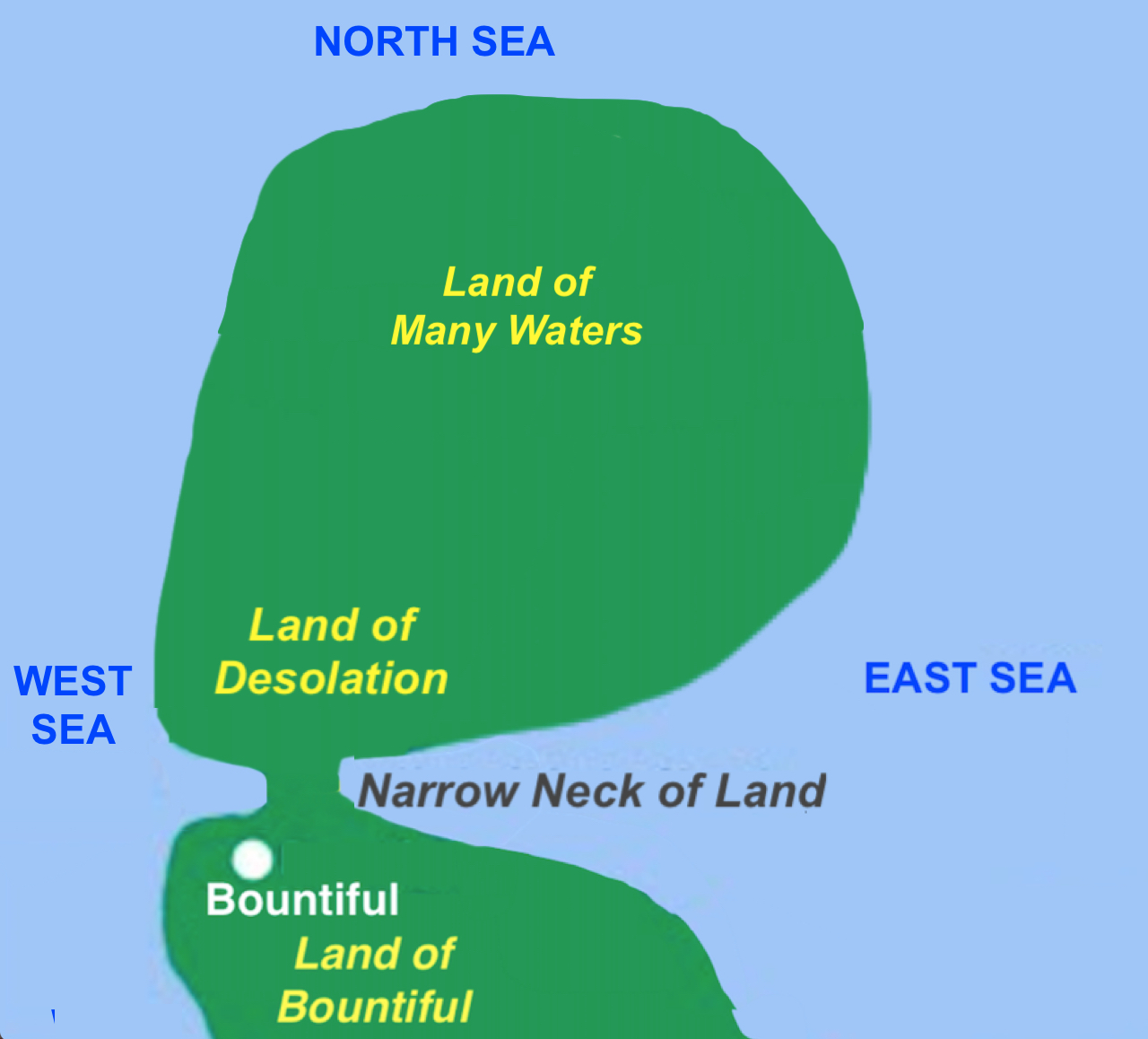
12. This Land of Bountiful bordered on the north with the southern boundary of the Land of Desolation 
   Again, the Nephites controlled all the land in the north and Mormon is now describing that land as it passes from the Land Southward (Bountiful) into the Land Northward (Desolation)
13. This Land of Desolation continued northward so far that it came into the land which had been peopled and been destroyed, of whose bones we have spoken, which was discovered by the people of Zarahemla 
   The bones belonged to the Jaredites, and Mormon is telling us that the Land of Desolation extended so far northward that it came to the area of many waters, rivers and springs 
14. Thus, it being the place of their first landing. 
    The first landing of the Jaredites, who landed along the seashore and came up into the south wilderness or up into the Land of Moron (Ether 7:5) 
15. Thus the land on the northward was called Desolation, and the land on the southward was called Bountiful 
   Along the border between Desolation and Bountiful, and extending in both directions a short distance, was a wildernesscalled here, the south wilderness.” Called the South Wilderness because it was in the south of the Land Northward or Jaredite lands 
16. This south wilderness was filled with all manner of wild animals of every kind, a part of which had come from the land northward for food. 
    These are the animals described in Ether 9:30-34, specifically vs 32 
17. And now, it was only the distance of a day and a half's journey for a Nephite, on the line Bountiful and the land Desolation, from the east to the west sea; 
    This line is the boundary between the Land Northward (Desolaton) and the Land Southward (Bountiful), which is the small or narrow neck of land which is between these two major lands 
The Land Southward, or the Land of Zarahemla and the Land of Nephi were nearly surrounded by water, except for (yellow circle) the narrow neck of land
  
18. And thus the land of Nephi and the land of Zarahemla were nearly surrounded by water, 
    “roundabout means not following a direct Mormon is describing the Land Southward, having begun with the kings proclamation in the Land of Nephi. Thus, he is telling us that this Land Southward was surrounded by water except for this small neck of land in between the two major lands 
19. There was a small neck of land between the land northward and the land southward. 
    This small neck of land is the same neck sometimes called narrow neck and is the only land form connecting the Land Southward (Bountifujl) with the Land Northward (Desolation) 
    The point of all of this is to show that all this information, covered here in 19 points, was describing the topography or geography of the Land of Promise, from the far south, where the Lamanites dwelled (even mentioning the area of First Landing), to the far north where the Jaredite final battles took place (Land of Many Waters). All his points, even the mention of the River Sidon, the Jaredite animals that escaped and became wild over time, even the landing area of the Jaredites, etc., was all intended by Mormon to describe the Land of Promise.
    Consequently, at this point of a small neck of land Mormon is simply continuing with his description of the land and tells us how narrow this narrow neck was so that his future reader could understand what a small neck of land meant. And to make sure we understand how narrow it is, or how small this neck was, he tells us what the distance was across this line or boundary between the Land of Bountiful and the Land of Desolation, i.e., the distance it would take a Nephite to travel in a day and a half journey.
    The word line between two lands tells us that this is a boundary. The word journey tells us it was a normal movement that was taken (not a race, not a quick or slow passage, just a normal pace). He also tells us in the word Nephite that this journey was taken by a normal man that lived in a city style environment as opposed to a Lamanite who lived in the wilderness and sought his food by chasing, trapping and killing animals. Also in using journey Mormon tells us that this was a normal movement, i.e., the Nephite would have traveled only in daylight where he could see along this border, and that he rested at times and slept at night.
    Now to make sure we understand that Mormon is describing just geography, he goes on in vs 33 to tell us:
20. The Nephites inhabited the land Bountiful, even from the east unto the west sea,
21. The Nephites in their wisdomhad hemmed in the Lamanites on the south, that thereby they should have no more possession on the north, that they might not overrun the land northward. 
22. The Lamanites could have no more possessions only in the land of Nephi, and the wilderness round about.
    All of this, along with the distance of the narrow neck, was intended to tell us, his future reader, what the Land of Promise was like, how it was configured, and where its size differed considerably, what this distance was. Therefore, from strictly an academic view of this passage (as I see it anyway), this was a distance measurement, it was intended to continue Mormons description of the land of which he was describing in some detail, and that he did not vary from his point by inserting unnecessary wordage or thoughts, or ideas that were not clear and easily understood.
    After all, what was he measuring in a day and a half journey if not the narrowing of the land where this small neck was situated between the Land Northward (Desolation) and the Land Southward (Bountiful). Nowhere else in his insertion does he introduce an unknown factor in describing the geography of the Land of Promise, and nowhere else does he introduce a distance measurement except where he describes a narrowing (small) are of land.