Saturday, June 23, 2018

The Head, Source, or Headwaters of the Sidon – Part III

Continuing with the understanding of how rivers and how the Mississippi River is not the Sidon River, although Rodney L. Meldrum’s claims it to be in his Heartland Model.
    Though we have shown in the previous two articles how inaccurate is Meldrum’s theory of the “head” of the Sidon River (or Mississippi River), he keeps at it, citing another example that he claims proves his point. As he states about the two different usages of the word “head” which he claims can be interchangeable, he says: “This also provides further insight into Alma 56:24-25, which reads, “They durst not pass by us with their whole army, neither durst they with a part, lest they should not be sufficiently strong and they should fall. Neither durst they march down against the city of Zarahemla; neither durst they cross the head of Sidon, over to the city of Nephihah.” 
Alma 56: Yellow dots: Cities Nephites controlled; Green dots: Cities Lamanites controlled; Red dotted arrows: The three routes that the Lamanites dare not take; White dotted arrow: Helaman leads his small force toward then past the city of Antiparah; Green dotted arrow: Antipus with his army follows Helaman’s route a little later [map for illustrative purposes only]

It is understandable that the Lamanite army would be afraid to battle the Nephite army, or go against the Nephite capital city Zarahemla, and in so doing, pass by Judea where Antipus and Helaman had 10,000 warriors. But Meldrum asks the question: Why would crossing a river at its “head” or source (presumably a stream) cause such dread?  The simple answer could be that the “head” was a junction of two rivers, thereby making it a fearfully difficult and dangerous point to attempt a crossing.”
    However, the problem with this thinking is that it does not agree with what Mormon, in his abridgement, clearly tells us. The reason the Lamanites “durst not cross the head of the Sidon,”—and it had nothing to do with fear or concern about crossing a river—was it brought the Lamanites in closer contact with the superior Nephite armies that outnumbered them. What needs to be done when Meldrum or other theorists begin citing scripture without providing the wordage, as in this particular case in Alma, is to check it out for one’s self.
    In this case, an epistle (letter or report) from Helaman who was dealing with the Lamanites in the “The Land of Manti, or the city of Manti, and the city of Zeezrom, and the city of Cumeni, and the city of Antiparah” (Alma 56:14), which sites the Lamanites occupied, when Helaman and the stripling (converted Lamanite) warriors arrived in the city of Judea close to these captured cities, and found Antipus and his men fortifying the city (Alma 56:15). By the following year Helaman and Antipus had “prepared our city and ourselves for defense” (Alma 56:20) and “were desirous that the Lamanites should come upon us; for we were not desirous to make an attack upon them in their strongholds” (Alma 56:21).
    Now, Helaman and Antipus had placed spies to watch the Lamanites, for if the Lamanites got past Judea and the Nephite army in the night or unawares, the Nephite cities to the north, which were not as well defended as Judea, Helaman and Antipus feared they would fall to the Lamanites (Alma 56:23).
    Now we come to Meldrum’s cited verses:
    “They durst not pass by us with their whole army, neither durst they with a part, lest they should not be sufficiently strong and they should fall. Neither durst they march down against the city of Zarahemla; neither durst they cross the head of Sidon, over to the city of Nephihah” (Alma 56:24-25).
It is not difficult to see the problem the Lamanties faced in trying to move down into the Land of Zarahemla—their path was blocked due north by a main army at Zarahemla; Judea to the center, blocked by Helaman and Antipus 10,000 warriors, and by the city of Nephihah with access to a major army of four major cities along the coast [map for illustrative purposes only]

As can be seen, the Lamanites were fearful of encountering a Nephite army that was “sufficiently strong and they should fall.” Thus, the Lamanites could not leave their captured cities to march northward and attack the weaker Nephite cities because the Nephite armies of Helaman and Antipus blocked the way, as did the routes past Zarahemla (west) and Nephihah (east). Thus, “they [Lamanites] durst not pass by us [Helaman and Antipus’ armies] neither durst they [Lamanites] with a part [of their force] lest they [Lamanites] should not be sufficiently strong and they [Lamanites] should fall [be defeated by the Nephite armies].”
    The cited scripture goes on: “Neither durst they march down against the city of Zarahemla; neither durst they cross the head of Sidon, over to the city of Nephihah.” In these two cited verses, Helaman is stating the predicament with which the Lamanite forces, protected within their captured cities, were faced. No matter what avenue they took, they were fearful of encountering a larger Nephite force that would defeat their current forces that could be mustered if they left their captured cities.
    Thus, an even more simple, and far more accurate, answer to the Lamanites not wanting to cross the head of the Sidon was the fear of exposing themselves to larger Nephite forces that could defeat them. Meldrum’s cited verses have nothing to do with fear of crossing the head of the river, or of there being two rivers to ford, etc. Besides, the heads of rivers are typically narrow and shallow streams that would not be a  hindrance to crossing, especially for warriors.
    The importance and responsibility of any reader, following or trying to understand any theorist’s ideas, locations, models, explanations, etc., is to check out their cited scriptural references, and read before and after and put the statements in context. When doing that with Meldrum, his arguments or points of view fall apart as anywhere from just being wrong, to downright ridiculous.
    Now, keep in mind that the entire purpose of Meldrum injecting these cited scriptures, is to validate his overall point, i.e., that the word “head” in the scriptural record is ambiguous and can mean different things. In fact, he concludes this line of thought with: “We can only speculate as to which of the two definitions were meant by the Book of Mormon authors. But it appears that each definition is valid.”
For anyone who knows anything at all about rivers, the simple fact is that an inflowing confluence (tributary) ends at the confluence (its mouth); and an outflowing confluence (distributary) begins at the confluence (head)—but that neither effect the stem or main river

Like most theorists when the scriptural record does not say what they are claiming it says, or what they want it to say, Meldrum tells us we need to speculate on the meaning of the word “head” as used by Mormon in his description of the Sidon River. However, no speculation is warranted. There are not two definitions of “the head of a river.” A river’s head is its source or beginning, and its mouth is its termination or end. Any river joining another either as a tributary or a distributary tells us whether that second river has its mouth (ending, like the Ohio River) or its head (beginning, like the Atchafalaya River), does not change the source and mouth of the stem or main river, in this case the Mississippi, no matter how much Meldrum wants it to or claims it does.
    So, lest we forget, Meldrum’s two definitions have to do with what is meant by “the head of the river Sidon.” However, what Meldrum and many theorists forget to do, or deliberately avoid doing, is to take the use of a word in its context. As an example, let’s take two normal words: “drive” and “write.” Most people would think they know what these two words mean; however, without a context, one might not find it so easy to describe.
    Drive: “I drive my Lamborghini,” “I drive my golf ball,” “I drive the campaign,” “I drive the agenda,” and “I drive the point.” Without a context, the phrase “I drive—“ carries no significance. It is the context of the use of the word that causes the word to be understood. Such as “I drive an SUV,” “I drive a tractor,” “I drive a lawn mower,” “I drive a submarine.”
    In addition, one could also say, “I drove home,” but that might not be significant if more is intended, such as “I drove home in my car,” “I drove home the winning run,” “I drove home the nail head,” “I drove home a wedge between them,” “I drove home my point in the meeting.”
    Or, take the word “Write”: “You write it,” means what? “Write a letter,” “Write a book,” “Write an apology,” “Write a law,” “Write graffiti.”
    It is the context in which the word is used that tells us what the speaker or writer meant.
(See the next post, “The Head, Source, or Headwaters of the Sidon – Part IV,” to continue with the understanding of how rivers are categorized with “head,” “tributary,” “distributary,” “confluence,” and “mouth”)

Friday, June 22, 2018

The Head, Source, or Headwaters of the Sidon – Part II

Continuing with the understanding of how rivers are categorized with “head,” “tributary,” “distributary,” “confluence,” “mouth,” etc., and how it relates to the Sidon River as well as the Mississippi River and the Heartland Model.
    As pointed out in the previous post, Rodney L. Meldrum makes several inaccurate statements regarding his claims that the head of the Mississippi River was at the confluence of the Ohio River, so he could claim a match between the Sidon River of the Book of Mormon and the Mississippi River of his Heartland Model.
The Confluence (white circle) of the Ohio with the Mississippi is the mouth of the Ohio River, or its termination point; however, the (yellow line) course of the Mississippi continues on from above the confluence to below it, without a change in name or river, thus being the river stem or the main river. Note, its name does not change, and therefore, it is not the head of the Mississippi

We also see that besides the Ohio River Confluence with the Mississippi where Meldrum erroneously claims is the head of the Mississippi, there are other confluences—the first is sixty-seven miles upstream from Cairo where the Missouri River terminates into the Mississippi, and twenty miles beyond that, the Illinois River terminates into the Mississippi.
To further his view, Meldrum goes on to argue his point by claiming that “In the Old Testament in Genesis 2:10, it states, “And a river went out of Eden to water the garden; and from thence it was parted, and became into four heads” (see also PoGP Moses 3:10, reference note b) There is a reference note b at ‘parted’ in the LDS King James Version of the Bible which reads “HEB (Hebrew) – divided into four heads (branches)” clearly indicating that the ‘heads’ of each of these four rivers were at the junction of two or more rivers.”
    Before accepting Meldrum’s explanation, and in order to understand this, we need to know what the scripture quoted says. First of all, it matches what we have said and modern hydrologist language. When a river branches off another and is renamed, it creates a head; but the original river, or stem or predominant river, retains its name and does not have a new head, as indicated, despite Meldrum’s claim. However, the river that came out of Eden in Genesis is not named, so either it had a name and would have been one of the four rivers mentioned, or was simply not named, thus when the four rivers are mentioned, their branch becomes the head of that river. Otherwise, if the river originally coming out of Eden was named, say, the Pison River, then its head would have been in Eden, and not at the confluence of the other three branches.
Top: One river running out of Eden “to water the garden,” and from there it was parted and became four heads, three new heads and the original river with its head in Eden; Bottom: If the river coming out of Eden had no name, then when it parted, all four new rivers had heads at the parting

It might be of importance to consider how this verse is worded: (vs 10): “And a river went out of Eden to water the garden;”
    This part of the statement means that a river flowed from Eden into the garden to water it…
    “and from thence it was parted,”
    “Thence” means “from a place previously mentioned, thus the river being in the garden where it watered the garden, went outward from there and split into four main rivers, one went to Havilah, another ran to Ethiopia, and a third flowed east of Assyria—it is not said where the fourth, or Phrath River (Greek: Euphrates) went.
    This, in no way, suggests or gives rise to the idea which Meldrum promotes that any river can have a head along its course. The Genesis account is that the river split into four main rivers: “and from thence [beyond the garden] it was parted, and became into four heads” (parenthetical note added).
    Not satisfied to try and prove his point with non-successful examples, Meldrum then turns to the Book of Mormon for examples of the meaning of “head.” As he states: “A second scriptural basis for understanding that the word “head” could designate a “junction” can be had from several passages wherein attempts are made to cut off or “head” something (an army or flocks) at a certain junction. 
    “And it came to pass that they went in search of the flocks, and they did follow Ammon, and they rushed forth with much swiftness and did head the flocks of the king, and did gather them together again to the place of water” (Alma 17:32); “And it came to pass that he did according to his desires, and marched forth into the wilderness, and headed the armies of Amalickiah” (Alma 46:32); “Therefore Moroni sent an army, with their camp, to head the people of Morianton, to stop their flight into the land northward. And…they did not head them until they had come to the borders of the land Desolation; and there they did head them, by the narrow pass” (Alma 50:33-34); “they were met by Teancum, who had slain Morianton and had headed his people in his flight. And…that he headed Amalickiah also, as he was marching forth with his numerous army that he might take possession of the land Bountiful, and also the land northward” (Alma 51:29-30); “But when Moronihah had discovered this, he immediately sent forth Lehi with an army round about to head them before they should come to the land Bountiful. And thus he did; and he did head them before they came to the land Bountiful” (Helaman 1:28-29).
    Now, in all these cases, the term “head” is used in a manner that has a specific meaning and nothing to do with Meldrum’s claim supporting the idea that the head of a river is involved. In all these cases, the word “head” meant in 1828: “to oppose, to veer round,” also: Resistance, successful opposition, to advance or resist with success.” Even the modern understanding is roughly the same: “to head someone or something off at a point—literally, to prevent someone or something from reaching or passing a certain point, especially to escape.” In both time frames, the word “head” has the same meaning as “to head someone off before they reach—“
    The point is obvious that Meldrum in his Heartland Theory, tries to muddy the waters of the clear understanding of the head of the river Sidon as it is covered in the scriptural record, by trying to introduce meaningless examples of the use of the word “head” but not in the context of a river in which Mormon used it regarding the Sidon River. There can be no question, that Meldrum’s attempt to claim that his River Sidon in his Land of Promise in the Heartland Theory, cannot be the Mississippi River by claiming the head of that river was actually at the confluence of the Ohio River just south of Cairo, Illinois.
Where two or more rivers join, if one maintains its name above and below the joining or confluence, there is no head involved and the river that joins the main river or stem river has its mouth (terminal point) at the confluence

Yet, Meldrum is not finished. He claims these examples prove his point by stating: “Therefore, there is scriptural evidence to support the use of ‘head’ of a river as where two or more rivers join, making this a perfectly legitimate choice among alternative definitions.”
    Unfortunately for those who do not follow closely the meaning of words and rely on others to tell them what things mean, thus being possibly swayed by flowery explanations that are meaningless, the word “head” cannot be separated in meaning when its companion noun is given, i.e., Mormon is describing the head of the river Sidon. Not heading off defectors, or the head of a body, or being the head person in a company, etc., which he also makes clear in the citings Meldrum uses which we have outlined above. 
(See the next post, “The Head, Source, or Headwaters of the Sidon – Part II,” to continue with the understanding of how rivers are categorized with “head,” “tributary,” “distributary,” “confluence,” and “mouth”)

Thursday, June 21, 2018

The Head, Source, or Headwaters of the Sidon – Part I

We write this article in hopes that the misuse of the words “river,” “head,” “headwaters,” “conflux,” and “confluence” might not be a problem for those who read or listen to people like Rodney L. Meldrum or Jonathan Neville, with their Heartland Theory, or John L. Sorenson and other theorists who try to play word games to substantiate their theories and models. First of all, let’s take a look at these words and their meanings as listed in Noah Webster’s 1828 American Dictionary of the English Language, which typify the meanings of these words in the region Joseph Smith grew up and where he translated the plates, as is illustrated in this dictionary that was used by Joseph and other leaders in the School of the Prophets:
• Headwaters: Webster has no listing [it was not a word in use in New England in the early 1800s—today the word means “the source of a river” or “the furthest place in a river or stream from its estuary [mouth] or confluence with another river”].
• Head: The principal source of a stream; as the head of the Nile. Thus, the 1828 “head” and today’s “headwaters” are the same word with the same meaning (source of a river).
• Confluence: A flowing together, meeting or junction of two or more streams, place of meeting.
• Conflux: A flowing together, a meeting of two or more currents of a river (fluid). “Conflux,” by the way, is the same as “confluence,” and in some types of writing, is used interchangeably.
    These words each have meaning and are used daily in such disciplines as hydrology, which studies the flow patterns of confluences and how they give rise to patterns of erosion, sand bars, and scour pools; and in chemistry, because sometimes the mixing of the waters of two streams triggers a chemical reaction, particularly in a polluted stream.
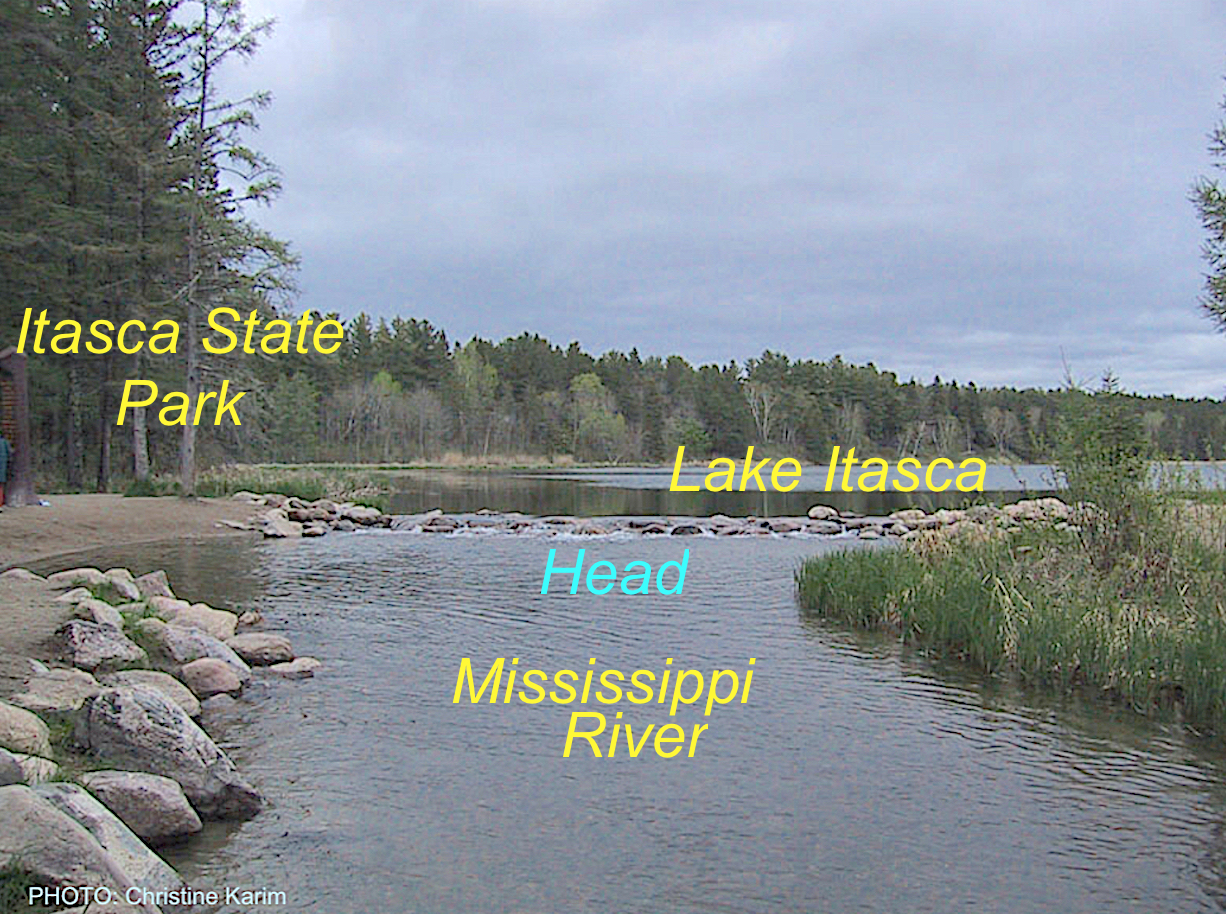
Lake Itasca and the head or headwaters of the Mississippi River in Minnesota

As an example, Lake Itasca in southeastern Clearwater County, of north central Minnesota (within the Itasca State Park, Park Rapids, Minnesota), is considered the headwaters of the Mississippi River, and the river's channel appears much as it did when Henry Rowe Schoolcraft discovered the source in 1832 (U.S. Geological Survey, U. S. Department of the Interior, March 5, 2009; Minnesota Department of Natural Resources, State of Minnesota), or in 1828, would have been called “the head of the Mississippi.” There are no other “heads” of the Mississippi River considered by the Mississippi River Commission, Hydrologists, map makers, and Limnologists anywhere along its 2,320-mile length from its head in Minnesota to its delta mouth in the Gulf of Mexico.
    However, Rod Meldrum, in his greater confessed wisdom, says “So the ‘head’ of the Sidon river of the Book of Mormon has two possible definitions, one at the commencement of a stream or river and one which is defined as the location where two branches or tributaries of a river meet, or their confluence.”
    Yet, as stated above, the official and overall understanding of rivers is that a river has one “head” and that is where it begins (also called its source, head water, or just head). In fact, in the days of the Nephites, the Sidon River would have been called such throughout its length, no matter if there were tributaries or not. The ancients did not give different names to a river of a land—only other people in other lands would have named a river differently (as an example, early settlers along the course of the Mississippi called the entire river by that name from Itasca, Minnesota, to the Gulf of Mexico; also, though we call the Allegheny River and the Ohio River by these two names today, the Iroquiois understood that to be one river and called it Ohí:o; also the early settlers called the entire Tennessee River by one name, distant Indian groups gave it many names: Chaovannon, Kallamuchee, Kaskinampo, Callamaco, Cootela, Hogohegee, Pellissippi, Nonachunkeh, or Euphasee – depending on which tributary they honored as the main branch.
    Yet, Meldrum goes on: “Which definition did the Book of Mormon authors and translator mean and is there a scriptural basis for the idea of the ‘head’ of a river being a junction of two or more rivers?
Left: Two rivers becoming one or flowing together, with the predominant or main stem river (River A) continuing along its channel, and the lesser river (River B) ending or flowing into the other; Right: One river becoming two, or a second river created, with the predominant or main stem river (River A) continuing along its channel, and the new river (River B) forming and becoming a new channel with a different or new name

The simple process illustrated above shows two examples of a river confluence. The first is the ending of one river as it flows into the stem river, forming the mouth of River B, creating what is called a “delta,” sometimes a silty area at this mouth (end) creating muddy banks with new land often forming (denuded area in photo) from the sediment brought down by River B. In the second example (right), the stem or main or predominant river (River A) continues flowing downriver, but a branch, called a distributary, breaks off and forms a new river (River B), at the confluence. This beginning (of River B) is its head, or beginning, and acquires a new, different name from that of the stem or predominant river (River A).
    The first example is seen where the Ohio River terminates at the confluence with the Mississippi River, with the Ohio forming its mouth (end) and the Mississippi river continuing on its channel.
The Mississippi River (Red Line), continues past this (Yellow Circle) confluence and on through Louisiana for 335 miles to its mouth in the Gulf of Mexico. At Simmesport, Avoyelles Parish, Louisiana, the distributary Atchafalaya River (green Line) branches off the Mississippi (creating the Head of the Atchafalaya) and flows to the west then south and runs about 170 miles basically parallel to the Mississippi to Morgan City, then into the Gulf of Mexico forming its mouth. The terminology of the Mississippi does not change
 
The second example is seen where a distributary, called the Atchafalaya River, branches off to the west from the Mississippi in south central Louisiana and flows south into the Gulf of Mexico near Morgan City.
    Other confluences connected to the Mississippi River is where the Missouri River flows into it at Jones-Confluence Point State Park, just north of St. Louis, Missouri; upriver the Illinois River flows into the Mississippi; and at Keokuk, Iowa, (just south of Zarahemla, Iowa) the Des Moines River flows into the Mississippi. In addition, the Madison, Jefferson and Gallatin rivers form a confluence with the Missouri River at Three Forks, Montana.
When a river flows into another and terminates at the confluence, it does not continue its name, and the river ends, creating its mouth (ending) and the main stem or predominant river continues on its channel, maintaining its name from before (above) and after (below) the confluence

In all these cases, the tributary river terminated at the confluence and the main stem or predominant river continued with its name unchanged, therefore, there was no head along the Mississippi River anywhere pertaining to the Mississippi. Stated differently, Meldrum’s claim that the Mississippi River had its head at the joining of the Ohio River/Mississippi River confluence has no claim on truth—in fact, is simply inaccurate according to any understanding of rivers and their flow and parts.
The beginning or head of the Ohio River is formed at the confluence of the Allegheny and Monongahela rivers in Pittsburg, Pennsylvania, where the northern rivers both end, with their mouths at the confluence and the head of the Ohio

In addition, there are occasions where two rivers come together and become the source of a new river, called the main stem river with a new name, such as is seen in the joining or confluence of the Monongahela and Allegheny rivers in Pittsburgh, Pennsylvania, creating the Ohio River. Another is where the confluence of the Kankakee River and the Des Plaines Rivers that meet and form the Illinois River.
(See the next post, “The Head, Source, or Headwaters of the Sidon – Part II,” to continue with the understanding of how rivers are categorized with “head,” “tributary,” “distributary,” “confluence,” and “mouth”)

Wednesday, June 20, 2018

Lehi’s Seed in the Americas – Part III

Continued from the previous post regarding the seed of Lehi in the Americas, from Canada to Chile, and the importance of the comments of Presidents and Church Leaders to support the idea that Lehi’s descendants filled the Americas, showing that the seed of Nephi ended up in South America, Central America, Mesoamerica and North America, showing that all these various theories are not isolated, non-connected models, but a single model that covered the entire Americas.
Israel’s Land of Promise is part of an overall land area, set apart by certain parameters, but not isolated from other lands surrounding it

While in the last post we showed how the concept of a “land of promise” did not necessarily depict such a land isolated from other lands in its physical or geographical setting, in the case of Lehi’s land of promise, it was isolated in the beginning on an island as Jacob pointed out in his talk in the Temple” “We are not cast off; nevertheless, we have been driven out of the land of our inheritance; but we have been led to a better land, for the Lord has made the sea our path, and we are upon an isle of the sea” (2 Nephi 10:20, emphasis added).
    We also need to understand from the scriptural account of this covenanted land the Lord promised to Lehi and his posterity that the land was not occupied by another group at the time of Lehi and his landing, at least in that area that became known as the land Southward and the Land Northward. Of this land, Lehi prophesied according to the working of the Spirit (2 Nephi 1:6), in which he said to his family: “And behold, it is wisdom that this land should be kept as yet from the knowledge of other nations; for behold, many nations would overrun the land, that there would be no place for an inheritance” (2 Nephi 1:8, emphasis added).
    Of course, “should be kept as yet” is clear and simple language that no one had yet been brought into Lehi’s Land of Promise and thus, there could be no other peoples in the land other than those yet to be  brought there.
    In addition, Lehi also stated about those that were and should be brought out of Jerusalem, “they shall be kept from all other nations, that they may possess this land unto themselves…they shall be blessed upon the face of this land, and there shall be none to molest them, nor to take away the land of their inheritance” (2 Nephi 1:9).
    Thus, once again, in clear and simple language, Lehi is telling his children and household that when others are brought, they would come from Jerusalem, and be part of the isolated Land of Promise where no other people would be allowed to come and molest Lehi’s family and posterity at that time—in fact, that did not happen until the early 16th century, when the Spanish conquistadors invaded Mexico, Central America, and Andean South America.
    Therefore, at least the island Jacob said they were on, that land in the Book of Mormon described as the Land Southward and the Land Northward, where all events in the scriptural record take place, was isolated from other people unless they had been brought out of Jerusalem—and the only other people who had been brought out of Jerusalem in Lehi’s time besides himself and his family and that of Ishmael, that were within Lehi’s Land of Promise, were the Mulekites, of whom Lehi had no knowledge at the time he was speaking to his family, and the Nephites would not encounter for another almost 400 years.
    Consequently, any proposed land of promise and model that includes other groups, indigenous peoples, migrants, shipwrecked people, etc., simply cannot be Lehi’s Land of Promise. This does not rule out, however, other occupants of the broader area of land beyond the confines of the Land Southward and the Land Northward as that land expanded as a result of the cataclysmic events of the crucifixion, and likely no longer remained an island, as the “whole face of the land was changed” (3 Nephi 8:12,18), where mountains became valleys and valleys rose to become mountains “whose height was great” (Helaman 14:23)…”And thus far were the scriptures fulfilled which had been spoken by the prophets” (3 Nephi 8:11).
Yellow dots: General location of stone ruins dating to Nephite period or later; Red dot: Early development area; Green dots: non-solid evidence, such as burial mounds; and blue dots where we know Nephites/Lamanites existed through modern-day revelation (dedicatory prayers, etc.)

With this in mind, let us trace the movement of the Nephites within Lehi’s Land of Promise, to see how and when they expanded into other areas within the great promised or “choice” land the Lord prepared for his people, and has led to modern Church Leaders to speak in terms of Zion and the land of promise as being the Americas (both North and South) and basically the Western Hemisphere.
    Thus, by at least the last century B.C. the Nephites were involved in building ships (Alma 63:5) and in the business of shipping (Helaman 3:14,10).  We know for certain that by 53 B.C., there “were many of the Nephites who did enter therein and did sail forth with much provisions, and also many women and children; and they took their course northward” (Alma 63:6,7), and at least one other ship sailed toward an unknown destination (Alma 63:8).
    Mormon particularly singled out the shipbuilder Hagoth (Alma 63:5) and the “exceedingly large ships” (Alma 63:5) he built, but there might have been other ship builders since the Nephites were involved in shipping at least by that time (Helaman 3:10,14). In fact, in this period of the last half of the last century B.C., following a devastating war conducted by the Lamanite king Tubaloth, who sent Coriantumr at the head of a large Lamanite army to invade the Land of Zarahemla and much of the land almost to Bountiful in 51 B.C., “an exceeding great many [Nephites] departed out of the land of Zarahemla and went forth unto the Land Northward to inherit the land” (Helaman 3:3).
    Obviously, fed up with the wars, and a renewal of contention and dissensions following a short peace (Helaman 3:1-2), these Nephites that went overland into the north “did travel to an exceedingly great distance, insomuch that they came to large bodies of water and many rivers…and spread forth into all parts of the land, into whatever parts it had not been rendered desolate and without timber, because of the many inhabitants [Jaredites] who had before inherited the land” (Helaman 3:4-5).
    Not quite ten years before this, a preceding migration northward took place when “there was a large company of men, even to the amount of five thousand and four hundred men, with their wives and their children, departed out of the land of Zarahemla into the land which was northward” (Alma 63:4). Following this, more Nephites migrated into the Land Northward when “in this year there were many people who went forth into the land northward” (Alma 63:9). Still others took their journey northward in ships Hagoth built, some to unknown destinations (Alma 63:5-8).
    Where these immigrants went is a point of debate among scholars and theorists, however, in most cases we know they went northward (Alma 63:6), and in a few cases we know they went into the Land Northward (Alma 63:7b) to inherit the land (Helaman 3:3) that had been promised to them through the Lord’s covenant with Lehi (2 Nephi 1:5).
    Therefore, wherever Lehi landed, and wherever Nephi went after escaping from his brothers, and founded the city of Nephi, and wherever later Nephites went in the ships Hagoth built, had to be to the north of the Land of Promise—they did not go south! Thus, any settlements elsewhere that were founded by Nephites and Lamanites, had to be in the north, and/or to the north of the land Lehi was promised.
Lehi landed in central Chili, Nephi fled northward into Peru, the Nephites occupied the Land Northward in Ecuador, Hagoth’s ships took immigrants into Central and Mesoamerica, where some eventually migrated into Mexico and the United States

Through archaeology, we can easily see that an advanced civilization existed far to the south in Andean Peru (Ecuador, Peru, western Bolivia and central and northern Chile), which is dated to be the oldest settlements and city structures in all of the Western Hemisphere (Harald Franzen, Scientific American, April 27, 2001; Smithsonian Magazine, August 2002).
    North of the Andes we find additional evidence of ancient ruins of an advanced civilization in Central America (Panama, Costa Rica, El Salvador, Honduras) and also in Mesoamerica (Belize, Guatemala, Yucatan), including central and southern Mexico.
Anasazi ruins in southwestern United States

And finally, north of Mexico we find evidence of an ancient civilization among the ruins of those known today as the Anasazi (the “Ancient Ones”) in the “Four Corners” area of New Mexico, Arizona, Colorado and Utah, who left behind vast evidence of their buildings, homes and plazas carved out of existing rock structures beneath overhanging cliffs, some such villages had 150 rooms, as well as their free-standing settlement structures (“Great Houses”) where several rooms were connected in one large edifice.
    These include: Blythe Intaglios, California (similar to Nazca Lines in Peru); Cliff Dwellings Mesa Verde, Colorado; Meadowcroft Rockshelter Pennsylvania; Chaco Canyon, New Mexico; Archaeological Park, Alabama; Poverty Point, Louisiana; Cahokia, Illinois; and numerous others.
Left: Anaszi/Pueblo Settlement, structured and laid out like many of the ancient settlements in Andean South America; Right: The doorway structures, resembling those found in Andean Peru

It should be noted that not only did the Nephites sail northward and also immigrate into the Land Northward, but also the children of Ammon, the converted Lamanites, went northward also. As it is stated: “And it came to pass that many of the Lamanites did go into the land northward” (Helaman 6:6). The point is, the work of Nephites and later Lamanites with their lesser building abilities, have been found all over the Western Hemisphere with the oldest in western South America (along the Andean shelf), and then Meso- and Central America, and finally North America, as Lehi’s seed continued to spread out over the “land which I have prepared for you; yea, a land which is choice above all other lands” (1 Nephi 2:20).
    It should therefore be understood that all the comments made by Prophets and Church Leaders, such as Joseph Smith regarding the white Lamanite Zelph, the prophet Onandagus who was known from the Rocky Mountains to the Atlantic (or eastern) ocean, traveling over the plains of the Nephites (a location never mentioned in the scriptural record), to his comments regarding the building edifices discovered in Mesoamerica as being built by an ancient civilization like the Nephites, and so many other remarks, all bear truth in that wherever you go in the Americas, there were likely some Nephites or Lamanites in that area at some former time.
    However, the land where Lehi landed, where Nephi built the City of Nephi, where Mosiah discovered the people of Zarahemla, where the many recorded wars were fought between the Nephites and Lamanites, where the Lord visited around the Bountiful temple those who survived  the cataclysmic events following the crucifixion, and the Land Northward where the Lamanite once lived, and the Nephites later inherited and the final battles of both the Jaredites and the Nephites took place, were on that long, narrow Andean shelf, now seen in that area between the eastern mountains and the Pacific Ocean, including Ecuador, Peru, western Bolivia, and central and northern Chile.
    Thus, the seed of Lehi not only inherited that area promised to Lehi, but over time spread into the vast lands to the north, reaching there both by ship and overland, leaving behind their cities, settlements and accomplishments that archaeologists have so abundantly been uncovering.
-->

Tuesday, June 19, 2018

Lehi’s Seed in the Americas – Part II

Continued from the previous post regarding the seed of Lehi in the Americas, from Canada to Chile, and the importance of the comments of Presidents and Church Leaders to support the idea that Lehi’s descendants filled the Americas.
    In addition to the South American, Central and Mesoamerican comments of Church Presidents in the previous post, we look here at more comments from Church Leaders regarding Lehi’s descendants in North America:
Arizona, southern United States: Heber J. Grant, Mesa Arizona Temple dedication, 23-26 October 1927:
    “We beseech Thee, O Lord, that Thou wilt stay the hand of the destroyer among the descendants of Lehi who reside in this land and give unto them increasing virility and more abundant health, that they may not perish as a people but that from this time forth they may increase in numbers and in strength and in influence, that all the great and glorious promises made concerning the descendants of Lehi may be fulfilled in them; that they may grow in vigor of body and of mind, and above all in love for Thee and Thy Son, and increase in diligence and in faithfulness in keeping the commandments which have come to them through the gospel of Jesus Christ, and that many of them may have the privilege of entering this holy house and receiving ordinances for themselves and their departed ancestors.”
Vernal, northeastern Utah: Gordon B. Hinckley, Dedication Prayer for the Vernal Utah Temple, 2–4 November 1997:
    “May there come about a reconciliation of feelings between the descendants of Lehi and those who have come to reside in these valleys. May old animosities be dispelled, and may there come a renewed spirit of brotherhood and love and respect.”

Rocky Mountains, western United States: Parley P. Pratt to Brigham Young, 13 March 1852, in Parley P. Pratt, Autobiography, p368: “Could we have preached to the Lamanites, if we had stayed in Nauvoo? No, we could not; but the people have driven us to a place where we can do much more good, than we could have accomplished by remaining in Nauvoo; they have driven us into the midst of the Lamanites, where we can preach the Gospel unto them.
Illinois, United States: Joseph Smith, Diary Entry, Thursday, May 23, 1844:
    “1pm. Held council with the Indians Sac & Fox in my back kitchen. I replied…Great Spirit wants you to be united and live in peace. (I) found a book, (presenting the Book of Mormon) which told me about your fathers and Great Spirit told me you must send to all the tribes you can, and tell them to live in peace, and when any of our people come to see you treat them as we treat you.”
Alberta, Canada: Heber J. Grant, Dedicatory Prayer for the Cardston Alberta Temple, 26–29 August 1923:
    “We beseech Thee, O Lord, that Thou wilt stay the hand of the destroyer among the descendants of Lehi, who reside in this land…that all the great and glorious promises made concerning the descendants of Lehi…”   
Temple dedicatory prayers where the existence of Lehi and his family are specifically mentioned 
    With all of this, and numerous other comments and factual writing and speaking of other leaders, we find that Lehi’s descendants were scattered all over the Americas. This is not to say that the specific area of the Jaredite, Nephite and Lamanite lands in the scriptural record of the Book of Mormon are scattered all over the Americas, but that Lehi’s people were.
    So how is that remark justified?
    To better understand this, there are a few things that we need to keep in mind:
1. Promised Land: The Lord told Nephi in the wilderness that: “inasmuch as ye shall keep my commandments, ye shall prosper, and shall be led to a land of promise; yes, even a land which I have prepared for you; yea, a land which is choice above all other lands” (1 Nephi 2:20). Lehi, to whom the land was promised, said: “behold, I have obtained a land of promise, in the which things I do rejoice” (1 Nephi 5:5), where his sons and their wives were to: “raise up seed unto the Lord in the land of promise” (1 Nephi 7:1). In a vision, Nephi “beheld the land of promise” and he also “beheld multitudes of people, even as it were in number as many as the sand of the sea” (1 Nephi 12:1). There was to be “multitudes of Gentiles upon the land of promise who would scatter and smite (conquer) Lehi’s seed (1 Nephi 13:14).
2. Covenant Land: In addition to having a land of promise prepared for Lehi and his posterity, it was “the land which is choice above all other lands, which is the land that the Lord God hath covenanted with thy father that his seed should have for the land of their inheritance” (1 Nephi 13:30, emphasis added). This covenanted land was for Lehi’s seed. As he stated: “we have obtained a land of promise, a land which is choice above all other lands; a land which the Lord God hath covenanted with me should be a land for the inheritance of my seed. Yea, the Lord hath covenanted this land unto me, and to my children forever” (2 Nephi 1:5, emphasis added)
    Therefore, Lehi didn’t just have a land of promise that the Lord prepared for him and his family, but it was a guaranteed contract, agreement, and promise from the Lord, for all of Lehi’s posterity, conditional upon their obedience to the Lord’s conditions of living righteously. This does not mean that if the Nephites were to eventually dwindle in disbelief that the covenant of the land would be withdrawn from Lehi’s descendants, but only withdrawn from those of his descendants who failed to live up to their end of the agreement, which is what happened to the Nephite people at the end (Mormon 2:15), when the day of grace passed with those individuals (Mormon 2:15) would no longer have the promised covenant of a land inheritance.
3. The Time Frame of Events: It is absolutely necessary for one to keep in mind the time frame in which scriptural events take place. As an example, there was a great Flood, called Noah’s Flood, which took place within a certain time frame in Biblical history. First, the Lord himself verified the Floods of Noah occurred when he said, “For as I have sworn that the waters of Noah should no more go over the earth, so have I sworn that I would not be wroth with thee” (3 Nephi 22:9; see also Moses 7:38,42-43,49-52). Secondly, the time frame of the early patriarchs is known by the years of their birth and when compiled, lead to an exact year of 2344 B.C. for when the rains began (Genesis 7:11), and the year 2343 B.C. when the waters were dried up from off the earth” (Genesis 8:13). Thus, all dates determined by man must fit into the time frame the Lord has revealed despite what modern science claims, what evolutionists demand, and what the geologic time scale (strata) chronological dating system states.
4. Lehi’s covenanted land: this land, referred to in the Book of Mormon as the Land of Promise (2 Nephi 1:5) states nothing about the size, shape, or continuity of the land Lehi was promised. Jacob says it was an island (2 Nephi 10:20), which may mean that the area of the original island was the land promised to Lehi (Land Southward and Land Northward), but as that changed during the devastating conditions at the time of the crucifixion, when “the whole face of the land was changed” (3 Nephi 8:12), more land may well have been added to the area that was not within the land covenanted to Lehi—but still part of the overall land that was “a land which is choice above all other lands” where there would be no kings (2 Nephi 10:11).
    So the Lord covenanted a land to Lehi and his posterity that was a land of promise to them, “a land which the Lord God hath covenanted with me should be a land for the inheritance of my seed” (2 Nephi 1:5), in an overall choice region of land that “should be kept as yet from the knowledge of other nations” (2 Nephi 1:8), a land which was consecrated unto those the Lord would bring (2 Nephi 1:7) out of the land of Jerusalem (2 Nephi 1:9), where eventually the Lord ”will bring other nations” and “give them power [to] take away from them the lands of their possessions, and…cause them to be scattered and smitten” (2 Nephi 1:11).
The area of the Land of Promise in Palestine and its division among the 12 tribes. Note all the other land around it and contiguous to it—that is, the Abraham/Jewish Land of Promise was not isolated from other land, and there is no reason to think that Lehi’s Land of Promise was isolated or separated from other land 

Thus, we can conclude that, like in Palestine, the Land of Promise was a smaller part of a much larger land mass, at one time just an island, that became an overall choice land the Lord had prepared, sometimes also referred to as the Land of Promise, especially by modern Church Leaders, than the land of promise covered in Lehi’s covenant promise. We see this in the land of Palestine promised to Israel through the promise given to Abraham (Genesis 28:13), which was the area of present day Israel, part of southern Lebanon, southwestern Syria, western and southwestern Jordan, and a small portion of the Sinai, originally surrounded by the lands of the Hittites to the north, Arameans to the northeast, Ammonites to the east, Moabites to the southeast, Edomites to the south, the Sinai of Egypt to the southwest and Philistines to the west.
    This should also suggest to us, that a land of promise the Lord covenants with a group is not necessarily isolated from other lands that might well be occupied by other peoples.
(See the next post, “Lehi’s Seed in the Americas – Part III,“ for more information on how the development of the seed of Nephi ended up in South America, Central America, Mesoamerica and North America, showing that all these various theories are not isolated, non-connected models, but a single model that covered the entire Americas)

Monday, June 18, 2018

Lehi’s Seed in the Americas – Part I

Could the Book of Mormon events have occurred in both South and North America, as well as Middle America (Mesoamerica)? If a church leader, or even Joseph Smith, have said or implied that this area or that area in the Americas was home of the Nephites or Lamanites, does that make apparent conflicting statements inaccurate?
    Critics, of course, use such diversity of opinion as a sure sign that the Book of Mormon is false, and the Church’s beliefs and origins are highly questionable. Theorists themselves, with their ideas of where Lehi landed and the location of both the entire Land of Promise and specifically cities, rivers, and lands are so set, as to raise antagonistic rebukes to anyone who disagrees with them. And also ridicules any Nephites shown to be in another area than what they think is the Land of Promise.
BYU has sent archaeological department students and leaders on digs to Mexico, Mesoamerica, Central America, and even Egypt. They have conducted digs nearer to home in Utah, but none had been sent to South America, where so much Nephite period ruins and evidences exist that one can only wonder why

As an example, the Mesoamericanists at BYU have never to anyone’s knowledge ever made an effort to conduct any research, or exploratory digs in South America; Heartland theorists claim that the United States and North America is the only place Lehi and Nephi were, using misinterpreted statements by Joseph Smith and early Church leaders.
    As James F. Stoddard III, founder of the Joseph Smith Foundation, and writing in “Does the Heartland Model contradict statements made by the Leadership of the Church?” (Joseph Smith Foundation, February 16, 2015/May 12, 2016). He then adds, “It appears on initial investigation that the early Brethren contradict what some of the later Brethren, particularly during temple dedications, have taught.  Can both be accurate or must we choose?”
    So what of this disagreement or apparent conflict? Is it a sign of irreversible dispute among members, or at least among scholars, historians and followers of the Jaredite/Nephite/Lamanite geography? Since the Church and the Brethren have never made a stand on any of this, are we who feel the geography, though a minor area of importance in the overall doctrines and knowledge the scriptural record provides, left to forever wonder without knowing? Or can we come to know the facts of the matter from which we can draw intelligent, fact-based, even personally inspired understanding?
    There are those who theorize that Lehi and his posterity never stepped foot in Canada; others claim they spent their time in Mexico and Guatemala; still others claim they landed and spent all their time in Central America, and still others championing North America, with some centering on the Great Lakes area, and others the entire Heartland region from the Gulf of Mexico to Canada, from the Rocky Mountains to the Atlantic Ocean. Still others limit their involvement to Baja California, and yet others lay claim to the area of Malay in Indonesia.
    However, when it comes to those who cite the America as Lehi’s landing site, and the area where the events in the Book of Mormon Land of Promise occurred, there are strong feelings about their pet theories and land models to the ignoring of anything not within their theorized area. If there were Nephite/Lamanite events found in North America, does that make those who believe in Middle, Central and South America wrong? If Nephites built the pyramidal structures in Mexico and Guatemala, does that mean they did not build the ones in Andean South America, or that Joseph Smith was wrong about the skeleton of Zelph, the white Lamanite, or the prophet Onandagus, known from the Rocky Mountains to the Atlantic Ocean?
    If Nephites built the structures found in Costa Rica and Nicaragua, does that mean everyone’s belief centered elsewhere is without merit? And what of the vast ruins of pre-Columbian, pre-Inca sites scattered all over Peru, western Bolivia, Ecuador, and northern Chile, signifying an advanced civilization that existed there during Jaredite and Nephite times?
    So who is right and who is wrong?
    First of all we need to ask the rhetorical question, “could it be that the Lehite remnant was scattered throughout the Americas and the South Pacific in the same way and for the same reasons that other remnants of Israel were dispersed? Are the answers found in the Book of Mormon itself and through the statements of latter-day prophets, past and present? Accepting the fact that Presidents and Church Leaders have been accurate in their dedicatory prayers and conference talks since the time of Joseph Smith, how can we validate their statements of very different geographical settings for the Book of Mormon peoples?
Peru, South America: Gordon B. Hinckley, Dedicatory Prayer for the Lima Peru Temple, 10-12 January 1986:
    “We are particularly mindful this day of the sons and daughters of Lehi. They have known so much of suffering and sorrow in their many generations. They have walked in darkness and in servitude. Now Thou hast touched them by the light of the everlasting gospel. The shackles of darkness are falling from their eyes as they embrace the truths of Thy great work. Surely father Lehi has wept with sorrow over his posterity. Surely he weeps today with gladness, for in this holy house there will be exercised the fullness of the priesthood to the blessing, not only of those of this and future generations, but also to the blessing of those of previous generations. Bless Thy work that it shall blossom and grow in this nation and in its neighbor nations of South America. Remember, Father, Thine ancient covenant with the children of Lehi that in the latter days Thou wouldst favor them and bring to them a knowledge of their Redeemer. Make them strong in faith and magnify them in leadership in Thy kingdom.”
Bolivia, South America: Gordon B. Hinckley, Dedicatory Prayer for the Cochabamba Temple, April 30,2000:
    “May this temple, together with its auxiliary structures, all be combined into a sacred complex built to assist the on-rolling of Thy work in this great nation of Bolivia. This nation is named for Simon Bolivar, the great liberator of much of South America, who died the year Thy Restored Church was organized. May the incomparable principle of democracy be preserved forever in this republic. Bless the land and its people. May Thy work grow and prosper in this area of Thy vineyard. We remember before Thee the sons and daughters of Father Lehi. Wilt Thou keep Thine ancient promises in their behalf. Lift from their shoulders the burdens of poverty and cause the shackles of darkness to fall from their eyes. May they rise to the glories of the past. May they recognize their Redeemer and be faithful and true Saints of the Most High. May they seek learning out of the best books (see D&C 88:118). May the enlightenment of education bring new and wonderful opportunities into their lives.”
Peru, South America: Dieter F. Uchtdorf, Dedicatory Prayer for the Trujillo, Ecuador, Temple, 21 June 2015:
    We pray for all in this land who have an opportunity to hear and ponder the message of the restored gospel of Jesus Christ. Please touch their hearts and lives with Thy goodness. Hasten the miracle of conversion among these great and good people. We thank Thee for the sacred record of Lehi, Nephi and Jacob, Alma and Mosiah, Benjamin and Mormon, and of Moroni. We thank Thee for this voice that has come from the dust to bear witness of the divinity of Thy Beloved Son, the Lord Jesus Christ. Thou hast sent Thy prophet Elijah to turn the hearts of the fathers to the children and the hearts of the children to their fathers. This holy temple opens the gates to eternity that these purposes may be fulfilled.
Guatemala, Mesoamerica: Gordon B. Hinckley, Dedicatory Prayer for the Guatemala City Guatemala Temple, 14–16 January 1984:
    “Thou kind and gracious Father, our hearts swell with gratitude for Thy remembrance of the sons and daughters of Lehi, the many generations of our fathers and mothers who suffered so greatly and who walked for so long in darkness. Thou hast heard their cries and seen their tears. Now there will be opened to them the gates of salvation and eternal life…We thank Thee for the restored record of our ancestors, the record of Lehi, Nephi and Jacob, of Alma and Mosiah, of Benjamin and Mormon and Moroni” (Salt Lake City: Church of Jesus Christ of Latter-day Saints, 1978).
Mexico City, Mexico (Mesoamerica): Spencer W. Kimball, Official Reports of the Mexico City Area Conference of the Church of Jesus Christ of Latter-day Saints, held in the Sports Palace in Mexico City, Mexico, February 13,1977:
    “When I was in Mexico in 1946, I was dreaming for the people of Mexico. I had a dream of your progress and development. Now this is precisely what I dreamed; this was my vision for the people of the Lamanites. I got up from my bed and wrote my dream. Maybe it was a vision rather than a dream. This is what I wrote: As I looked into the future, I saw the Lamanites from the isles of the sea and the Americas rise to a great destiny. I saw great numbers of Lamanites and Nephites in beautiful homes that have all the comforts that science can afford. I could see you children of Lehi with your herds and flocks on a thousand hills. . . . I saw the church growing with rapid strides, and I saw them organized in wards and stakes. (I think there was not a single stake or ward in all of Mexico when I dreamed this dream.) I saw a temple of God and expect to see it filled with men and women and young people.”
    Obviously, those six dedicatory prayers by Presidents of the Church or members of the First Presidency that took place over the peoples of South America, Central America, and Mesoamerica, cannot be ignored. But there are more in North America…
(See the next post, “Lehi’s Seed in the Americas – Part II,” for more information where to find Lehi’s seed in the Americas both during and following the Nephite Nation as well as today)

Sunday, June 17, 2018

The Land of David, Jashon and Other Cities

We received a comment from a reader not long ago stating: “I a post you mentioned that the land of David was in the Land Northward. And that the city of Laman and the city of Kiskuman were in the land of Nephi. I do not remember ever reading in the Book of Mormon anything that even hints that this was so.”
    This is one of the problems we get into when trying to identify a Land of Promise city or town that is poorly defined with little, if any, descriptive information in order to make a placement. While most theorists make wild guesses and place cities and lands willy-nilly throughout their models, we have tried to stay away from opinions, guesses, and assumptions on such matters. On the other hand, once in a while the circumstances seem to warrant at least a noted guess. Regarding the article singled out by this reader, it appears to have been “More comments from Readers - Part V,” posted on Friday, June 2, 2017.
    It should be noted that this particular article, in answer to a reader’s question, began with our response: “The problem in answering such a question, as we have stated many times, is that there is insufficient information in the scriptural record to place most cities, and even lands.”
Red Circle encompasses the area where these cities would have been located with some definitely in the Land Northward, others in or very close to that land

However, in this particular case, since a question was asked, we gave our opinion on the matter, which we stated was a very close understanding of where these cities were—though it is only an opinion, it is stated with years of reading and placing what we can within the Land of Promise. Thus, it seems likely that the city of David was in the Land Northward from the locations Mormon describes, in connection with the events surrounding it. Also, we might add that the city of Jordan was further northward from Boaz, and very possibly inland, away from the coast where Teancum was located (Mormon 5:3).
    These latter cities must have been stretched out across the landscape, north of the narrow neck of land, and deeper and deeper into the old Jaredite lands, for the Nephites were continually being “driven” and “marched forth before the Lamanites” (Mormon 6:1) in their retreat northward, yet always seemed to keep the Lamanites south of them so “they could not get into the country which lay before us, to destroy the inhabitants of our land” (Mormon 5:4). All the while, the Nephites kept retreating away from the invading Lamanites from the south, for they continued “to take to flight” before the Lamanites (Mormon 5:7).
    As for the land of David, it is always hard to know exactly where some of these areas are from the limited information found in the scriptural record, however, we might be able to draw some specific and concrete conclusions from the circumstance in Mormon chapter 2.
Mormon tells us that this final battle began at the Waters of Sidon, and progressed northward from there “toward the north countries”

“And it came to pass that in the three hundred and twenty and seventh year the Lamanites did come upon us with exceedingly great power, insomuch that they did frighten my armies; therefore they would not fight, and they began to retreat towards the north countries“ (Mormon 2:3, emphasis added). Now the rationale behind this is simple—if they were in the Land Southward and retreating, Mormon would have used the term “began to retreat northward,” or if not northward, then simply “began to retreat before the Lamanites” etc.
    On the other hand, being in the northern area of the Land Southward and near the Land Northward, the term “began to retreat toward the north countries” would be more specific and meaning they were near those countries, or near the Land Northward. Then, the next thing we know, they came to the city Angola, which they fortified and defended, but were driven out of the city of Angola (Mormon 2:4), and then they were driven out of the land of David (Mormon 2:5), and then marched to the land of Joshua, which was near the borders of the west seashore (Mormon 2:6).
    Here a battle of Mormon’s 42,000 withstood and defeated a Lamanite army of 44,000. Then in the following year, the Lamanites drove the Nephites to the land of Jashon before they stopped their retreat (Mormon 2:16), and “the city of Jashon was near the land where Ammaron had deposited the records unto the Lord” (Mormon 2:17)—this was well within the Land Northward, in the area where Mormon was born and grew up—at least he lived very near there when he was ten years old and knew of the specific hill Ammaron told him about (Mormon 1:2-4).
    So at the time of these battles mentioned above, Mormon had to have been very near the Land Northward, making these cities very near or within the Land Northward, and he was actually within the Land Northward when Jashon was reached.
    Then they were driven, probably northward, to the land and city of Shem (Mormon 2:20-21), where Mormon prevailed with an army of 30,000 against a Lamanite army of 50,000 (Mormon 2:25). Following this, the Lamanites fled, and the Nephites followed, defeating them again in a running battle, but their strength was spent (Mormon 2:26-27).
    Now, interestingly enough, despite the Nephites being wicked and involved in abominations, they “did go forth against the Lamanites and the robbers of Gadianton, until they had again taken possession of the lands of their inheritance” (Mormon 2:27). At this point, Mormon agrees with a treaty with the Lamanites, which resulted in the dividing line between Lamanite lands and Nephite lands being the narrow neck of land (Mormon 2:28-29).
A treaty in 350 A.D. between Mormon and the Lamanite king gave the Nephites the Land Northward and the Lamanites the Land Southward (Mormon 2:28-29)

If Mormon meant the “lands of our inheritance” to be the Land Southward or the old Lands of Bountiful and Zarahemla, then why did he agree with the Lamanites to give the Lamanites those lands back in a treaty they had just won in battle? That doesn’t make sense, so the “lands of our inheritance” must mean the Land Northward, where they were fighting and driven so far back that the Lamanites had captured or occupied most of the Land Northward, thus, when the Nephites rose up and defeated the Lamanites and “had again taken possession of the lands of our inheritance,” Mormon had to have meant he won back the cities and lands within the Land Northward.
    Then, at that point, he agrees to a treaty, giving him those lands in the Land Northward, and conceding the Land Southward which the Lamanites already controlled. Thus, this seems to suggest that all this fighting from the point of “toward the north countries” was very near or in the Land Northward, making these cities and lands very near or within the Land Northward.
    It would appear then, the city of Angola, and the lands of David and Joshua, were near the Land of Desolation, and the land of Jashon and Shem were within the northern part of the land of Desolation, or north of that land (Mormon 2:3-6;16-17, 21). We also see that the city of Teancum, “was in the borders by the seashore; and it was also near the city of Desolation” (Mormon 4:3), making it nearby in the Land of Desolation and north of the city of Desolation. We can also see that the city of Boaz was near to the city of Desolation, but probably not in the same direction from the city as was Teancum, for there were also towns and villages in the general vicinity of Boaz (Mormon 4:20,23).
    Thus, we might be able to say with some certainty that Angola and the land of David were very close to the narrow neck of land and that north of Teancum lay the cities and lands of Joshua, Jashon, and Shem to which the Nephites retreated during one of their last battles with the Lamanites. And northward from these areas, at an unknown distance, lay the land of Cumorah, which was located within the Land of Many Waters (Mormon 6:4).
    So while one “has never read anything in the Book of Mormon that even hints this was so,” it is likely quite probable based on the events in Mormon chapter 2, that all these cities were right at that far northern area or within the Land Northward, north of the Narrow Neck of Land.